
Introduction
National Income refers to the total monetary value of all final goods and services produced by a country’s residents within a specific period, usually one financial year. It acts as a key indicator of a nation’s economic health and development. It reflects the productive capacity and income-generating ability of the economy.
National Income is the aggregate value of all goods and services produced by firms in a given financial year. It can be stated that when the aggregate revenue generated by the firms is paid out to factors of production, it equals aggregate income or National Income. There are different variants or aggregates of National Income and each of the aggregates has a specific meaning, use, and method of measurement.
Policymakers, economists, and analysts rely on national income data to make informed decisions on budgeting, planning, and economic reforms. National income is crucial for understanding living standards, resource allocation, and income distribution in a country.
Meaning of National Income
National Income denotes the total worth of all final goods and services generated within a country during a specific time frame, typically over the course of one financial year.
- From a macroeconomic perspective, national income plays a central role in measuring the economic performance and prosperity of a nation.
- It is utilised in evaluating per capita income, understanding inequality, and comparing growth across countries. It also forms the basis for fiscal policy formulation, taxation, and welfare schemes.
- Globally, institutions like the World Bank, the IMF, and the United Nations rely on national income statistics to assess global economic trends and design development frameworks.
- In India, agencies such as the National Statistical Office (NSO) under the Ministry of Statistics and Programme Implementation (MoSPI) handle national income estimation.
Components of National Income
National income is comprised of various components that reflect the flow of money within an economy. These components not only show how income is generated but also where it is spent or invested. The primary components include:
- Consumption (C): Consumption refers to the total spending by households on goods and services for their personal use.
- Investment (I): Investment refers to capital formation — the creation of new assets that contribute to future production. It includes business expenditure on machinery, tools, buildings, inventory accumulation, and residential construction.
- Government Spending (G): This includes all expenditure by central, state, and local governments on: public goods and services, salaries of government employees, welfare programs and subsidies.
- It does not include transfer payments (like pensions or unemployment benefits), as these do not correspond to the production of goods or services.
- Net Exports (X-M): This is the difference between a country’s exports and imports. A positive net export (trade surplus) adds to national income, while a negative net export (trade deficit) reduces it.
- Factor Income: Additionally, factor incomes (wages, rent, interest, profits) contribute to National Income at Factor Cost, adjusted for taxes and subsidies.
Circular Flow of Income
Before understanding the different aggregates of national income, it is important to know how income is generated and circulated in an economy. The circular flow of income represents the continuous movement of goods, services, and money between the two main sectors of an economy—households and firms. In this simple two-sector model, households provide factors of production such as land, labor, capital, and entrepreneurship to firms. In return, firms make factor payments in the form of rent, wages, interest, and profit.
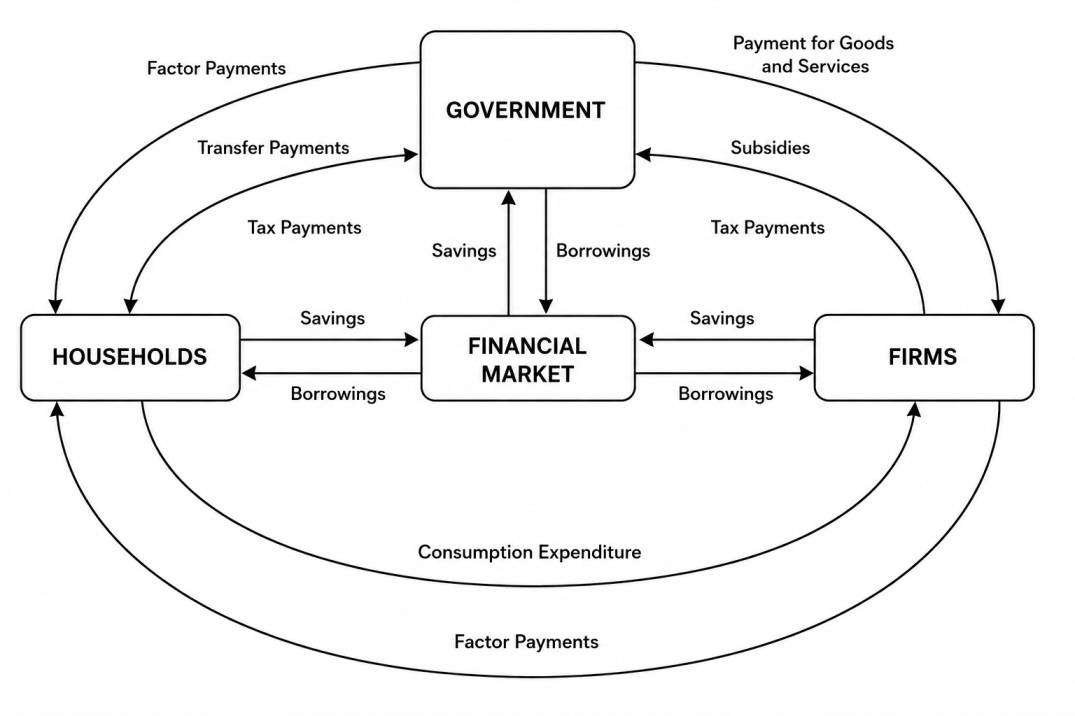
The income received by households is then spent on the goods and services produced by firms. This creates a continuous loop of production, income, and expenditure within the economy. The real flow of goods and services moves from firms to households, while the money flow moves from households to firms. This circular movement ensures that the total value of production, income, and expenditure remains equal, forming the foundation for measuring national income.