
“Treat the Earth well. We do not inherit the earth from our ancestors; we borrow it from our children’.
Introduction of Environment
The term ‘environment‘ is derived from the French word ‘environner,’ that means ‘to surround.’ According to the Environment (Protection) Act of 1986, the environment encompasses all the physical and biological surroundings of an organism and the interactions within them. It is defined as the collective composition of water, air, land, and the intricate interconnections that exist among these elements, as well as with human beings, other living organisms, and materials.
Environmental Determinism And Possibilism
We need to understand the following two approaches and understand the shift from one to another.
- Environmental Determinism: This is the idea that the physical environment, particularly the climate and terrain, actively shapes cultures, societies, and behaviours of individuals. It suggests a strong influence of the environment on human behaviour and culture.
- Environmental Possibilism: As the name suggests, this explores the new ‘possibilities‘ between humans and their environment, despite certain environmental limitations. Through environmental possibilism, we focus on development with the help of technology, innovation, new energy explorations and so on.
Industrialization and urbanization became a way of life. This can be linked with anthropogenic activities which are to be discussed later.
Thus, balancing of life was required in the form of sustainable development which we will discuss later. Right now we are discussing basic concepts of environment in the following topics.
Ecology
- Ecology is the scientific study of interactions among organisms and between organisms and their environment. Ecology examines how organisms adapt to their environment, how they interact with other species, and how they influence and are influenced by the non-living environment.
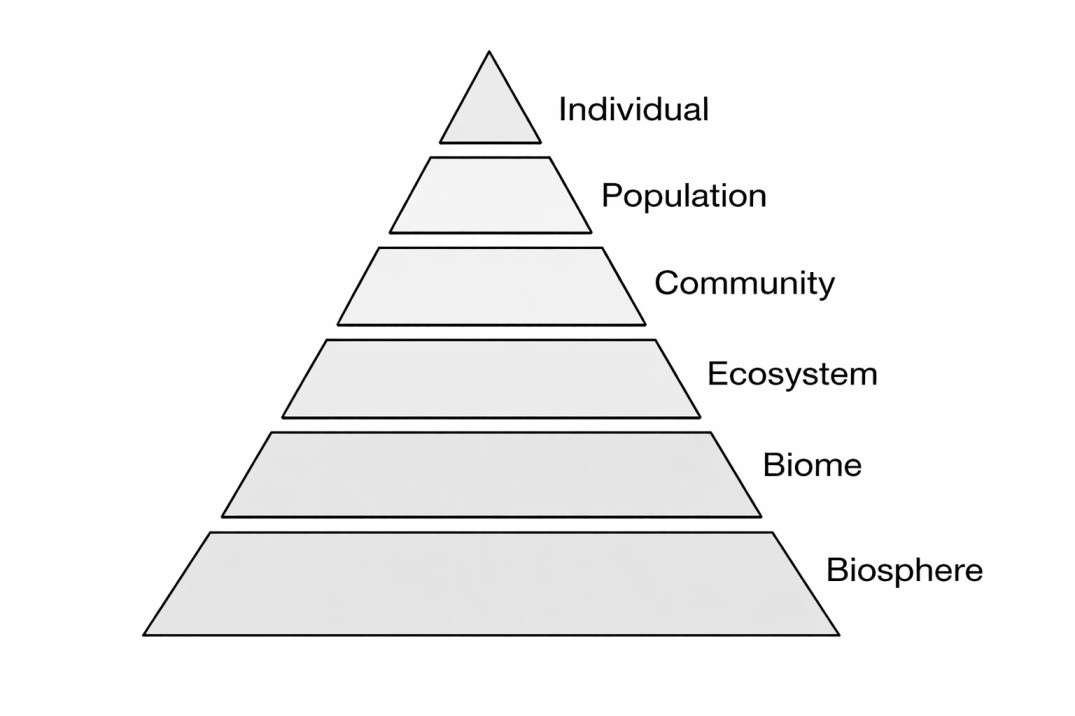
- The scope of ecology covers the study of individual organisms, populations, communities, ecosystems, and the global scale of the biosphere. (Take note that ecosystem is included here).
- The concept of ‘ecology‘ was coined by Ernst Haeckel, a German biologist in 1869.
Levels of Ecology:
Ecology can be understood at the following levels:
1. Individual Organism:
Here, we study a single organism and its interactions with its environment. It adapts to its surroundings (adaptations), and it is essential to see where it lives (habitat), how it ensures its safety, and what potential threats it faces.
For instance, let’s take the example of a frog. We can examine how it locates food sources, ensures its safety, and employs protective adaptations in its habitat. We can also investigate how it thrives in a moist environment to maintain skin moisture and reproduces by laying eggs in water.
2. Species:
A species is a group of similar individual organisms that are capable of interbreeding to produce fertile offspring and share common characteristics. For example, human beings (Homo sapiens), roses, or trees.
Species is a step above the individual organism. They take us towards population. Their interactions take place at the following levels:
Within species – population ecology
Between species – community ecology
Between organisms and their physical environment – ecosystem ecology
Some Central Role Playing Species:
Keystone Species:
Keystone species play a unique and crucial role in the functioning of an ecosystem.
They are essential for the health and biodiversity of ecosystems. They may be less in number, but their impact is much greater.
They maintain the balance of nature, provide essential services, and function as:
Predators
Mutualists
Habitat modifiers
Without them, ecosystems would be less diverse and resilient.
Example: In the Sundarbans mangrove forest, the Indian elephant acts as a keystone species.
Another example is termites, which:
Build complex mounds
Regulate temperature and humidity
Improve soil quality
Enhance biodiversity
Critical Link Species:
This is broader than keystone species. These species connect different parts of an ecosystem.
Types include:
Ecosystem Engineers – alter environment physically
Foundation Species – define ecosystems (e.g., coral reefs)
Umbrella Species – their conservation protects many species
Indicator Species – show ecosystem health
Flagship Species – symbols for conservation
Endemic Species – found only in specific regions
Examples of endemic species:
Lion-tailed Macaque
Nilgiri Tahr
Kakapo
Giant Panda
3. Population
This level deals with groups of the same species and their dynamics.
Important aspects:
Reproduction and Natality – birth rate
Population Growth Rate – births, deaths, migration
Age Structure – pre-reproductive, reproductive, post-reproductive
Population Dispersal – immigration, emigration, migration
Predation – predator-prey interaction
Mortality – death rate
Carrying Capacity – maximum sustainable population
Metapopulations: Multiple populations connected through migration (e.g., deer populations across forests).
4. Community
A community refers to all living organisms in an area and their interactions.
It involves:
Interdependence
Competition
Disturbances (pollution, human intervention)
Example: A pond ecosystem with frogs, fish, insects, and plants.
Ecological Niche:
An ecological niche is the role and position of a species in an ecosystem.
Important aspects:
Habitat – natural environment
Physical factors: soil, temperature, light
Biotic factors: food, predators
Cohabitat – different species living together
Microhabitat – small specific area
Example: Frogs are ectothermic and prefer moist environments.
Other factors:
Resource Utilization
Behavioural Patterns
Interactions
Tolerance Limits
Ecological Footprint:
The ecological footprint measures how much nature we use (food, water, energy).
It checks whether human consumption exceeds Earth’s capacity to regenerate.
Measured in global hectares (gha)
Represents Earth’s biological productivity
Ecological Succession:
Ecological succession is the gradual change in ecosystems over time.
Primary Succession – starts from bare areas (e.g., rocks)
Secondary Succession – develops from existing ecosystems
Types of Ecology:
Autecology:
Study of individual species and their:
Life cycle
Behaviour
Adaptations
Synecology:
Study of communities and:
Species interactions
Energy flow
Nutrient cycles
Haute Ecology:
An interdisciplinary approach combining:
Ecology
Design
Engineering
Architecture
Ecosystems
The term ‘ecosystem‘ was introduced by Arthur Tansley in 1935. It describes a self-regulating community where living organisms interact with each other and their physical environment. For example, in a pond ecosystem, various plants, animals, and microorganisms coexist and interact within their specific aquatic environment.
Biological Components (Biotic): This includes all the living things in the pond, such as plants, animals (frogs, fish, insects), bacteria, and algae.
Physical Components (Abiotic): These are the non-living parts of the ecosystem, such as water, soil, nutrients, sunlight, and temperature.
The other components worth most discussing are as follows:
Energy Flow:
The Sun is the primary source of energy for most ecosystems. Sunlight is captured by producers, like plants, through the process of photosynthesis.
Producers (Autotrophs): These are organisms, typically plants and algae, that make their own food using sunlight, water, and carbon dioxide. They form the base of the energy pyramid in an ecosystem.
Consumers (Heterotrophs): These organisms cannot produce their own food and must consume other organisms. Consumers are divided into different categories:
Primary Consumers: Herbivores that eat producers.
Secondary Consumers: Carnivores or omnivores that eat primary consumers.
Tertiary Consumers: Predators that eat secondary consumers.
Decomposers and Detritivores: These organisms, like fungi and bacteria, break down dead organisms and waste materials, releasing nutrients back into the environment. They play a crucial role in recycling energy and matter within the ecosystem.
Energy Transfer: Energy is transferred between trophic levels (producers, consumers, decomposers), typically through consumption. However, during each transfer, some energy is lost as heat due to metabolic processes, as described by the Second Law of Thermodynamics.
Energy Loss and 10% Energy Rule: The energy flow is always unidirectional; it goes in one direction. The concept of energy loss tells us about the essence of unidirectional energy flow in ecosystems. Energy moves from one trophic level to another but without any returning. A significant portion of energy is lost as heat during various biological processes like digestion, metabolism, maintaining body temperature etc. Thus, we need the continuous energy input, primarily from sunlight, to sustain the different trophic levels in an ecosystem. The 10% Energy Rule also tells us that only 10% of energy is transferred from one trophic level to another, and 90% is the energy loss. Include the following definitions also. This can be understood better with the help of a diagram, refer figure 9.4.
Nutrient Cycling:
We know that nutrients, such as nitrogen, phosphorus, and carbon, are essential for life, but they need to be in proper form for our health. Nutrient cycles are processes that transform nutrients from one form to another and make them available to organisms.
For example, in the nitrogen cycle, plants absorb nitrogen from the soil, and animals get nitrogen from eating plants. When plants and animals die, their bodies decompose, and the nitrogen is released back into the soil. If such cycles are not used, the system sustenance will collapse.
Food Chain, Trophic Levels and Food Web
Let us try to understand the three in a logical sequence for understanding in ecology:
Food Chain: A linear sequence that shows who eats whom in an ecosystem. There are different levels in a food chain, starting from producers (like plants) and moving through various consumer levels (herbivores, carnivores).
For example, in a grassland ecosystem, food chain is grass → deer → tiger. The grass is the primary producer, the deer is the primary consumer, and the tiger is the secondary consumer.
Trophic Levels: Each trophic level receives energy from the level below it and provides energy to the level above it.
Food Web: A complex network of interconnected food chains in an ecosystem, illustrating the multiple feeding relationships among different organisms across various trophic levels.
System Perspective: This provides a wholesome view of the ecosystem.
- We observe how the biotic and abiotic components interact and function together as a whole. There are diverse ecosystems, such as forests, marine, and deserts, each with unique characteristics.
- Ecosystems vary in size and composition but share basic structural and functional characteristics.
- The exchange of matter and energy with the environment is either free in open systems or limited in closed systems.
- All ecosystems, whether a large forest or a small clump of bushes, are interconnected and form the biosphere.
- Basically, it is a cybernetic system that is self-regulated to ensure stability and balance.
Trophic Levels in an Aquatic System
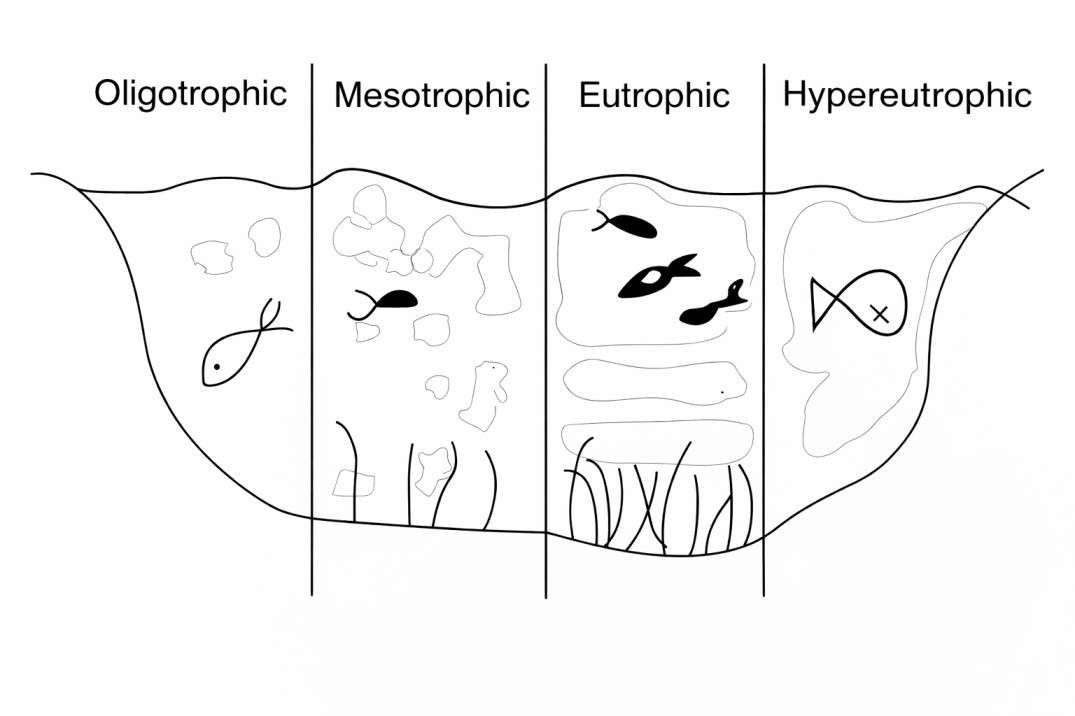
- Oligotrophic: Low in nutrients and hence low biological productivity. They typically have clear water with high oxygen levels, this support spe-cies like trout.
- Mesotrophic: Intermediate level of nutrients and biological productivity. They support more productivity.
- Eutrophic: Thy are high in nutrients, particularly nitrogen and phosphorus, thus have high biologi-cal productivity in terms of abundant plant and algal growth. This leads to problems like algal blooms and low oxygen levels in deeper waters due to the decomposition of dead algae and plants.
- Hypertrophic: These are extremely nutrient-rich water bodies, often suffering from severe problems like dense algal blooms, very low oxygen levels in deeper waters, and poor water clarity.
- Dystrophic: These water bodies are rich in organic matter, often undecomposed, similar to those found in bogs and marshy lakes. They are not necessarily nutrient-rich in the traditional sense (like nitrates and phosphates) but have high levels of organic carbon.
Comparison of Ecology and Ecosystem
| Feature | Ecology | Ecosystem |
|---|---|---|
| Scope | Broad | Specific |
| Focus | Interactions between organisms and their environment | Interactions within a local community |
| Levels of Organization | Various | Single community |
| Examples | Studying predator-prey interactions, organismal adaptation, ecosystem responses to disturbances | Studying energy flow, nutrient cycling, ecosystem responses to climate change |
Ecological Pyramids
This concept of Ecological Pyramid was developed by Charles Elton in 1927. They are a simplified representa-tion of a complex system. We already discussed producers and consumers in the context, with producers at the bot-tom and herbivores and carnivores at the top.
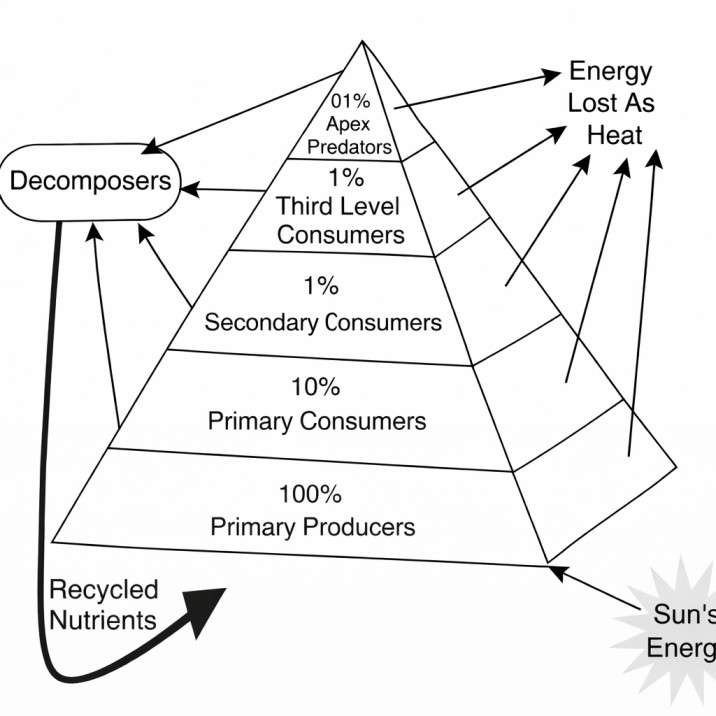
The following three types of ecological pyramids are interconnected.
1. Pyramid of Energy: This represents the flow of energy through an ecosystem. Energy is transferred from one trophic level to the next, but not all of it is available for consumption at the next level. In fact, only about 10% of the energy is transferred to the next level, with the remaining 90% being lost as heat or used in respiration.
We can again look at grass deertiger. The energy is lost at each trophic level.
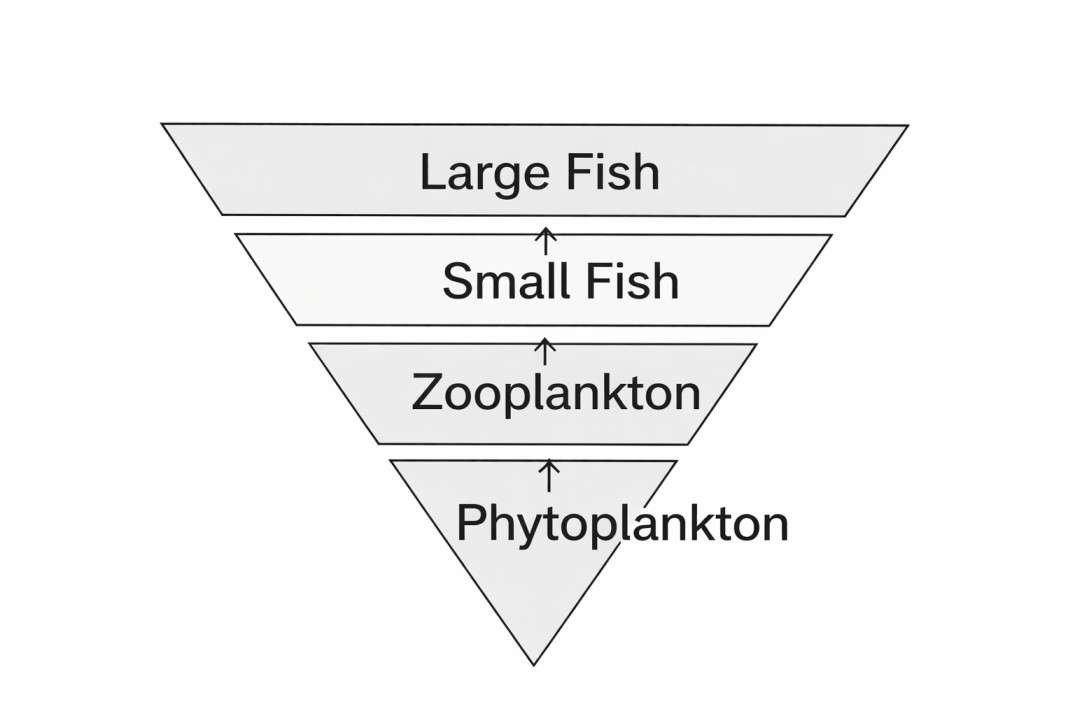
2. Pyramid of Numbers: The pyramid of numbers rep-resents the number of organisms at each trophic level. The pyramid of numbers can be upright, inverted, or partly upright.
Upright Pyramid: In a forest ecosystem, the trees are the primary producers, and most numerous. There are fewer herbivores, such as deer or rabbits, and even fewer carnivores, such as wolves or bears.
Inverted Pyramid: In a marine or aquatic ecosys-tem such as pond, the biomass of primary consumers (zooplankton, the herbivores) can indeed be larger than the biomass of primary producers (phytoplank-ton, reproduce quickly).
3. Pyramid of Biomass: This represents the total mass of organisms at each trophic level. The pyramid of biomass is usually upright, but it can be inverted in some cases.
We can take the example of grass, zebra and lion here again. There is same example of inverted as was in pyramid of numbers.
Biome:
Biomes are large-scale ecological units that are characterized by their climate and vegetation. They are influenced by factors such as temperature, precipitation, soil type etc. They are found all over the world, from the frozen Arctic tundra to the lush tropical rainforests.
Biomes regulate the Earth’s climate by absorbing carbon dioxide and releasing oxygen. They help in regulating precipitation and temperature.
Biodiversity:
Biodiversity refers to all the different forms of life on Earth, including different species, genetic diversity, and ecosystems. It’s crucial for a healthy planet and our well-being, providing us with food, medicine, clean air and water, and recreational opportunities. However, human activities like habitat destruction, pollution, and overuse of resources are causing a decline in many species. The Convention on Biological Diversity (CBD) is also in the syllabus, that is an international treaty adopted in 1992.
Ecotone
An ecotone is the transition zone or area between two biomes, ecosystems, or habitats, where there is often a high degree of biodiversity and species interaction. The following concepts are important in ecotone.
Edge Effect: The edge effect in ecology refers to the changes in population or community structures that occur at the boundary of two or more habitats. Areas where different habitats meet, such as forests and grasslands, are known as ‘edges.’ This effect has several key aspects such as increased diversity at boundaries, differential environmental conditions, and species interaction. The whole situation may be beneficial to some, but detrimental for others.
Human activities often create artificial edges, such as those formed by agriculture, logging, or urban development.
Habitat loss: This refers to the disappearance of natural environments that are home to particular plants and animals. This may occur due to deforestation, urbanization, agricultural expansion, climate change, pollution etc.
Biodiversity Hotspots: Biodiversity hotspots are areas of high ecological richness and diversity, often found in ecotones, which are transition zones between different ecosystems. These ecotones showcase a greater variety of plant and animal life compared to the neighbouring ecosystems.
Fragmentation: Fragmentation turns a large, continuous natural area (like an ecotone) into smaller, isolated pieces due to human development activities. This is harmful as it reduces the overall area where plants and animals can live. Species that need large, uninterrupted spaces may struggle or decline as they may not find mates for reproduction.
Four Spheres of Earth:
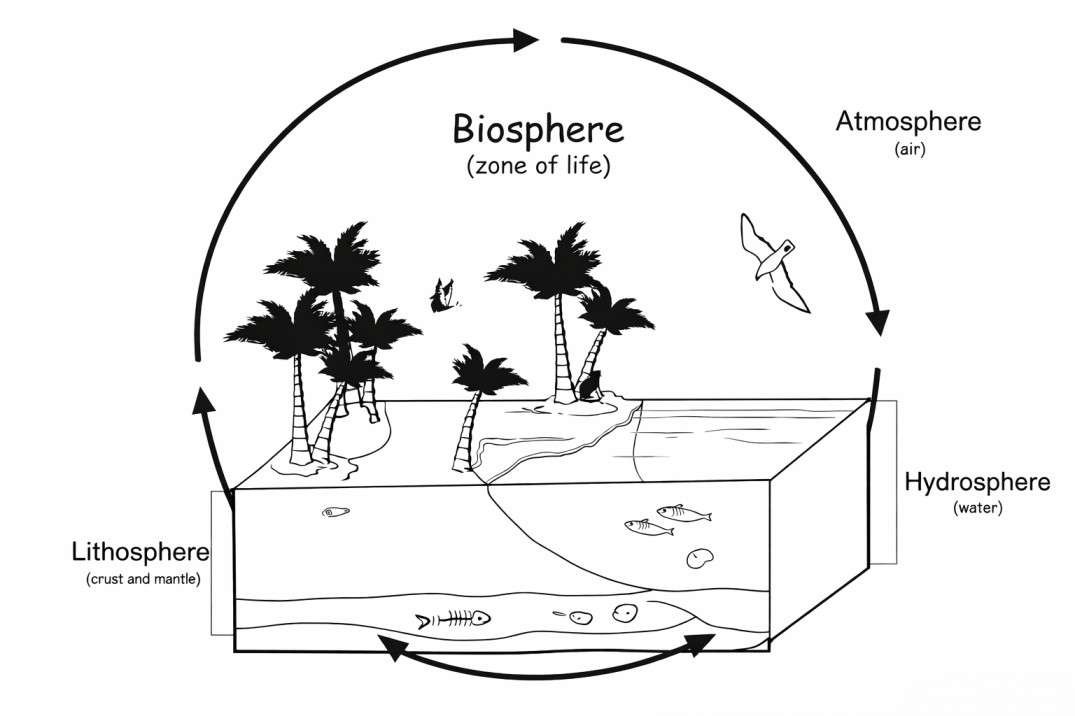
The Earth consists of four main spheres: Lithosphere (solid earth), Hydrosphere (water), Biosphere (living things), and Atmosphere (air). Each part has a unique function in supporting life, with the atmosphere further divided into different layers. These actually make the base of syllabus also.
Lithosphere (Solid Earth):
This is the Earth’s outermost layer – the crust and top part of the mantle (the layer under the crust).
This is mostly made of rocks and minerals which makes the base of land-based ecosystems.
This sphere has features such as mountains and valleys. The geological events such as earthquakes and volcanoes occur. We will discuss these under natural disasters.
Hydrosphere (Water):
The hydrosphere encompasses all of the Earth’s water bodies, including oceans, rivers, lakes, and even moisture in the air. Water in the hydrosphere is crucial for all forms of life and plays a key role in global climate systems.
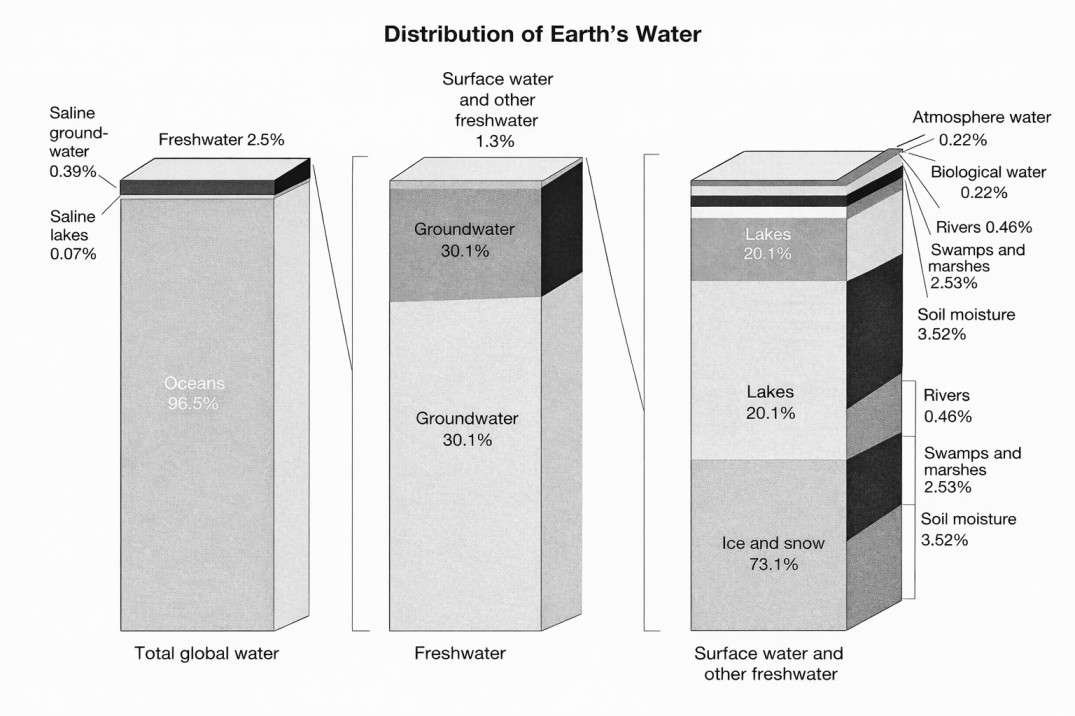
We are taking the help of a diagram (Figure 9.5) to explain the fresh water availability in the world. Look at the following points for the sake of easiness.
- 1ª Column: Oceans (along with saline groundwater and saline lakes) contain almost 97.5% of the Earth’s water. This water is almost saline.
- 2nd Column: The remaining 2.5% of the water is freshwater, found in glaciers, ice caps, rivers, lakes, and groundwater. As freshwater is most important as this is required for drinking, routine chores, agriculture etc, we are assuming this to be of 100 percentage units to know its breakup.
- 3rd Column: The actually available 1.3% surface water and other freshwater in the 2nd Column is further broken into different parts in the 3rd Column. (This 1.3% is further divided into 100 parts in 3rd column).
While freshwater is relatively scarce compared to saltwater, it is crucial for most terrestrial life, including human civilization, which relies heavily on freshwater for drinking, agriculture, industry, and other uses. The uneven distribution and accessibility of this freshwater pose significant challenges, especially in regions prone to drought or where water is not easily accessible.
Biosphere (Life):
- The biosphere is the zone of life on Earth. It encompasses all living organisms, including plants, animals, fungi, bacteria, and humans.
- Life exists in various environments within the lithosphere, hydrosphere, and atmosphere.
- The biosphere extends from about 3 meters below the ground (where soil and underground habitats are located) to about 30 meters above the ground (including treetops and aerial habitats) and within the top 200 meters of oceans and seas, where sunlight can penetrate.
- The biosphere is facing a number of challenges, including climate change, pollution, and resource depletion. These challenges are threatening the health of the biosphere and all living things.
Distribution of Earth’s Water:
Atmosphere (Air)
The atmosphere is a mixture of gases surrounding the Earth, primarily composed of nitrogen, oxygen, carbon dioxide, argon, and other trace gases, along with water vapor. It is divided into several layers, with distinct characteristics:
Layers of Atmosphere:
Troposphere:
- The altitude ranges from the Earth’s surface to about 8–14.5 km.
- In troposphere, all human activities and nearly all weather phenomena take place. It contains the majority of the atmosphere’s mass and is where we experience daily weather patterns.
- Importance also lies in the fact that troposphere holds the air we breathe and the water vapor that forms clouds and precipitation.
- Normal Lapse Rate: This is specific to troposphere, that reflects the decrease in temperature with increase in altitude. This reduction is typically around 6.5°C per 1000 meters of altitude gain. This rate can vary due to local weather conditions. This is linked with climate, such as cloud formation and weather patterns, and also with meteorology.
Stratosphere:
- Altitude: This extends from above the troposphere up to about 50 km high.
- Atmospheric Pressure: This layer is about 1/1000th of the pressure at sea level.
- Ozone Layer: This layer lies within stratosphere that is located roughly between 15 and 35 km above Earth. This layer acts as a protective shield against the sun’s harmful ultraviolet (UV) rays, preventing most of them from reaching the Earth’s surface. Thus, it protects life on Earth.
- The most harmful UV-C is almost completely absorbed by the ozone layer, UV-B is also harmful but is absorbed less.
- Otherwise, exposure to high level of UV radiation can cause skin cancer, cataracts, and damage to the DNA of living cells.
- Impact on Climate: The stratosphere holds an important role in the climate system. While it contains a much smaller portion of the atmosphere’s mass compared to the troposphere, its chemical and thermal properties significantly influence Earth’s climate and weather.
- Compared with the concept of normal lapse rate in troposphere, there is an increase in temperature with altitude in stratosphere due to the ozone layer.
Mesosphere:
- The mesosphere extends from about 50 km to 85 km.
- This layer is known for the burning up of meteors, which become visible as shooting stars when they enter the Earth’s atmosphere and disintegrate due to friction with air molecules.
- It is the coldest part of the Earth’s atmosphere, with temperatures dropping as low as -90°C.
Thermosphere:
- This sphere lies between 85 km to 600 km from the surface of Earth.
- This sphere experiences very high temperatures (1,000°C and above), but feels cold due to its thin air.
- It is known for the beautiful auroras (Northern and Southern Lights) and is where most satellites orbit our planet.
Ionosphere:
- This spans from approximately 48 km to 965 km. The word ‘iono‘ indicates that it is vital for radio communication.
- It contains charged particles that reflect radio waves back to Earth, facilitating long-distance communication.
- The ionosphere changes with solar activity and is divided into three areas D, E, and F layers, each reacting differently to various wavelengths of solar radiation.
Exosphere:
- The exosphere, Earth’s outermost atmospheric layer, extends from the top of the thermosphere up to about 10,000 km.
- It marks the transition where the atmosphere gradually merges into outer space and contains particles, like hydrogen and helium atoms, potentially escaping Earth’s gravity.
- Kármán Line: This is an internationally recognized boundary between Earth’s atmosphere and outer space. It is defined at an altitude of 100 kilometers. Above this line, the air is too thin for conventional aircraft to generate lift.
Our Forests Resources
Definition of Forests:
Forests are large areas dominated by trees. They play a crucial role in the Earth’s ecosystem, providing habitat for a multitude of species, influencing climate patterns, and serving as significant carbon sinks.
Forests as a Resource:
- Biodiversity: Forests are the cradle of biodiversity, they are rich in it. They function as ‘terrestrial lungs‘ of the Earth, they regulate climate and maintain air quality. They house a vast array of flora and fauna, including several endangered species. National Parks, Wildlife Sanctuaries, Biosphere Reserves are required to conserve biodiversity.
- Economic Value: They contribute to the economy through timber, non-timber forest products (like medicinal plants and bamboo), and ecotourism.
- Environmental Importance: Forests in India play a vital role in water conservation, soil preservation, and climate regulation.
Facts about Forests in India:
- India has tropical evergreen, deciduous forests, thorn forests, and mangroves. The Western Ghats, Eastern Himalayas, and Northeastern region are some of the most forest-rich areas.
India State of Forest Report (ISFR) 2021:
- The ISFR 2021 shows an increase of 0.28% in forest and tree cover, with a slight increase of 0.22% in forest cover and 0.76% in tree cover compared to the previous report. The total forest and tree cover of India are now 80.9 million hectares, which is an increase of 2,261 square kilometers from 2019.
- The increase in forest and tree cover is largely due to plantations and assisted natural regeneration. Plantations account for 47% of the increase, while assisted natural regeneration accounts for 39%.
- Madhya Pradesh, Maharashtra, and Chhattisgarh are the three leading states in forest coverage; they together account for almost half of India’s forest and tree cover.
- The three states with the highest percentage of forest and tree cover are Mizoram, Arunachal Pradesh, and Manipur. The forest cover percentage is more than 75%.
- India’s forest and tree cover is still below the global average.
Deforestation:
Deforestation is the extensive removal of Earth’s forests, leading to land degradation. At the current rate of deforestation, the world’s precious rainforests are predicted to disappear within a century. The primary drivers of deforestation include:
Agriculture Expansion: Agriculture, including subsistence and commercial farming, is the leading cause of deforestation, responsible for 85% of forest loss.
Shifting Cultivation: This practice, seen in regions like Assam and Madagascar, involves clearing small patches of tropical forests for crops. They lead to a pattern of unsustainable land use practices.
Timber Harvesting: The logging for wood and paper products contributes to 14% of deforestation. Countries like Myanmar, Malaysia, Indonesia, Brazil, Argentina, and various African nations are prominent examples.
Hill Slope Cultivation: Terrace farming (contour farming) involves farming on narrow steps cut across hillsides. This practice can lead to soil erosion.
Wildfires: These are influenced by human and natural factors. Climate change has increased the frequency and intensity of wildfires. Australia and Canada can be taken as examples.
Negative Effects of Deforestation:
Deforestation has significant environmental consequences:
Climate Change: Deforestation results in less carbon dioxide absorption, leading to increased greenhouse gas emissions and global warming.
Water Cycle Disruption: Trees contribute to the water cycle by returning water vapor to the atmosphere. Deforestation decreases precipitation, impacting water availability.
Soil Erosion: Tree roots stabilize soil, preventing erosion and landslides. Deforestation raises the risk of landslides and flash floods.
Desertification: Excessive tree removal contributes to desertification, particularly in drylands. This leads to land degradation and threatens ecosystems.
Biodiversity Loss: Deforestation reduces habitat for countless species, contributing to biodiversity loss.
Main Forest Projects in India:
Here is a summary of the forestation programs:
- National Afforestation Programme (1979): To increase forest cover and provide environmental benefits.
- Social Forestry Programme (1980): Encourage local community participation in forestry.
- Joint Forest Management (JFM) Programme (1990): Collaborative effort between government and communities for forest management and protection.
- Van Mahotsava (1950): Annual nationwide tree-planting campaign to raise awareness and encourage tree planting.
- Green India Mission (2016): Flagship program to increase forest cover by 2.5% by 2030.
- Mission for Greening Indian Cities (MGCI – 2022): National initiative to improve urban green cover and enhance quality of life.