- Introduction
- Stages of Perception
- Approaches to the Study of Perception
- Physiological Approach
- Cognitive Perspective
- Ecological Approach
- Constructivist Approach
- Gestalt Approach
- Theoretical Approaches to Perception
- Sensation
- Role of Attention in Perception
- Law of Organisation: Gestalt Principles
- Figure-Ground Relationship
- Law of Proximity
- Law of Continuity or Good Continuation
- Law of Closure
- Law of Common Region/Common Fate
- Law of Good Form/Pragnaz
- Perceptual Constancy
- Size Constancy
- Shape Constancy
- Colour or Brightness Constancy
- Factors Affecting Perception
- Effect of Motivation or Need
- Effect of Expectation or Perceptual Expectancy
- Effect of Emotions
- Effect of Stimulus Characteristic
- Effect of Experience
- Effect of the Culture
- Perception of Depth and Distance
- Monocular Cues
- Binocular Cues
- Movement Perception
- Size Perception
- Errors in Perception
- Types of Illusion
- Muller-lyre Illusion
- Ponzo Illusion
- Ebbinghaus Illusion
- The Ames Room Illusion
- The Moon Illusion
- Role of Motivation and Learning in Perception
- Role of Motivation in Perception
- Role of Learning in Perception
- Signal Detection Theory
- Introduction and Scope
- History of Signal Detection Theory
- The Mechanics of Signal Detection Theory
- Signal Detection Theory Example
- Applications of Signal Detection Theory
- Subliminal Perception and Related Factors, Information Processing Approach
- Debate Over Terms and Methodology
- Just-Noticeable Differences
- Exclusion Paradigm
- Conclusion
- Information Processing
- Basic Assumption
- Information Processing and Selective Attention
- Critical Evaluation
- Culture and Perception
- Perceptual Styles
- Visual Learning Style
- Auditory Learning Style
- Tactile or Kinesthetic Learning Style
- Perceptual Styles
- Ecological Theory of Perception
- Meaning of Perception
- Affordances
- Direct Perception
- The Role of Context
- Implications for Design and Learning
- Gibson's Ecological Theory
Introduction
- The psychological process responsible for our interpretation of the world is known as perception. Perception is a set of processes that help us understand the world around us. Every second, we encounter numerous stimuli. For example, in a room, you may notice walls, colours, sounds, objects, and more. Your awareness of these is due to a higher mental process called perception.
- Perception helps us in interpreting information and making appropriate decisions, from simple choices like what to wear to complex ones like how to cross a road. Thus, perception can be defined as the process of selecting, organising, and interpreting sensory information, based on past experiences, expectations, and needs.
- When you try to visualize your kitchen, you may not recall every detail. This is because the brain cannot process all available information at once and instead focuses on selected stimuli.
- For instance, while crossing a busy road, you pay attention to important stimuli such as traffic signals, moving vehicles, and people, while ignoring less relevant details like buildings or trees. This shows how perception involves selective attention.
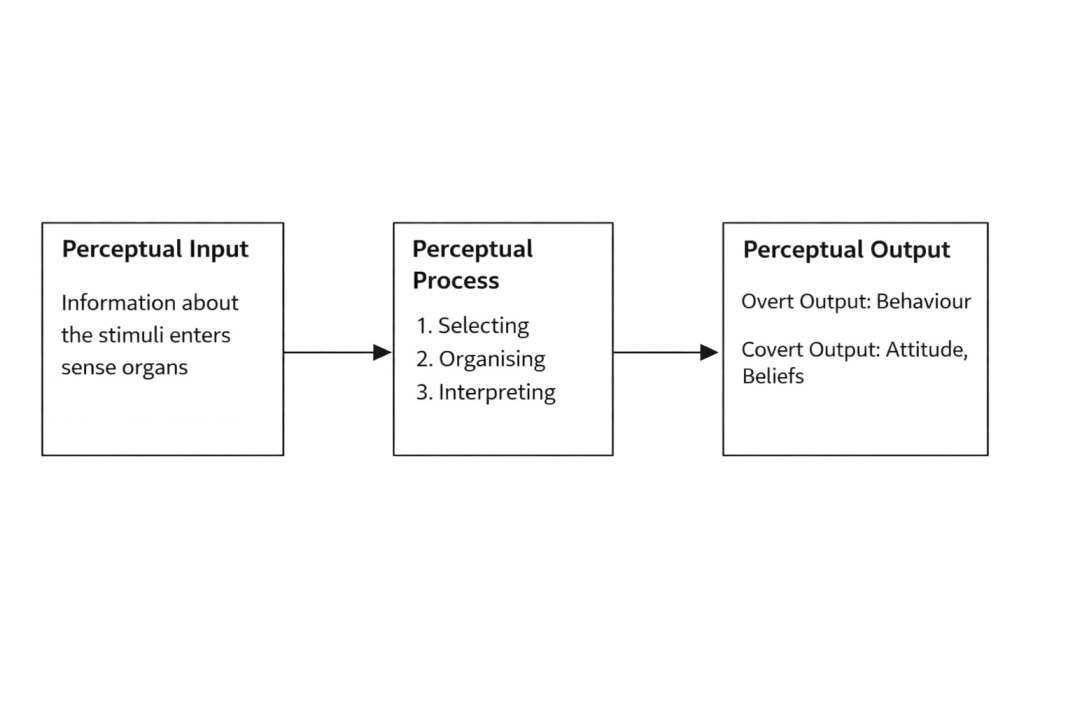
The process of perception can be understood in three main steps:
(i) selection – choosing relevant stimuli,
(ii) organization – arranging information meaningfully, and
(iii) interpretation – understanding and making sense of the situation.
Thus, perception is an active process where the brain filters, structures, and interprets information to guide effective action and decision-making.
Stages of Perception
Stage I: Selection
- The first stage of perception is selection. Since the brain has limited capacity, it cannot attend to all stimuli at once. Therefore, we either consciously or unconsciously select certain stimuli and ignore others. The selected stimulus is called the attended stimulus.
- Our interpretation of any figure depends on how we organise information, and this organisation is influenced by attention. For example, in certain images, some people focus on one part while others focus on another.
- In the case of a figure, some individuals may pay attention to the white area and perceive two human faces, while others may focus on the black area and see a vase.
- These differences show that individual differences in perception exist, as people may attend to different aspects of the same stimulus, leading to different interpretations.
Stage II: Organization
- In this stage, stimuli are mentally arranged into a meaningful pattern. This process occurs unconsciously. Several principles have been proposed to explain this process of organisation.
- The Gestalt principles of organisation help explain how humans naturally organise stimuli to form a meaningful whole, which further aids in interpretation.
Stage III: Interpretation
- In this last stage, meaning is assigned to the organised stimuli. The interpretation of stimuli depends on one’s experiences, expectations, needs, and beliefs.
- Thus, this stage is subjective in nature, and the same stimulus can be interpreted differently by different individuals.
Approaches to the Study of Perception
Perception is that process in psychology which enables the interpretation and making sense of sensory information from an environment so that people may identify, organize, and respond to stimuli. Perception is not a passive reception of data; it is influenced by previous experiences, context, and expectations. Psychologists have studied aspects of perception on both the visual and the auditory side, as well as those related to depth and motion perception. They have also analyzed how perception influences behavior and decision making. Knowledge of perception is vital in understanding human cognition since it determines how humans manage to live within the world; with other people; and, thus, how they form reality.
Perception is one of the study approaches that try to come to terms of how people perceive sensory information and transform that sensory information into meaningful experience. Each approach has different insights on the complexity of perception, so you look at both the processes that lay beneath and how context can affect our perception of the world.
Physiological Approach
Physiological approaches toward perception are focused on biological and neurological processes which provide underpinnings for experiences based on sensory perceptions. This type of research focuses on the mechanisms by which sensory organs-the eyes and the ears, to mention a few-detect the stimuli and send them through various neural pathways in the brain for further processing. Neural pathways, regions in the brain, and neurotransmitters are the primary focus of investigation in this field. Brain imaging and electrophysiology techniques are common methods used to trace these processes on human and animal subjects. Knowing the physiological basis of perception reveals to what extent mechanisms influence our perception of the world.
Cognitive Perspective
The cognitive approach focuses on mental processes concerning perception, such as attention, memory, and interpretation. The cognitive perspective asserts that perception is not just a straightforward reflection of sensory input but an active brain construction based on available knowledge and experience. Cognitive psychologists examine how variables such as the components of expectation, context, and individual differences affect perceptual outcomes. Experiments and cognitive modeling are used to explore these processes as they relate to perception. Being able to look at the cognitive aspects of perception allows researchers to understand what happens in perception-that is, how we take in and organize sensory information.
Ecological Approach
The ecological approach developed by James J. Gibson centers on the relationship between perception and the environment. It does claim that perception is an active process, thereby suggesting direct access to our surroundings, rather than the passive reception of sensory input. This theory maintains that the environment has rich information that can be directly accessed by people for purposes of adaptive behavior. There are two critical terms: affordances: meaning the possible actions offered by objects in the environment. In the ecological approach, natural contexts studies of perception emphasize how environmental factors build perceptual experience.
Constructivist Approach
Constructivist approach interprets perception as constructive and constructive through past knowledge and experiences and context factors. Through this, interpretation will be based on the individual's aspect of sensory information rather than responding to a given stimulus. The constructivist approach focuses on the cognitive frameworks or schemas and expectations through which we come to perceive stimuli. For instance, two people perceive the same visual scene distinctly considering their pre-experience and cultural backgrounds. In this way, this approach allows researchers to gain insight into the subjective experience through knowledge and context.
Gestalt Approach
The Gestalt approach claims that perception is organized in a holistic manner, whereby importance has to be placed on patterns and configurations. The principles of Gestalt postulate that people actually tend to perceive objects as integrated wholes rather than isolated parts which would influence how they interpret their sensory information. A few key principles include figure-ground organization, proximity, similarity, and closure, which illustrate how we group elements and form coherent perceptions. This approach shows that our brains are designed to find patterns and impose meaning on something complex, thereby facilitating efficient and adaptive perception. The understanding of such principles enables psychologists to be better able to know how we see and navigate our surroundings and interpret our visual environment.
Perception is that process in psychology which enables the interpretation and making sense of sensory information from an environment so that people may identify, organize, and respond to stimuli. Perception is not a passive reception of data; it is influenced by previous experiences, context, and expectations. Psychologists have studied aspects of perception on both the visual and the auditory side, as well as those related to depth and motion perception. They have also analyzed how perception influences behavior and decision making. Knowledge of perception is vital in understanding human cognition since it determines how humans manage to live within the world; with other people; and, thus, how they form reality.
Theoretical Approaches to Perception
Two separate theoretical approaches have been proposed by psychologists to explain the process of perception. One is known as “Top-down processing approach” and, other is known as “Bottom-up processing approach”.
Theoretical Approaches to Perception
| Bottom-up processing | Top-down processing |
|---|---|
| Process of perception is direct. | Process of perception is indirect. |
| Perception is a data driven process i.e., stimuli carries sufficient information to be interpreted meaningfully and we don’t need to rely on our experiences. | Perception is an experience driven process i.e., stimuli don’t have sufficient information to be interpreted meaningfully and therefore, we need to rely on our experiences. |
| J. J. Gibson was one of the strongest advocate of this view. | Richard Gregory was the strongest advocate of this view. |
Sensation
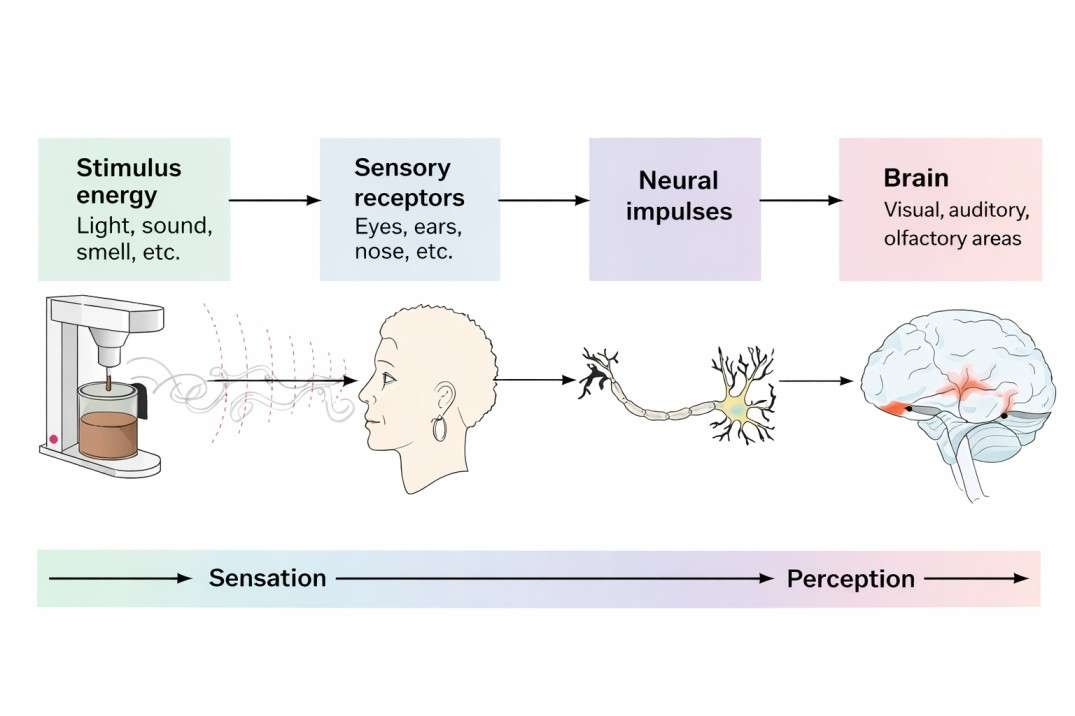
- A closely related term to perception is sensation. Sensation is the first contact we establish with our physical environment. It focuses on the relationship between sensory stimulation (such as electromagnetic waves, sound waves, and pressure) and how these inputs are received by our sense organs—the eyes, ears, nose, tongue, and skin (Baron, 2001).
- Thus, sensation can be understood as the process of gathering information from the environment through our senses and transmitting it to the brain for further processing. The process of perception, which occurs unconsciously, then interprets this sensory information to make meaning of the world around us.
Process of Sensation:
The process of sensation consists of three main steps.
- The first step is reception—the process of receiving information such as light, heat, or physical energy through sense organs using specialised sensory receptor cells.
- The second step is transduction—the process of converting this physical energy into electrical impulses, which is the form of information that can be understood by the brain and nervous system.
- In the final step, these electrical impulses travel through nerve fibres to the nervous system, where they are interpreted.
Role of Attention in Perception
- The dish antenna we use in our home receives all available signals from the satellite but the tuner of the television-set selects signal according to our wishes. Similarly, our senses can register numerous stimuli at a given time but attentional processes help us in selecting relevant stimuli responsible for perception.
Following are some important functions of attention in context of perception:
- Selective attention: The most important function of attention is selectivity. It refers to a process by which attention is focused on stimulus of ongoing interest, while ignoring other irrelevant stimuli. Selective attention acts as a filter.
- Sustained attention: It is the ability to attend to a stimulus for a longer period of time without being distracted. Job of looking at a radar screen requires sustained attention. Our attentional process helps us in doing this kind of monotonous jobs.
Law of Organisation: Gestalt Principles
- In the early 20th century, three German psychologists Max Wertheimer, Wolfgang Köhler and Kurt Koffka proposed new principles for explaining perception called as Gestalt principle. According to these psychologists, the process of perception does not involve perceiving an array of stimuli as an object but it involves our tendency to seek a form or pattern in it.
- The literal meaning of the word Gestalt is form or configuration. The basic premise of Gestalt psychology is that ‘whole is different from the sum of its part’. Based on this basic premise, Gestalt psychologists proposed a number of principles or laws to explain the process of perceptual organisation, i.e., how we perceive smaller units of stimuli as a whole, having a particular pattern.
- In the following section, let us discuss some important Gestalt laws of perceptual organisation but before doing so, can you find thirteen faces in the following picture?