
Theory of Plate Tectonics suggests that Earth’s outer shell (lithosphere) is divided into several plates that glide over the Earth’s rocky inner layer above the soft core (mantle). The plates act like a hard and rigid shell compared to Earth’s mantle. According to Theory of Plate Tectonics earth’s outer crust lithosphere is divided into plates (seven major and seven minors) that move over the asthenosphere, the molten upper portion of the mantle. Plate Tectonics is responsible for various geomorphological processes such as folding, faulting etc. The theory of plate tectonics provides the necessary rationale for the distribution of oceans and continents around the globe.
Historical Background
- Continental Drift Theory given by Alfred Wegener in 1912 put forth a comprehensive argument which stated that all existing continents on earth were in the form of a supercontinent called PANGAEA and the mega ocean was called PANTHALASSA about 200 million years ago.
- Pangaea first broke into two continental masses as Laurasia (northern part) and Gondwanaland (southern part) which further continued to break into smaller continents that exist today.
- Convection Current Theory was postulated by Arthur Holmes in the 1930s which discussed the possibility of convection currents operating in the mantle portion generated due to radioactive elements causing thermal differences in the mantle portion.
- This theory made an attempt to explain the reason behind the movement of different continents in different directions for which Alfred Wegener could not give a rational explanation in continental drift theory.
- During post world war period a lot of geological literature about ocean floor configuration was added due to various military as well as scientific explorations.
- Studies provided a detailed picture of the ocean relief and indicated the existence of submerged mountain ranges as well as deep trenches, mostly located closer to the continental margins.
- The mid-oceanic ridges were found to be most active in terms of volcanic eruptions and the dating of rocks from the oceanic crust revealed the fact that the latter is much younger than the continental areas.
- After the studies of oceanic floors and paleomagnetic studies of rocks, several interesting facts were found:
- Rocks on either side of the crest of oceanic floor ridges and having equidistant locations from the crest were found to have remarkable similarities in terms of their age, chemical properties, and magnetic properties.
- The deep trenches have deep-seated earthquake occurrences while in the mid-oceanic ridge areas, the quake foci have shallow depths.
- Based on these facts Harry Hammond Hess geological scientist put forth his theory of seafloor spreading in 1961.
What is a Tectonic Plate?
- A tectonic plate (also known as a lithospheric plate) is a massive, irregularly shaped slab of solid rock made up of both continental and oceanic lithosphere.
- The science of lithosphere plate motions is called plate tectonics.
- The term tectonics comes from the Greek word tektonikos, which means “building or construction,” and refers to the deformation of the earth’s crust caused by internal forces.
- Plates range in size from a few hundred to thousands of kilometres across; the Pacific and Antarctic Plates are among the largest.
- Plate thickness varies greatly as well, ranging from less than 15 km for young oceanic lithosphere to 200 km or more for ancient continental lithosphere (for example, the interior parts of North and South America).
- The continental crust is made up of granitic rocks, which are composed of relatively lightweight minerals like quartz and feldspar.
- The oceanic crust, on the other hand, is made up of basaltic rocks, which are much denser and heavier.
- The theory of plate tectonics identifies 7 major and 20 minor types of lithospheric plates.
- These plates are continuously in motion with respect to each other.
Theory of Plate Tectonics
- Plate tectonics theory explains the large-scale motions of the earth’s lithosphere. The term plate was first coined by JT Wilson in 1965.
- Though this theory was proposed by Harry H. Hess in 1962 still, it was explained scientifically by other important thinkers like Morgan, Mckenzie, Parker, and Holmes.
- It is considered the most complex and comprehensive hypothesis about the drift of continents and the expansion of sea floors, and it is an improvement over Wegener’s continental drift theory.
- According to this theory, the crust of the earth is divided into several big and small fragments called plates. These lithospheric plates are about 100 km thick. These plates are floating over the semi-molten asthenosphere.
- Lithospheric plates (tectonic plates) range in size from small to significant, continental (Arabic plate) to oceanic (Pacific plate), and occasionally a combination of continental and oceanic plates (Indo-Australian plate).
- The oceanic plates are thinner and mostly made up of Simatic crust, whereas the continental plates are heavier and mostly made up of Sialic crust.
- The formation of various landforms and all earth motions are caused by the movement of these crustal plates (due to convection currents in the mantle).
- Convection currents created in the upper mantle are thought to be responsible for the movement of these plates.
- Seafloor spreading, volcanic eruptions, crustal deformation, mountain construction, and continental drift all occur along the plate borders.
Major Tectonic Plates
The lithosphere is the solid, outer part of the Earth and has seven major tectonic plates. A tectonic plate (also known as a lithospheric plate) is a huge slab of solid rock that is made up of both continental and oceanic lithosphere. The seven major plates are African, Antarctic, Eurasian, Indo-Australian, North American, Pacific and South American. They are named after nearby land masses, oceans, or regions.
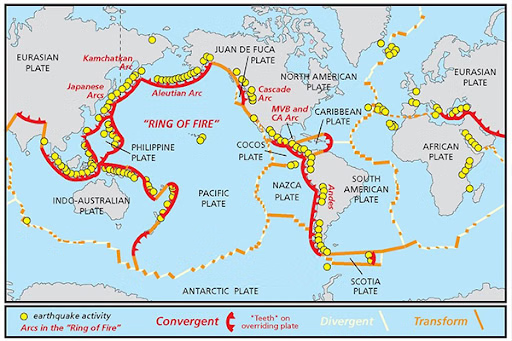
- The theory of plate tectonics proposes that the earth’s lithosphere is divided into seven major and some minor plates.
- The Pacific plate is mostly oceanic, whereas the Eurasian plate is continental.
- The seven major plates are African, Antarctic, Eurasian, Indo-Australian, North American, Pacific, and South American.
- Young fold mountain ridges, oceanic trenches, and/or transform faults surround the major plates.
- These plates are floating over the semi-molten asthenosphere.
Antarctic Plate
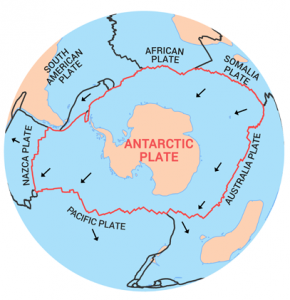
- One of the seven major plate tectonic borders on the planet is the Antarctic Plate. It is slightly smaller than the African Plate in terms of size.
- The Antarctic Plate encompasses not just the entire continent of Antarctica, but also the majority of the water surrounding it.
- The South American Plate, the Indo-Australian Plate, the African Plate, and the Pacific Plate all border it.
- The Antarctic Plate moves at a glacial rate over time. The Antarctic Plate, for example, shifts around a centimeter every year on average.
- Antarctica used to be part of the supercontinent Gondwana, which also included Australia and India. However, Antarctica broke away some 100 million years ago, resulting in its current icy location at the south pole.
- The Antarctic Plate, which lies at the bottom of the Southern Hemisphere, also encompasses the entire continent of Antarctica.