
Introduction
A Market is a place where the exchange of goods takes place. The market is the nervous system of modern economic life where producers and consumers carry out the sale and purchase transactions. The market has a different and wider meaning in economics, as it does not refer to a specific place. In Economics, a Market is a region where the buyers and sellers don’t have to assemble at a specific place for the sale and purchase of goods. Instead, they have to be in contact with each other through any communication means, such as the internet, letters, mail, telephone, etc.
Market refers to the whole region where buyers and sellers of a commodity are in contact with each other for the purchase and sale of the commodity.
- Markets can exhibit different structures based on the number of buyers and sellers and the degree of competition. Common structures include perfect competition, monopolistic competition, oligopoly, and monopoly.
- Markets are driven by the forces of supply and demand. Sellers provide goods or services, while buyers demand them.
- In a competitive market, equilibrium occurs when the quantity supplied equals the quantity demanded at a specific price, known as the equilibrium price.
- Markets are considered efficient when they allocate resources to their most valued uses.
Essentials or Characteristics of a Market
- Area: In economics, a market is not related to a specific place, instead, it spreads over an area that becomes the point of contact between the producers/sellers and consumers/buyers. With the advancement of technology and modern means of communication, the market area of a product has become wide.
- Commodity: In economics, a market is not related to a specific place but to a specific product. It means that a market can exist if there is one commodity that will be purchased and sold among the buyers/consumers and sellers/producers.
- Buyers and Sellers: Another characteristic of a market is the presence of buyers and sellers. The buyers and sellers must contact each other in the market. However, it does not mean that they should meet physically, the contact can be through modern means of communication, like the internet, mail, telephone, etc.
- Competition: For a market to exist, it is necessary that there is free competition amongst the buyers and sellers. The absence of competition in the market results in the charging of different prices for the homogeneous commodity by the sellers.
Market Structure
The number and types of firms operating in the industry and the nature and degree of competition in the market for the goods and services is known as Market Structure. To study and analyze the nature of different forms of market and issues faced by them while buying and selling goods and services, economists have classified the market in different ways.
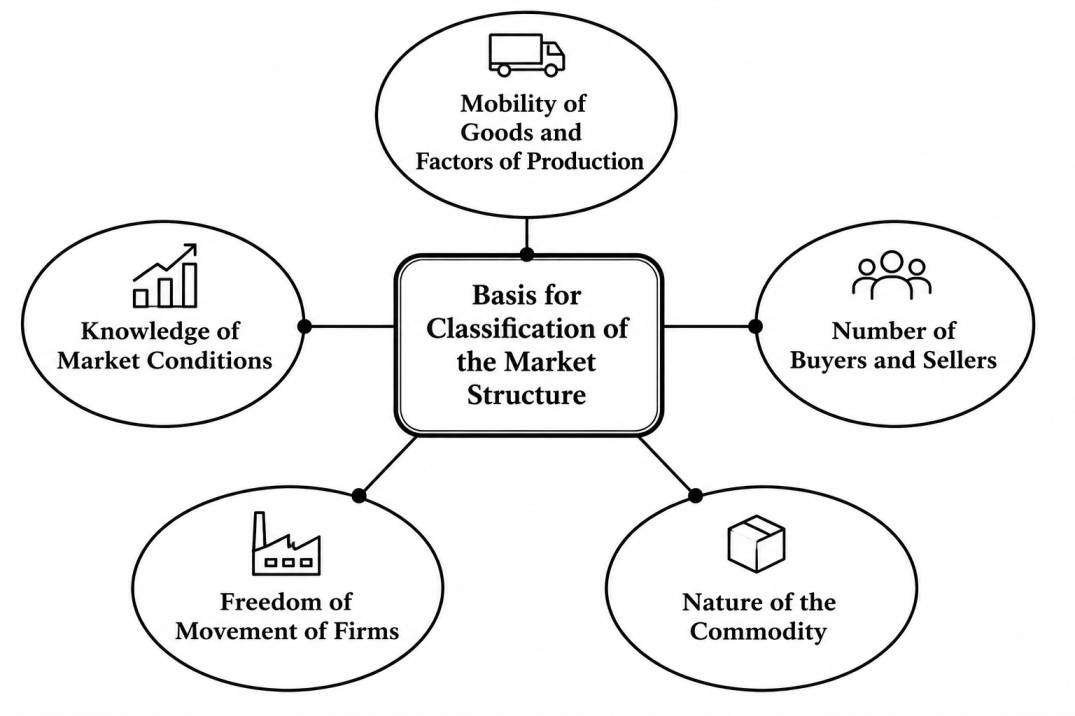
Basis for Classification of the Market Structure
The factors determining the market structure are as follows:
- Number of Buyers and Sellers: The volume/number of buyers and sellers in the market of a commodity exercises a great influence on the price of a commodity. If there are a large number of buyers and sellers in the market, then a single buyer or seller cannot influence the price of a commodity. However, if there is one seller of a commodity, such as Railways, then the seller has great control over its price.
- Nature of the Commodity: The nature of the commodity has a great impact on the price of the commodity. If a commodity is homogeneous in nature (identical goods such as pen, paper, etc.), then it is sold at a uniform price in the market. If a commodity is heterogeneous in nature (non-identical, totally different goods, such as different toothpaste brands, etc.), then it may be sold at different prices. However, commodities with no close substitutes, such as Railways can charge a higher price from the buyers.
- Freedom of Movement of Firms: Freedom in entry and exit of firms results in price stability in the market. However, restrictions on the entry of new firms or exit of the existing ones can lead to the firms influencing the price of goods and services, as they have no fear of competition from other existing or new firms.
- Knowledge of Market Conditions: If the buyers and sellers are aware of the market conditions and have full knowledge about them, then the uniform price of goods and services prevails in the market. Whereas, if the buyers and sellers are unaware of the market conditions, then sellers are in a position to charge their customers different prices.
- Mobility of Goods and Factors of Production: Free movement of factors of production from one place to another results in a uniform price in the market. However, if the movement of factors of production is not free, then the prices may differ from each other.
Forms of Market Structure
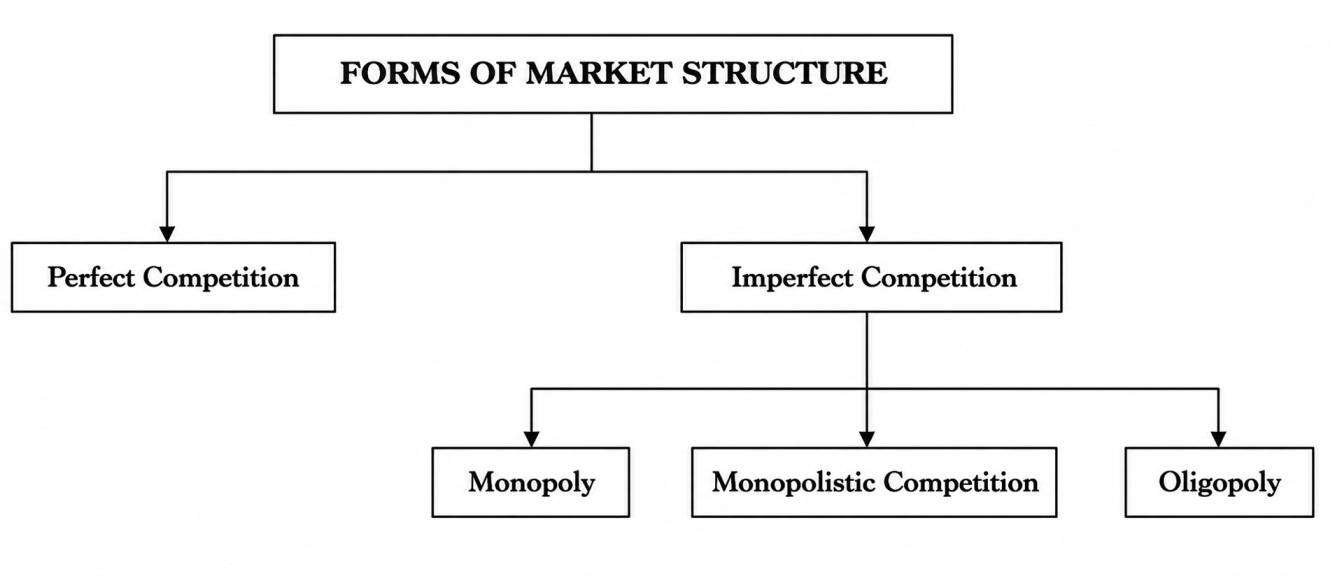
The different forms of market structure are Perfect Competition and Imperfect Competition (Monopoly, Monopolistic Competition, and Oligopoly).
Perfect Competition
A market situation where a large number of buyers and sellers deal in a homogeneous product at a fixed price set by the market is known as Perfect Competition. Homogeneous goods are goods of similar shape, size, quality, etc. In other words, in a perfect competitive market, the sellers sell homogeneous products at a fixed price determined by the industry, not by a single firm. In the real world, the situation of perfect competition does not exist; however, the closest example of a perfect competition market is agricultural goods sold by the farmers. Goods like wheat, sugarcane, etc., are homogeneous in nature and their price is influenced by the market.
Key Features:
The key features of perfect competition include a large number of sellers, identical products, perfect knowledge, and zero entry barriers.
- Sellers/Buyers: Very many small firms & buyers
- Product: Homogeneous (identical)
- Price Power: Price taker (P = MR = AR)
- Entry/Exit: Free, negligible barriers
- Information: Perfect information
- Profit: Supernormal profit only in short run; normal profit in long run
- Efficiency: Allocative & productive efficiency in long run
- Examples: Agricultural markets, commodity exchanges
Advantages:
- Cheap Prices to Consumers: Very, very strong competition results in market price being very low under no set pricing capability by firms, benefiting consumers.
- Resource Efficiency: In fact, firms are required to operate and get it within the point when price equals marginal cost (P = MC); afterward, it will generate allocative efficiency.
- Free Entry and Exit: Firms can freely enter or leave the market such that it exists as dynamic and flexible to demand changes.
- Consumer Sovereignty: Firms have no power on the price and all depend on consumer needs.
Disadvantages:
All the developments were made just for theorization because there are no profits in the long term, and products are homogeneous, so companies have no incentive to innovate or improve themselves for the simple reason there are no real profits built-in.
- Margins Are Really Thin: Keeping competitive forces firms on very little profits that are not going to last.
- No choice of product: All products are uniform; therefore, no choices in brand names, quality, or features are available to the consumers.
- Not Realistic in Today’s Markets: True perfect competition is rare in today’s condition; it is true that the most markets do not show any kind of differentiation or control.