
Introduction of Research
According to the renowned thinker Hudson Maxim, ‘All progress is born out of inquiry. Our doubts lead to inquiries, and an inquiry leads to an invention.’ It is important to understand that research is distinct from common sense, primarily in its procedures and methods. We are discussing research in a very pragmatic manner so that conceptual clarity helps in PhD-Fellowships admissions as well.
We acquire knowledge from various sources, and the process of knowledge acquisition has become increasingly rapid. There are five fundamental methods that gradually evolve into research-oriented approaches:
Intuition: This is our initial method of gaining knowledge, where we rely on our gut feelings, emotions, and instincts.
Authority: Accepting new ideas based on the endorsement of authoritative figures.
Rationalism: Utilizing logic and reasoning to gain new insights.
Empiricism: Acquiring knowledge through direct observation and personal experience.
Scientific Method: This systematic process involves collecting and evaluating evidence to test ideas and answer questions. The purest form of the scientific method is known as deduction, which will be discussed later under positivism.
Research is a structured investigation that employs accepted scientific methodology to solve problems and generate new universally applicable knowledge. The objective of research is to comprehend an object, phenomenon, or to address a problem.
The term ‘research’ is comprised of two words, ‘re’ and ‘search.’ ‘Re’ denotes repetition or revisiting, while ‘search’ signifies the act of finding out. Research, therefore, is a meticulous inquiry and exploration, particularly to unearth new facts within any field of knowledge.
As defined by Creswell, research is a process involving steps to collect and analyze information, ultimately enhancing our understanding of a specific topic or issue. In essence, research:
involves a process of inquiry and investigation.
is systematic and methodical.
expands our knowledge.
Cook offers a comprehensive perspective, defining research as a sincere, exhaustive, and intelligent search for facts and their meanings or implications in relation to a problem. According to him, ‘research’ can be broken down into the following key components:
R = Rational thinking
E = Expert and thorough treatment
S = Search and solution
E = Exactness
A = Analysis
R = Relationship of facts
C = Critical observation, careful planning, constructive attitude, and condensed generalization
H = Honesty and hard work
The scientific method entails systematic observation, classification, and interpretation of data. Research is fundamentally scientific in nature, emphasizing unbiased data evaluation. Even in social sciences, there is no room for unscientific approaches. A successful researcher must exhibit qualities such as diligence, open-mindedness, and critical thinking.
Understanding what constitutes a scientific method is crucial. According to the Random House Dictionary, the scientific method involves identifying a problem, collecting relevant data, formulating a hypothesis, and empirically testing it.
Research is akin to embarking on a journey, and it is imperative to have a clear understanding of its ultimate destination. While there is no fixed sequence of steps during this journey, researchers must navigate through multitude of methods, approaches, and procedures. The experience of the researcher plays a pivotal role in guiding actions towards achieving objectives.
Research can be conducted on a multitude of issues, including:
Investigating the emergence and global spread of the COVID-19 disease.
Identifying prevalent health conditions among rural students.
Tracing the evolution of the New Education Policy since independence.
Examining changes in students’ comprehension levels with varying teaching methods.
The possibilities for research questions are virtually limitless.
Some Basic Terms in Research
1. Research Paradigms:
These refer to overarching frameworks or worldviews that guide research methodologies and approaches. They include the philosophical assumptions, values, and beliefs that underpin research in a particular field. Examples are of positivism, post positivism, constructivism, cognitivism etc.
Here is how research paradigms work:
- Foundational Assumptions: Paradigms are built on foundational beliefs about the nature of reality and how we gain knowledge.
- Guidance: They provide direction for research and practical work in a field.
- Methodology: Paradigms come with specific methods and tools for data collection and analysis tailored to their beliefs.
There are three main types of research paradigms:
- Realism: This paradigm seeks to gather information from the external world or external sources.
- Constructivism: Here, the focus is on unique individual experiences, suggesting that nothing important exists outside of these personal experiences.
- Pragmatism: Pragmatism acknowledges that both realism and constructivism are valid ways to understand the world, offering two alternative perspectives.
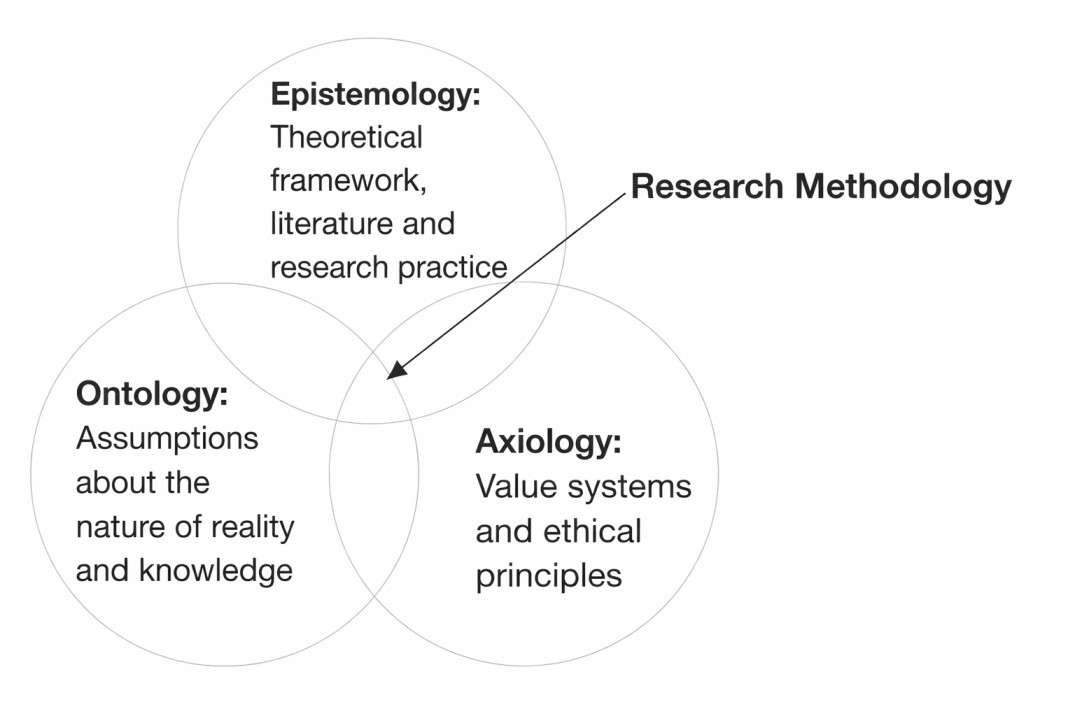
2. Epistemology:
This term was first used by Fredrick Ferrier. This branch of philosophy that deals with the nature of knowledge, how knowledge is acquired, and what constitutes knowledge. It explores questions about the sources, limits, and validity of knowledge.
Rationalism and Empiricism are two ways of looking at how do we gain knowledge:
(a) Rationalism: This believes in the power of logic and reason. René Descartes argue that some knowledge is innate and derived from reason. Rationalism places the mind above the senses, using logic and reason before actual experience to draw conclusions. Think of it as ‘thinking before experiencing.’ Rationalism is closely tied to deduction, where you start with general principles and derive specific conclusions from them.
(b) Empiricism: John Locke argues that knowledge comes primarily from sensory experience which are the foundation of knowledge. It argues that all knowledge comes from our senses, and without these sensory experiences, we wouldn’t have any knowledge at all. This approach is known as ‘learning from experience’ or ‘seeing is believing.’ Empiricism is associated with induction, where you draw general conclusions based on specific observations.
3. Metaphysics:
Metaphysics is the branch of philosophy that explores fundamental questions about the nature of reality, existence, and the relationship between the mind and the external world. Metaphysics deals with abstract concepts such as time, space, causation, and existence.
4. Ontology:
Ontology is a subfield of metaphysics that specifically deals with the study of being and existence. Ontology seeks to answer questions about what entities or categories of things exist in the world and what their fundamental nature is.
Metaphysics and Ontology closely related. Metaphysics is concerned with the broad questions about the nature of reality, while ontology is concerned with the specific questions about what exists and what the fundamental nature of things is.
5. Axiology:
Axiology is the branch of philosophy that deals with values, ethics, and aesthetics. It explores questions about what is morally right or wrong, what is beautiful or ugly, and what constitutes good or bad. For example, here, we study about utilitarianism that maximizes our overall happiness.
6. Theory:
A theory is a systematic and coherent set of principles or ideas used to explain phenomena or make predictions. Theories provide frameworks for understanding the world and guide research and inquiry. For example, in psychology, Sigmund Freud’s psychoanalytic theory says that human behaviour is influenced by unconscious drives and conflicts.
Research methodology emerges as a result of combining epistemology, ontology and axiology. As we discuss, research methodology is the process of designing and conducting research. It is concerned with the questions of how to generate knowledge, how to test hypotheses, and how to interpret findings.
Positivism and Post-Positivism
First, we need to have a historical perspective on research:
- Research has roots in ancient civilizations such as the Greeks, Egyptians, Chinese. In ancient Bharat, research took place in Mathematics (courtesy Aryabhatta, Brahmagupta, Bhaskara II), Astronomy, Astrology, Philosophy, Yoga, Meditation, etc. The book Charak Samhita (traditional Indian medicine system) might have been written as a result of empirical observation and experimentation.
- During the Middle Ages and the Renaissance, Leonardo da Vinci and Galileo Galilei emphasized systematic observation and experimentation, setting the stage for the development of modern scientific methods.
- During the Enlightenment era of the 17th and 18th centuries, Francis Bacon and John Locke championed empiricism and reason.
Positivism
Positivism had origins in the natural sciences but was extended to the social sciences, such as sociology, economics, psychology, etc. French philosopher Auguste Comte (1798–1857) is supposed to be the first person to apply positivist principles in a systematic manner to the study of society. In that way, he challenged the view that society was governed by divine or supernatural forces. His work paved the way for theories on social development and social change. Other sociologists used empirical data and scientific methods for better understanding and solving social problems.
Key features of positivism include:
- Emphasis on science: Positivists apply scientific observation and experimentation in social sciences as was being done in natural sciences. This includes hypotheses, sampling, measurements, analysis, and drawing conclusions. All these are guided by empiricism, objectivity, and value neutrality. To be scientific, we must first be systematic.
- Objectivity: Positivists hold that the world can be studied objectively, free from personal biases or values. Researchers act as objective data collectors and interpreters, minimizing interaction with participants and emphasizing quantifiable observations.
- Empiricism: Positivists stress the importance of basing knowledge on empirical evidence, which means collecting data through observation and experimentation.
- Reductionism: Positivists believe that complex phenomena can be broken down into their simplest components, allowing their study using the scientific method. The data is quantifiable.
Overall, positivism’s ontology is realist, and its epistemology is objectivist, emphasizing factual knowledge through observation. The deductive approach is preferable, with less scope for alternative methods.
Post-Positivism
The focus on objectivity and quantitative methods in positivism was gradually acknowledged as a limitation.
To counter this limitation, post-positivism emerged as an alternative approach. Researchers began to acknowledge the role of subjectivity, context, and interpretation in research, especially in the social sciences. They often use qualitative research methods, critical theory, and a more nuanced understanding of the social world.
Key features of post-positivism:
- Recognition of subjectivity: Researchers recognize that they are not completely objective and that their experiences and biases influence research. They strive for transparency and minimize bias.
- Emphasis on context: The social world is complex, and findings may not be generalizable across contexts.
- Use of qualitative methods: Methods such as interviews, focus groups, and ethnography help understand experiences and perspectives in depth.
- Use of critical theory: Research is used to examine power imbalances and promote social change.
Post-positivism allows researchers to explore complex social phenomena in a way that is both rigorous and nuanced. It is especially useful for studying marginalized or overlooked groups.
Difference of ‘Reality’ and ‘Critical Reality’:
Positivism assumes a single objective reality independent of human minds.
Post-positivism promotes critical thinking and accepts that knowledge is always evolving and context-dependent.
Mixed Research:
Positivism and post-positivism can be applied together, known as a mixed-methods approach.
Example:
- Positivism → quantitative surveys and statistical analysis
- Post-positivism → qualitative interviews and thematic analysis
There is a growing dominance of post-positivism today.