Research Tool: Data Collection
- Here, we are going to address the three essential questions in data collection—what, why, and how—along with its main types. Data collection is the systematic process of gathering, measuring, and analysing information using standard techniques. Its primary aim is to enable informed decision-making.
- In language studies, for example, collecting data about the number of speakers in a particular language group can guide policy makers. Decisions related to the preservation, dissemination, and education of Indian languages are often based on such systematically collected data.
There are two major types of data collection: quantitative and qualitative.
Quantitative data is numerical and measurable.
Qualitative data is descriptive, including not only text and words but also photographs, audio recordings, and video recordings.
The choice of data collection method depends on two key factors:
The nature, objective, purpose, and scope of the research design.
The time and resources available to the researcher.
Data can also be categorized as primary data (collected directly by the researcher) and secondary data (collected by others and consulted for research purposes).
Primary Data
- Primary data refers to data that is collected for the first time by a researcher. It is regarded as an original source of information because it is gathered directly for the specific purpose of the study. Primary data can be either quantitative (numerical) or qualitative (descriptive) in nature, depending on the objectives and design of the research.
Language Studies
- At present, the National Education Policy 2020 (NEP 2020) is being implemented. The policy emphasizes school education in Indian languages and/or mother tongues and promotes a bilingual mode of education at the undergraduate and postgraduate levels.
- If researchers aim to study language acquisition in children, speech samples serve as important primary data. Such data can be collected using either the observational method or the experimental method.
- In the observational method (also known as natural speech data collection), speech samples are gathered in a natural environment. Earlier, researchers relied on diary notes to record speech, but these were less reliable because aspects such as intonation, pronunciation, context, and structure could not be accurately verified.
- Today, speech samples can be recorded using digital audio or video recorders, which provide more reliable and permanent data. However, it is essential to obtain consent or permission from the speaker—or from schools and parents (in the case of children)—before making recordings. Audio and video recordings are valuable because they allow for data preservation and reanalysis or verification. While video recordings provide richer contextual information than audio recordings, an adult must be present when recording children.
- In the experimental method, researchers ask specific questions to a speaker and record their responses. The aim is to understand how a speaker produces speech patterns and comprehends the principles of language.
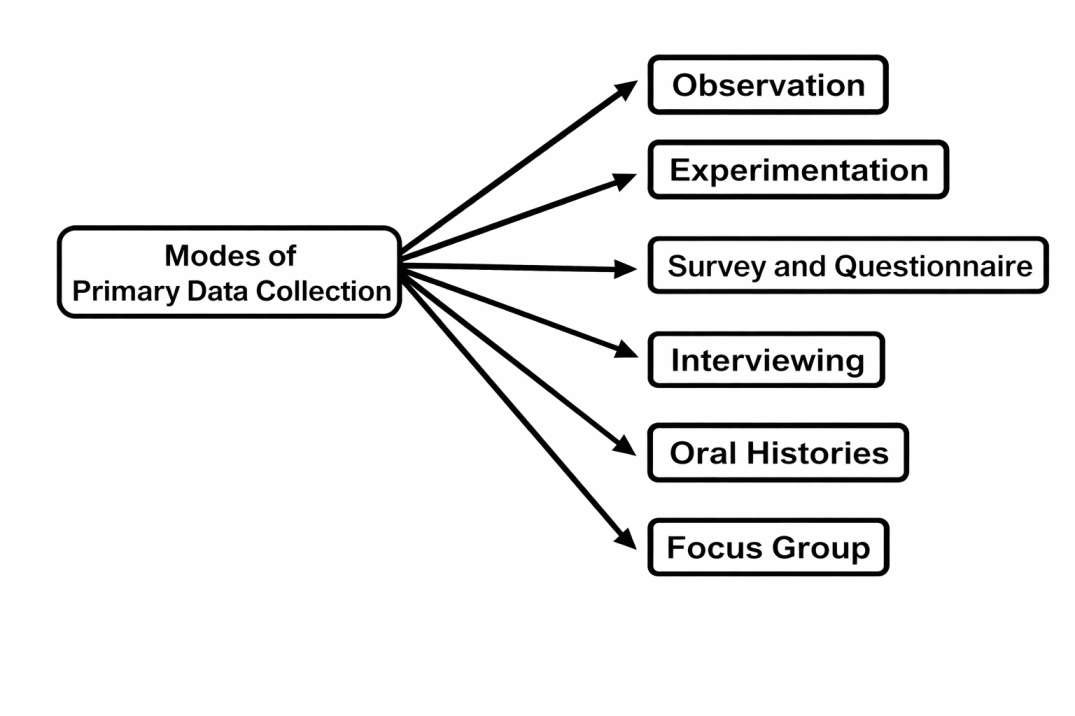
Modes of collecting Primary Data
The following mind map captures the different ways of collecting primary data in language studies: