
Reshaping India's Political Map
Class 8th
NCERT
Language
Choose your preferred language
Reshaping India’s Political Map
🎨 Reading Colors
Background
Text Color
Table of Contents
- Rise and Fall of the Delhi Sultanate
- The Vijayanagara Empire
- The Mughals
- Akbar
- Aurangzeb
- Resistance to the Mughals
- Surge of the Rajputs
- The Ahoms
- The Rise of the Sikhs
- Administering India
- People’s Lives
- A new era in India’s journey began in the early 11th century, when invasions from beyond the Hindu Kush mountains began to reshape India’s political map.
- Although India had experienced much warfare in earlier periods, the repeated invasions by people from outside the Indian subcontinent during this period were unprecedented in their scale and impact.
- Many of these invaders were Central Asian, especially Turkic or Afghan peoples.
- They were attracted to India for several reasons: her reputed riches, their own territorial ambitions, and often the desire to spread their versions of their religion, sometimes through force and violence.
- The chapter explores the ever-changing landscape of India from the 13th century onward, continuing into the next chapter.
- This period, along with the following one, is often described as the latter part of India’s medieval period.
- The term ‘medieval’ means “between two ages” and was originally used for European history, roughly from the fall of the Roman Empire in the 5th century CE to the Renaissance in the 14th–16th centuries.
- The Renaissance was Europe’s cultural revival, nurtured by the rediscovery of Greek and Roman art and literature.
- Medieval Europe was once believed to be a dark age before the rise of modern science, but this view is now considered too simple.
- Since Europe’s and India’s histories are very different, applying the same term ‘medieval’ to both is not ideal.
- Historians do not always agree on the exact period covered by the term ‘medieval’ in Indian history.
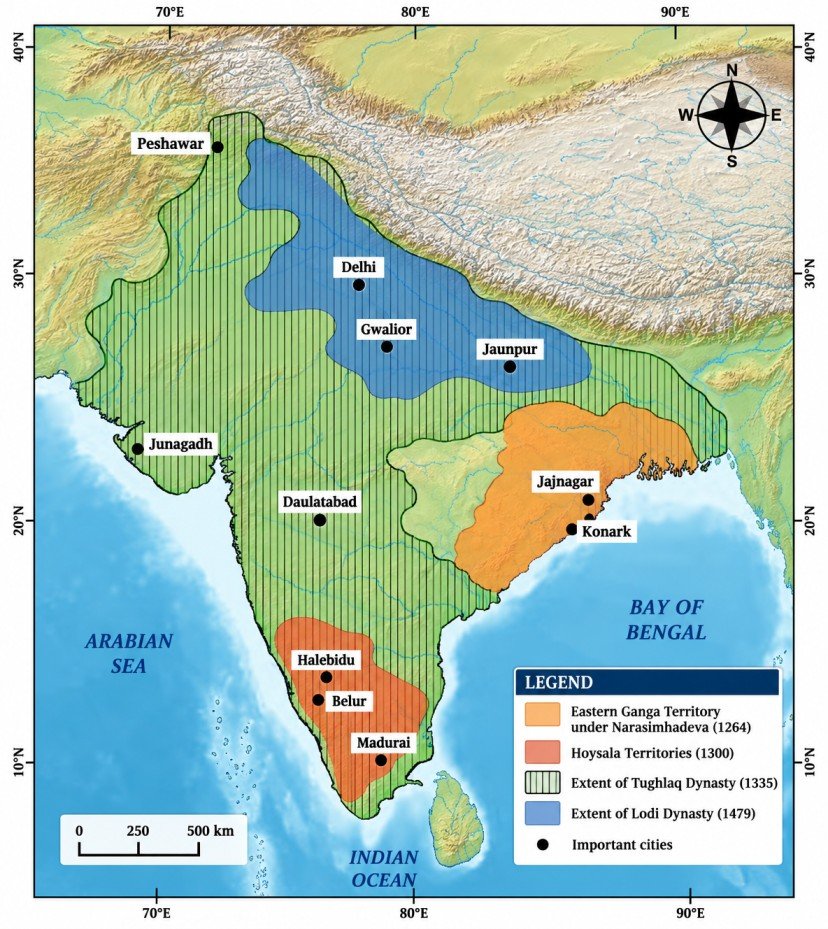
- A comparison of the territories under the Tughlaqs and the Lodis
(13th to 15th centuries), and regional powers in the south and east
Rise and Fall of the Delhi Sultanate
- The journey begins with the Delhi Sultanate, which was formed after the defeat of King Prithviraj Chauhan in 1192; he had ruled over parts of northwestern India.
- The Delhi Sultanate was ruled by five successive foreign dynasties of Turkic–Afghan origin: the Mamluks or ‘Slave dynasty’, the Khiljis or Khaljis, the Tughlaqs, the Sayyids, and the Lodis or Lodhis.
- Although certain parts of northern India came under the control of the Delhi Sultanate, neighbouring kingdoms such as the Eastern Gangas in the east and the Hoysalas in the south resisted its advance and became thriving centres of art, culture, and administration.
- The city of Delhi assumed a much larger role in the political landscape of northern India during the Sultanate period.
- The Sultanate period was marked by political instability combined with efforts at territorial expansion, leading to military campaigns that raided villages and cities, plundered and destroyed temples and seats of learning.
- Successions, meaning the appointments of new sultans, were often violent; almost two out of three sultans seized power by eliminating their predecessor, so a sultan’s average reign was hardly more than nine years.
- At the turn of the 14th century, Ala-ud-din Khilji conducted military campaigns over large areas of north and central India, sacking and plundering many cities, while also repelling several invasions by Mongol forces who wanted to add India to their vast empire, which covered most of Asia at that time.
- Ala-ud-din Khilji’s slave-general, Malik Kafur, expanded the Sultanate’s reach southward by conquering several kingdoms; the plundered wealth helped finance the Sultanate’s enormous military apparatus.
- Malik Kafur attacked several important Hindu centres, including Srirangam, Madurai, Chidambaram, and possibly Rameswaram.
- A few decades later, Muhammad bin Tughlaq ruled Delhi and expanded the Delhi Sultanate’s territories further; for the first time since the Mauryan Empire, most of the Subcontinent came under one ruler, though this dominance proved short-lived.
- Muhammad bin Tughlaq had ambitious schemes that were often poorly executed; one such scheme was shifting his capital from Delhi to Daulatabad, then called Devagiri, near present-day Sambhaji Nagar, possibly because its more central location seemed better for controlling the empire.
- People were forced to travel over 1,000 km during this capital shift, and a few years later, when the plan failed, Muhammad bin Tughlaq shifted the capital back to Delhi; according to some sources, both transfers caused a great loss of life.
- Another failed scheme was the introduction of ‘token currency’, in which cheap copper coins were declared to have the value of silver or gold coins; although this was a progressive idea, as most modern currency is also token currency, it created confusion in trade and encouraged counterfeiting, causing the economy to decline.
- The sultans and their court elite lived in luxurious palaces, enjoying elaborate clothing, jewelled ornaments, and fine food.
- Their wealth came mainly from plunder obtained during military campaigns, taxes levied on common people and conquered regions, and participation in the slave trade, as enslaved people provided free labour or were sent to distant Central Asia to be sold.
- However, plunder negatively affected trade networks and agricultural production.
- This period also witnessed numerous attacks on sacred or revered images in Buddhist, Jain, and Hindu temples; such destruction was motivated not only by plunder but also by iconoclasm, the opposition to religious images.
- Some sultans imposed the jizya, a tax on non-Muslim subjects, officially to grant them protection and exemption from military service.
- In practice, depending on the ruler, the jizya became a source of economic burden and public humiliation, and acted as a financial and social incentive for subjects to convert to Islam.
- At the end of the 14th century, Timur, a brutal Turkic–Mongol conqueror from Central Asia, invaded northwest India and launched a devastating attack on Delhi, then a thriving city.
- According to Timur’s memoirs, his two-fold objective was to wage “war with the infidels” and to gain wealth by plundering the infidels.
- Large numbers of people were killed or enslaved, and Delhi was left in ruins; Timur soon withdrew from India with huge plunder, leaving behind chaos.
- In the aftermath of Timur’s invasion, the Lodis emerged and established the last dynasty of the Delhi Sultanate.
- By this time, the Sultanate’s territory had shrunk considerably because of increasing resistance from other states and kingdoms within India.