
Subject resourcesQuick Links
Rise of Ancient Indian Empire
(Detailed Notes)
Ancient History of India
CUET PG HISTORY
Language
Choose your preferred language
Rise of Ancient Indian Empire
🎨 Reading Colors
Background
Text Color
Table of Contents
- Magadha Empire
- Haryanka dynasty
- Bimbisara (558 BC – 491 BC)
- Ajatashatru (492-460 B.C)
- Sisunaga Dynasty
- Sisunaga
- Kalasoka
- Nanda Dynasty
- Mahapadma Nanda
- Dhana Nanda
- Causes of Rise
- Conclusion
Magadha was an ancient Indian kingdom located in what is now west-central Bihar state in northeastern India. Between the sixth and eighth centuries BCE, it served as the foundation for numerous bigger kingdoms or empires. Magadha's early prominence can be explained by its strategic location in the Ganges (Ganga) River valley, which allowed it to dominate communication and trade on the river.
Magadha Empire
- Over time, the Magadha Empire was ruled by three dynasties: the Haryanka Dynasty, the Shishunaga Dynasty, and the Nanda Dynasty.
- The Magadha Empire is thought to have existed from 684 BCE to 320 BCE.
- From the sixth to the fourth centuries BCE, the four Mahajanapadas - Magadha, Kosala, Avanti, and Vatsa – vied for power.
- Finally, Magadha emerged triumphant and gained statehood. It rose to supremacy as the most powerful state in ancient India.
- Magadha is located in modern-day Bihar.
- Jarasandha, a descendant of Brihadratha, established the empire in Magadha, mentioned in the Mahabharata.
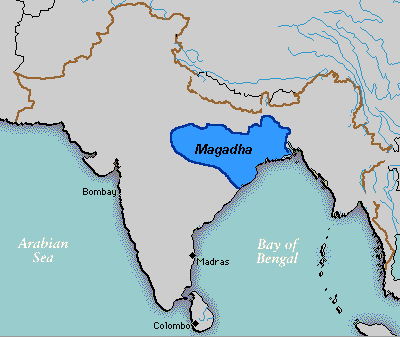
Magadha empire