

The rural economy continues to be the Achilles Heel of the Indian economy, as overall economic growth has not been matched by rural development, a problem recognised early, leading to land reforms, rural poverty alleviation programmes, and agrarian-focused policies.
To address food insecurity and low agrarian incomes, the Green Revolution was launched in the 1960s, yet despite these interventions, results were mixed, a large population remains dependent on agriculture, sub-optimal labour use persists, and rural distress and migration continue.
Within planned development, rural and agrarian transformation became central since India was a predominantly agrarian economy, focusing on improving rural living standards, enhancing agricultural productivity, reducing rural poverty, improving education and health, and redistributing land.
In the first two decades after independence, agricultural growth was achieved mainly by expanding cultivated area, land reforms, and scientific interventions supported by public investment in infrastructure, but benefits accrued largely to a small, privileged minority, deepening rural inequality.
By the 1970s, it became evident that top-down approaches to agrarian development and the Green Revolution model had serious shortcomings, prompting a rethinking of rural development strategies.
The emerging agenda of rural transformation prioritised improving living standards through assured food, shelter, clothing, employment and education, recognising these as foundational to inclusive rural growth.
A key focus became people’s participation in planning and decision-making through decentralisation of administration, shifting away from purely centralised development models.
Raising rural productivity and reducing poverty were identified as core objectives to ensure sustainable agrarian and non-agrarian livelihoods.
Ensuring distributive justice and equalisation of opportunities was recognised as essential to correct entrenched rural inequalities.
Agricultural reforms aimed at introducing new agrarian practices, innovation, and de-crowding the over-burdened agriculture sector were emphasised to diversify rural employment.
Overcoming structural barriers like caste, class and gender inequalities was acknowledged as necessary for achieving meaningful and lasting rural transformation.
Programs of Rural Development
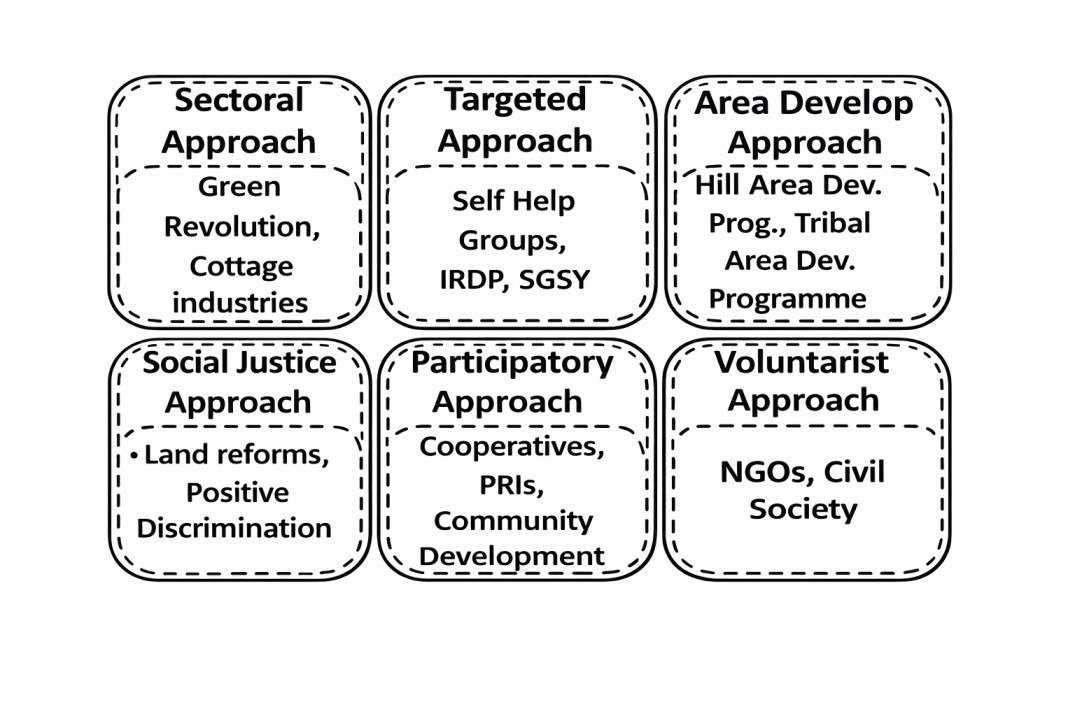
Rural development has always been a top priority for the Government of India because a majority of the population lived in rural areas, it was crucial for food security, for achieving socio-economic equality as envisioned in the Constitution, for reducing urban–rural disparities, checking migration, and ensuring a decent standard of living in villages.
Even in recent times, rural development remains a major planning concern as earlier strategies proved largely ineffective in reducing rural poverty and inequality, top-down approaches failed, and therefore current programs emphasise people’s participation.
The broad objectives of rural development include enhancing agricultural productivity, creation of basic infrastructure, reduction of inequality, development of rural leadership, reducing pressure on cities, checking rural–urban migration, improving rural ecology and environment, addressing unemployment, promoting community participation, empowering women and depressed classes, ensuring distributive justice and equalisation of opportunities, and improving the overall standard of living.
Rural development programs consist of multiple interlinked projects that simultaneously influence economic and social life, cover a large geographical and population base, are complex to implement due to scale, and therefore require an integrated, multi-pronged approach.
The Community Development Programme (1950s) focused on popular participation and rural infrastructure creation with active involvement of local communities.
National Extension Services aimed at delivering agricultural extension, improving farm practices, increasing agricultural output, and raising rural incomes.
The Cooperative Movement sought to create collective strength and synergy, with Amul emerging as a pioneer and model institution.
Panchayati Raj Institutions were visualised as instruments of local self-governance, grassroots leadership development, and political transformation, and became effective after the 73rd Constitutional Amendment.
The Green Revolution aimed at national food security and higher agricultural productivity and incomes, though in hindsight it delivered mixed outcomes.
The idea of Integrated Rural Development emerged to address the need for a comprehensive and coordinated planning approach, recognising that different aspects of rural life are interrelated and cannot be treated in isolation.
In addition to major programs, several specific schemes were launched, including National Literacy Mission, Swachh Bharat Mission, Drought Prone Areas Programme (DPAP), Integrated Watershed Development Programme, Swarnjayanti Gram Swarojgar Yojana, MNREGS for rural employment, Minimum Support Price to support farmers, Pradhan Mantri Gram Sadak Yojana for rural connectivity, and Backward Regions Grant Fund for development of underdeveloped regions.