Shaping of the Earth's Surface
Chapter 2 | Class 9th
NCERT
Language
Choose your preferred language
Shaping of the Earth’s Surface
🎨 Reading Colors
Background
Text Color
Table of Contents
- Plate Tectonics
- Process of Weathering and Erosion
- Agents of Gradation
- Running Water
- Waves and Currents
- Glaciers
- Wind
- Underground Water
- Landforms and Disasters
- Landslides
- Avalanches
- GLOFs
- Dust Storms
- The Earth’s surface is not consistent; it is constantly being transformed by powerful forces acting from within the planet and on its surface.
- One of the most important ideas explaining these changes is the theory of plate tectonics, which describes how large pieces of the Earth’s crust move slowly over the molten mantle.
- The movement of these plates gives rise to various landforms such as mountains, volcanoes, plains, and valleys.
- Understanding plate tectonics and landforms helps us explain natural phenomena like earthquakes, volcanic eruptions, and the formation of continents and oceans.
- This knowledge allows us to better appreciate the dynamic nature of the Earth.
Plate Tectonics
- The Earth’s Interior
- Plate tectonics is an important theory of earth science, given by W.J. Morgan, that explains the movement of the Earth’s crust.
- According to this theory, the outermost layer of the Earth is not one single piece but is broken into several large and small pieces called tectonic plates.
- These plates move slowly over the semi-molten layer beneath them and are responsible for major physical features and natural phenomena such as mountains, earthquakes, and volcanoes.
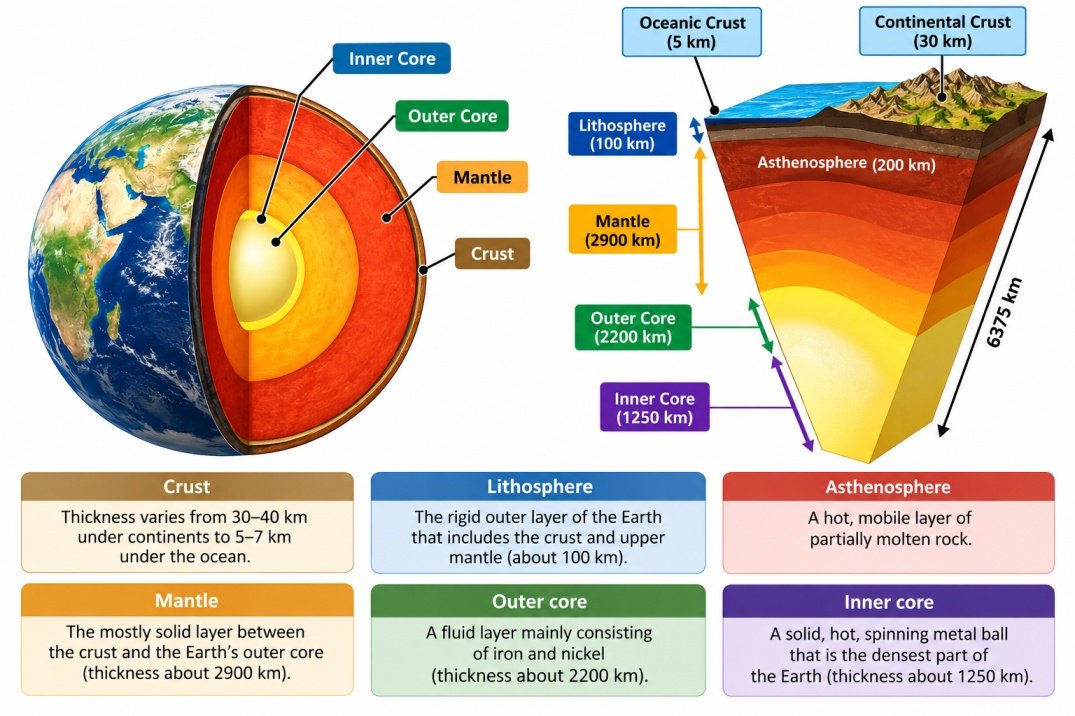
- The Earth is made up of three main layers: the crust, the mantle, and the core.
- The crust is the outermost layer on which we live; the mantle lies below the crust and is very thick and hot; the core is the innermost layer and is extremely hot and heavy.
- The crust along with the upper part of the mantle forms the lithosphere, which is broken into different tectonic plates.
- Beneath the lithosphere lies the asthenosphere, which is semi-molten and allows the plates to move.
- Tectonic plates are massive slabs of solid rock that move very slowly, usually a few centimetres per year.
- There are three main types of tectonic plates: continental plates, which carry continents; oceanic plates, which carry ocean floors; and mixed plates, which carry both continents and oceans.
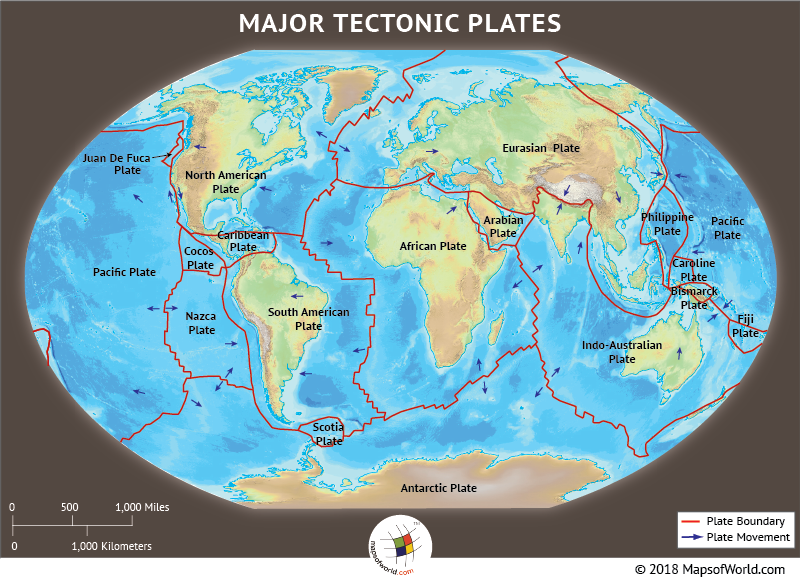
- Some major tectonic plates of the world are the Pacific Plate, Eurasian Plate, African Plate, North American Plate, South American Plate, Indo-Australian Plate, and Antarctic Plate.
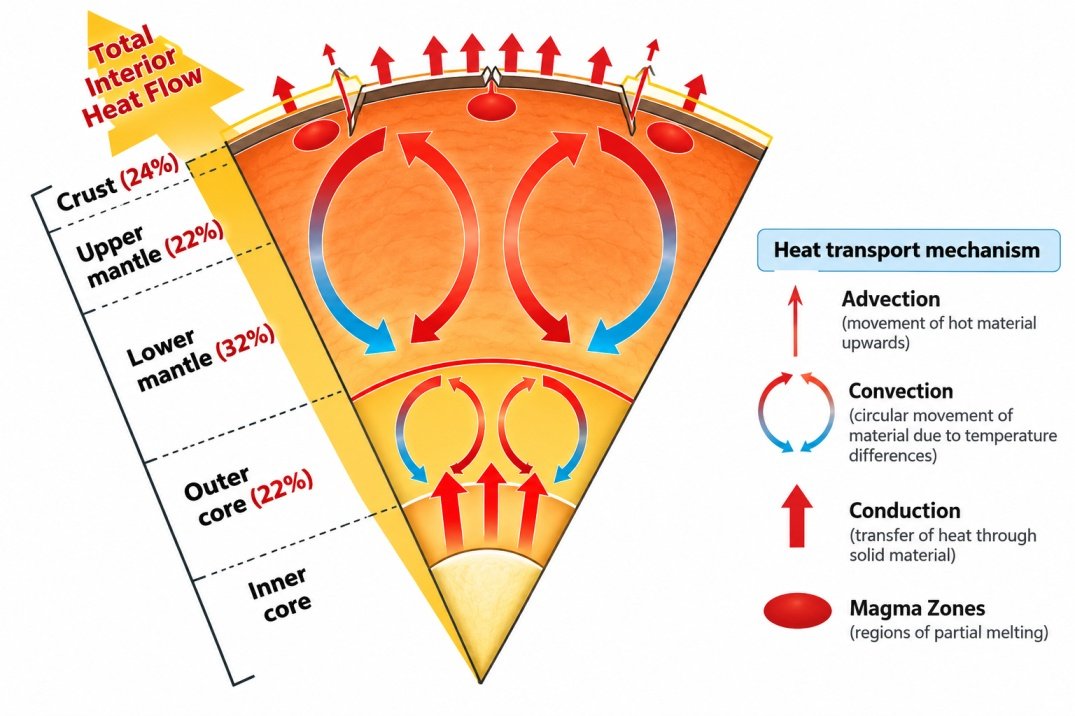
- The movement of tectonic plates is caused by convection currents in the mantle, where heat from the Earth’s core causes molten material to rise and cooler material to sink.
- This continuous movement creates convection currents that push and pull the tectonic plates, causing them to move in different directions.
- The edges where tectonic plates meet are called plate boundaries, and there are three main types: convergent, divergent, and transform boundaries.
- At a convergent boundary, two plates move towards each other; when continental plates collide, they form fold mountains such as the Himalaya.
- When an oceanic plate collides with a continental plate, the oceanic plate sinks beneath the continental plate, leading to volcanic activity and earthquakes.
- At a divergent boundary, plates move away from each other; magma rises from below and forms new crust, creating features such as mid-ocean ridges, for example the Mid-Atlantic Ridge.
- At a transform boundary, plates slide past each other without creating or destroying crust, and this movement mainly causes earthquakes, such as along the San Andreas Fault in the United States.
- Plate tectonics plays a major role in shaping the Earth’s surface by leading to the formation of mountains, valleys, ocean basins, volcanoes, and earthquakes.
- It also explains the distribution of continents and oceans across the Earth.
- Most earthquakes and volcanoes occur along plate boundaries, especially around the Pacific Ocean, an area known as the Ring of Fire.
- The theory of plate tectonics helps us understand how the Earth’s surface is constantly changing, explains the origin of many landforms and natural disasters, and is important for identifying earthquake- and volcano-prone regions and managing disasters arising from them.
- Movement of Material Below the Crust