INTRODUCTION
Keynes developed his theory of income and employment during the Great Depression of the 1930s, when unemployment reached nearly 25% in advanced capitalist economies like United Kingdom and United States, and his approach gained prominence in the 1950s–60s when inflation was modest (2–3% annually) but unemployment remained a major policy concern.
Keynesian economics emphasised management of aggregate demand through fiscal and monetary policies: increasing aggregate expenditure to reduce unemployment during recessions, and decreasing expenditure to control inflation during periods of high price rise, assuming inflation and unemployment did not occur simultaneously.
In the 1960s, the Phillips Curve suggested an inverse relationship between inflation and unemployment, implying that low unemployment came at the cost of higher inflation and vice versa, creating a policy dilemma; Keynesians supported achieving a socially acceptable short-run trade-off, while monetarists led by Milton Friedman advocated slow money supply growth to control inflation and relied on free labour market adjustments to reduce unemployment.
This consensus collapsed in the 1970s with the emergence of stagflation, especially in the United States and United Kingdom, where high inflation and high unemployment occurred together, a situation Keynesian demand-management policies could not address effectively because reducing demand to curb inflation worsened unemployment, and expanding demand to cut unemployment intensified inflation.
The simultaneous failure of Keynesian and monetarist prescriptions to solve stagflation led to doubts about demand-side economics and initiated the search for alternative approaches, giving rise to supply-side economics, which focuses on managing aggregate supply rather than demand to combat the twin problems of inflation and stagnation.
STAGFLATION
Stagflation refers to a situation where a high rate of inflation exists simultaneously with a high rate of unemployment, implying a reduced level of real GNP along with rising prices.
The term gained prominence in the 1970s when developed economies faced severe supply shocks, particularly after the 1973 oil crisis when Organization of the Petroleum Exporting Countries (OPEC) raised oil prices nearly fourfold, sharply increasing production costs worldwide.
In the United States (1973–75), higher fuel and petroleum costs led to a surge in manufactured goods prices, pushing inflation above 12% in 1974, while a severe recession—the worst since the 1930s—caused real GNP to decline and unemployment to rise to nearly 9%, marking a clear phase of stagflation.
Similar simultaneous high inflation and unemployment were observed in other developed free-market economies such as United Kingdom, France and Germany; recovery began around 1975 with rising GNP, falling unemployment, and inflation moderating to 5–7%.
A second oil shock occurred in 1979 following the Iranian Revolution, which disrupted global oil supplies and led Organization of the Petroleum Exporting Countries to double oil prices again, resulting in renewed stagflation during 1979–81, with real GNP falling sharply and inflation exceeding 10% in major developed economies.
India was also affected by the oil price shocks of 1973 and 1979, experiencing cost-push inflation; however, it did not face full stagflation as understood in developed economies, partly because increased public investment from 1974 stimulated economic growth and prevented prolonged stagnation.
Causes of Stagflation
Different explanations have been offered for stagflation, and its causes in India (1991–94) differed from those in developed capitalist economies such as United States and United Kingdom during 1973–75 and 1979–81, where the primary reason was severe adverse supply shocks.
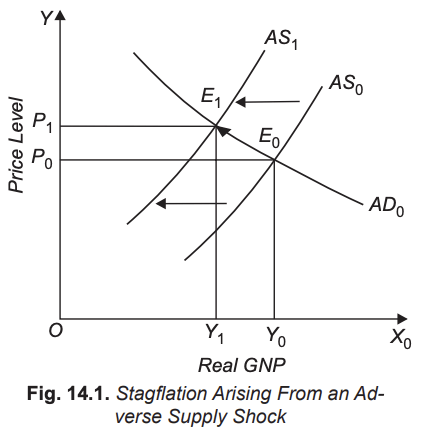
The most significant supply shocks in the 1970s and early 1980s were oil price hikes by Organization of the Petroleum Exporting Countries following the 1973 Arab-Israel war and the 1979 Iranian Revolution, which sharply increased energy costs, raised unit production costs, shifted the aggregate supply curve leftward, reduced GNP, increased unemployment, and simultaneously pushed up the price level, thereby generating cost-push inflation with recession.
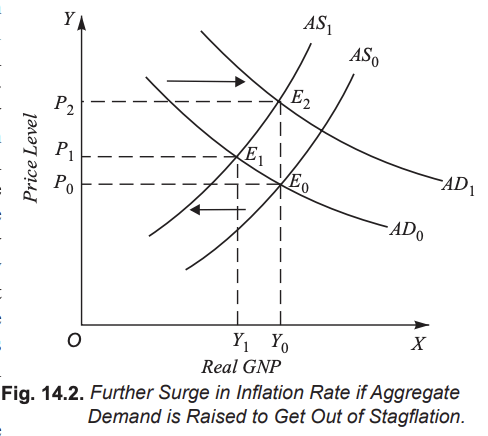
In aggregate supply–demand terms, with aggregate demand unchanged, a leftward shift of the supply curve raised prices and lowered output; if governments attempted to counter recession through expansionary fiscal and monetary policies to boost aggregate demand, output could return to its original level but at the cost of even higher inflation, showing that demand management alone was inadequate to solve stagflation.
Besides oil shocks, other supply disturbances contributed to stagflation in the United States, including shortages of agricultural products due to large exports to Asia and the Soviet Union after poor harvests (1972–73), which reduced domestic supply, raised raw material costs for food and fibre industries, increased prices, and shifted aggregate supply leftward; similar cost pressures from agricultural price rises have also affected India.
Additional shocks in the USA included depreciation of the dollar (raising import prices and production costs where imports were inputs), removal of earlier wage and price controls (leading to higher wages and product prices), and rising production costs, all of which reinforced the leftward shift of aggregate supply and intensified stagflation.
Inflationary expectations further aggravated stagflation, particularly in the USA, where heavy military expenditure on the Vietnam War in the late 1960s fuelled persistent inflation; expecting continued price rises, workers demanded higher wages, firms conceded, unit costs increased, and the aggregate supply curve shifted left again, sustaining the combination of high inflation and high unemployment.