
State and Society upto 1000 CE
Chapter 5 | Class 9th
NCERT
Language
Choose your preferred language
State and Society upto 1000 CE
🎨 Reading Colors
Background
Text Color
Table of Contents
- Understanding Early Indian State and Society
- State and Administration
- Political Institutions in the Vedic Period
- Duties and Ideals of the King
- Council of Ministers
- How Were Empires Administered?
- Ethics: The Foundation of Law and Life
- Social Structures and Everyday Life
- Varṇa and Jāti
- Family and Society
- Role of Women
- Religious Life and the Emergence of Bhakti
- The Quest for Knowledge
- Economy
- Agriculture and Land Revenue
- Irrigation
- Trade: Trade Routes and Ports
- Guilds
- Guilds as Financial Institutions
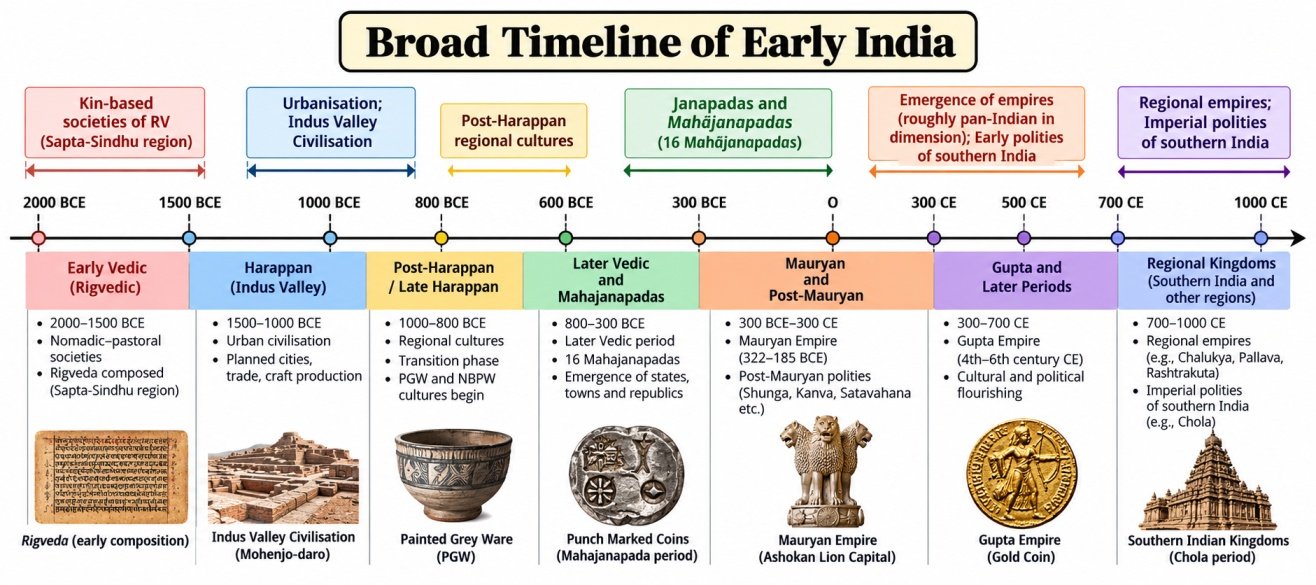
Understanding Early Indian State and Society
- Whenever large groups of people live together, certain rules and shared norms evolve over time to maintain order and harmony; these rules and norms bind different social groups into a unified whole, forming a ‘system’ that helps organise and govern people effectively.
- From early times, Indian society developed several systems of organisation based on existing customs, traditions, and agreed practices.
- A society may be understood as a system of social relationships among individuals who share a common territory, culture, and a shared sense of belonging.
- Society consists of structural units such as families or households, institutions such as marriage, and customs that provide a framework for individual and social life.
- Most importantly, society is primarily regulated by customs and practices rather than formal laws.
- A State refers to an organised political system based on rules and laws; it includes well-defined rights and duties of rulers and subjects, mechanisms of governance, and institutions for enforcing law and order.
- From a historical perspective, such political systems developed gradually as societies became larger and more complex.
- By studying early historical sources, historians attempt to understand how forms of governance and political authority evolved over time.
- Against this background, the evolution of the state and society in India can be explored beginning with the Vedic period.
State and Administration
The Vedic Period:
- The Vedic Period is understood mainly through the four Vedas, which are among the earliest texts of India and are regarded as foundational to Indian culture and traditions due to the continuity of cultural practices.
- Vedic texts are used by historians and scholars to learn about the times and geographies in which they were composed; for instance, the earliest sections of the Ṛigveda were composed in the region known as Sapta–Sindhu, including the Indus River, its five tributaries, and the Sarasvatī.
- Vedic texts are also studied to gain insights into the lives of people, social structures, political systems, economic pursuits, and religious practices.
The Four Vedas:
| Veda | Main Features |
|---|---|
| Rigveda | The earliest Veda, containing some of the world’s oldest-surviving poetic compositions; it consists of 1,028 hymns (sūktas), some in praise of various deities, while others reflect on universal thoughts such as creation and cessation, birth and death, and so on. |
| Yajurveda | Elaborates the performative aspects of yajnās and the hymns referred to in the Rigveda; it includes explanations in prose. |
| Sāmaveda | Comprises hymns drawn from the Rigveda, carefully arranged for musical recitation; its chanting tradition forms an important foundation for the system of the seven svaras (notes) that lie at the heart of Indian music. |
| Atharvaveda | Contains a wide range of hymns, some intended to ward off evil, and others related to the treatment of physical and mental ailments. |
Four Parts of Each Veda:
| Part | Description |
|---|---|
| Samhitā | Primarily contains hymns used for invoking the deity and for offering oblations in the yajña. |
| Brāhmaṇa | Composed in prose, these texts offer explanations for ritual performances. |
| Āranyaka | The word aranya means forest; these texts expand on the philosophical speculations of sages living in forests. |
| Upanishad | These texts delve into issues like the Self (Atman) and the Ultimate Universal Being (Brāhman). |
- It is important to note that Brahman is a concept, Brāhmaṇas are texts, and Brāhmaṇas/Brahmins is a varṇa category.