Subject resourcesQuick Links
Stone Age
(Detailed Notes)
Ancient History of India
CUET PG HISTORY
Language
Choose your preferred language
Stone Age
🎨 Reading Colors
Background
Text Color
Table of Contents
- Human Evolution
- Pre-historic Period or Stone Age
- Paleolithic Age: Hunters and Food Gatherers (Up to 10,000 BC)
- Prominent Archaeologists in Pre-Historical Studies in India
- The Lower Palaeolithic Age (Up to 100,000 BC)
- Lower Palaeolithic Age Sites
- The Middle Palaeolithic Age (100,000-40,000 BC)
- Middle Palaeolithic Age Sites
- The Upper Palaeolithic Age (40,000-10,000 BC)
- Bhimbetka Rock Shelter
- Upper Palaeolithic Age Sitesheand
- Mesolithic Age Hunters and Herders (9000-4000 BC)
- First Pottery in the Mesolithic Phase
- Neolithic Age Food Producers (4000 -1000 BC)
- Some Important Features of Neolithic Sites
- Neolithic Age Sites
- Pre-Historic Art
- Chalcolithic Age (3500 -1000 BC)
- Different Chalcolithic Cultures
- Megalithic Culture in South India
- Potteries of Megalithic Culture in South India
- Burial practices during the Stone Age were particularly noteworthy:
The term ‘Stone Age’ is used to describe a period of human evolution where stone was used as the hardest material for making tools. The Stone Age started around 2 to 2.5 million years ago. The transition out of the Stone Age occurred between 6000 BC and 2500 BC.
Human Evolution
- The process of human evolution delineates the timeline of human development on Earth, with the earliest fossil evidence of life dating back 3.7 billion years.
- Australopithecus, a group of hominins, inhabited the planet 4.4 million to 1.4 million years ago, closely related to and nearly the ancestors of modern humans.
- Homo habilis, an extinct species regarded as the earliest member of the human genus, Homo, inhabited parts of sub-Saharan Africa around 2-1.5 million years ago.
- The first fossil of Homo erectus considered the missing link between man and apes, was discovered on Java Island in 1891.
- Homo sapiens neanderthalensis, commonly known as Neanderthal man, is a species within the Homo sapiens family, with the first fossil finds in Germany in AD 1856.
- Homo sapiens, an upright-walking species, first evolved in Africa approximately 315,000 years ago.
- The oldest fossils of modern human beings, Homo sapiens sapiens, were discovered at Cro-Magnon in France, dating back 100,000-125,000 B.P. years.
| The earliest evidence of humans in India is found in the Narmada Valley (Madhya Pradesh), commonly known as Homo erectus narmandesis |
- The history of Ancient India has been divided by historians into three heads as follows: GIG
- Pre-historic period (Stone Age)
- Proto-historic period
- Historical period
Pre-historic Period or Stone Age
- The Stone Age or the pre-historic cultural stage is characterized by the creation and use of stone tools. It is the period that goes from the appearance of the first hominids on Earth, that is to say, the ancestral human species of Homo sapiens.
- Pre-history is also understood as progressive stages in the evolution of human capacities to handle materials and produce tools.
- The archaeological system based on the Stone Age was developed by Christian Jurgensen Thomson in 1820.
- The Pre-history of the Stone Age is divided into three broad divisions
Paleolithic Age: Hunters and Food Gatherers (Up to 10,000 BC)
- The term “Palaeolithic” was introduced by archaeologist John Lubbock in 1865, defining a prehistoric era marked by the emergence of the first stone tools made of Quartzite.
- Consequently, individuals from the Palaeolithic period are also known as Quartzite Men. This era unfolded during the Pleistocene period, commonly referred to as the Ice Age.
- The Palaeolithic age is conventionally categorized into three periods: the Lower Palaeolithic, Middle Palaeolithic, and Upper Palaeolithic distinguished by the nature of stone tools created by humans and climatic changes.
- During this period, people did not know about pottery, agriculture, or the use of metals.
Prominent Archaeologists in Pre-Historical Studies in India
- Two notable British archaeologists significantly contributed to the discoveries and identification of pre-historical studies in India:
- Sir Alexander Cunningham: A British historian and archaeologist, he became the first director of the Archaeological Survey of India established in AD 1861.
- Robert Bruce Foote: A British geologist and archaeologist, often regarded as the Father of Indian Pre-history. He was the first to discover Palaeolithic tools in India, with the Pallavaram Hand Axe being a crucial find.
The Lower Palaeolithic Age (Up to 100,000 BC)
- This is the earliest sub-division of the Palaeolithic or Old Stone Age.
- Key features of this phase include tools such as hand axes, cleavers, choppers, and chopping tools.
- The people of the Lower Stone Age primarily engaged in foraging, hunting, and fishing for sustenance.
- No burials were discovered during this phase, and shelters were constructed using tree branches, leaves, and stones.
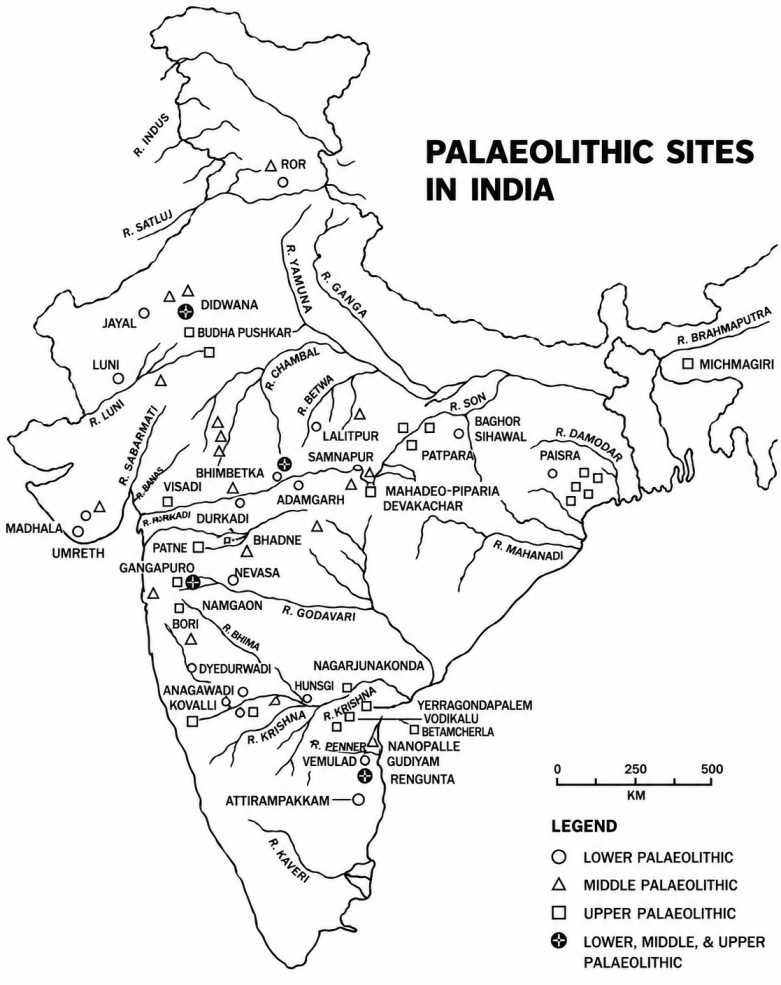
Lower Palaeolithic Age Sites
| Sites | Area |
| Belan Valley | Madhya Pradesh and Uttar Pradesh |
| Bhimbetka, Jogdaha | Madhya Pradesh |
| Bagor, Budha Pushkar | Rajasthan |
| Patne, Nandipalle | Maharashtra |
| Renugunta, Kurnool Caves | Andhra Pradesh |
| Singhbhum | Jharkhand |
| Sohan Valley | West Punjab (Pakistan) |
The Middle Palaeolithic Age (100,000-40,000 BC)
- The tools of this age are based upon flakes and crude pebble industry. The dominant tool types are blades, points, and borers.
- Hunting, food gathering, and fishing are the main occupations of the people.
- The Belan Valley (Uttar Pradesh), which lies at the foothills of the Vindhyas, is rich in stone tools and animal fossils including cattle and deer.
- These remains relate to both the Lower and Middle Stone Ages.
Middle Palaeolithic Age Sites
| Sites | States |
| Nevada | Maharashtra |
| Bhimbetka, Narmada Valley | Madhya Pradesh |
| Bagor, Karmali Valley, Didwana | Rajasthan |
| Singhbhum | Jharkhand |
The Upper Palaeolithic Age (40,000-10,000 BC)
- The Upper Palaeolithic Age (40,000-10,000 BC) is distinguished by the presence of burins, scrapers, a developed flint industry, and the emergence of modern man (Homo sapiens).
- In the Belan Valley of the Mirzapur district in Uttar Pradesh, remnants of animals such as goats, sheep, and cattle indicate human exploitation.
- During this period, known as the last phase of the Ice Age, the climate experienced a shift towards warmth and reduced humidity. Human habitation sites, including caves and rock shelters, have been uncovered at Bhimbetka.
Bhimbetka Rock Shelter
- Bhimbetka Rock Shelter, located in Madhya Pradesh, is a significant archaeological site renowned for being one of the largest prehistoric complexes in India. It boasts the country’s oldest-known rock art.
- Designated as a World Heritage Site by UNESCO in 2003, these Palaeolithic rock shelters and caves offer a unique glimpse into the evolution of human settlement and culture, transitioning from hunter-gatherer lifestyles to agriculture, as well as the expression of prehistoric artistic forms.
Upper Palaeolithic Age Sitesheand
| Sites | Area |
| Kurnool Caves | Andhra Pradesh |
| Belan Valley | Madhya Pradesh and Uttar Pradesh |
| Nevasa | Maharashtra |
| Sabarmati Valley | Gujarat |
| Singrauli | Madhya Pradesh |
| Kichler | Andhra Pradesh |
| Hunsgi Valley | Karnataka |
| Attirampakkam | Tamil Nadu |
| Pahalgam | Kashmir Valley |
| Hathnora, Narmada Valley, Bhimbetka, Adamgarh | Madhya Pradesh |
| Kortallayar Valley | Tamil Nadu |