
Education
Definition and Meaning of Education
The concept of education is more important than teaching because education encompasses the broader goals of what we want to achieve with learning, while teaching is focused on the specific methods and techniques used to deliver instruction. Thus, we begin our discussion with education.
Education is the methodical and deliberate process of acquiring knowledge, skills, values, beliefs, and habits through teaching, training, or research. The scope of education includes the transfer of knowledge across generations and its transformative impact on individuals and society to produce responsible and progressive citizens. It contributes to intellectual, social, and personal growth, leading to self-actualization.
The mission of education also encompasses the promotion of equity, cultural preservation, inclusivity, environmental awareness, and economic empowerment. Education takes place both formally (in schools, colleges, and universities) and informally (through real-world exposure and self-directed learning).
Thus, education is a complex and multifaceted concept. Various thinkers have defined education in different ways:
Rabindranath Tagore: The aim of education is self-realization, meaning the realization of the universal soul within oneself.
Swami Vivekananda: Education is the manifestation of perfection already present in a person.
John Dewey: Education is not just preparation for life; education is life itself.
Nelson Mandela: Education is the most powerful weapon to change the world.
Malcolm Forbes: The purpose of education is to replace an empty mind with an open one.
Albert Einstein: Education is what remains after one has forgotten what was learned in school.
Aristotle: Education is the best provision for old age.
Maria Montessori: Education is a natural process developed through experience and environment, not just words.
Benjamin Franklin: Investment in knowledge yields the best returns.
B. F. Skinner: Education is what survives after learned facts are forgotten.
Plato: Education is the kindling of a flame, not the filling of a vessel.
Horace Mann: Education is the great equalizer, balancing social conditions.
In conclusion, education is not merely about acquiring information but about developing a sound mind and character, enabling individuals to face life’s challenges and opportunities with confidence and wisdom.
Education Philosophies
The statement by Will Durant that “science gives us knowledge, but philosophy gives us wisdom” highlights the deeper role of philosophy in human life. While science helps us understand facts and realities, philosophy guides us in forming values, judgments, and wise decisions. Thus, philosophy plays a crucial role in shaping education.
The ancient Bhartiya system of education was largely centered around the Gurukul system, emphasizing the guru–shishya relationship, discipline, and often rote memorization. This system focused on character building, spiritual growth, and a holistic way of life. It contributed significantly to creating a refined society with strong cultural and architectural foundations.
In contrast, the Western education system is generally seen as more flexible and dynamic, focusing on critical thinking, problem-solving skills, and practical application of knowledge. While the Indian system emphasized tradition and values, the Western system promotes inquiry and innovation. Both systems have their own strengths, and understanding them helps in developing a balanced perspective on education.
Philosophy and education are deeply interconnected. Every aspect of education—such as aims, objectives, curriculum, teaching methods, discipline, and the role of the teacher—is influenced by philosophical thought. Philosophy provides the foundation upon which educational systems are built and developed.
The educational process can be understood through three fundamental questions:
“Why” — determined by philosophy, as it defines the purpose and goals of education.
“How” — determined by psychology, as it deals with methods of teaching and understanding learners.
“What” — determined by social needs, as society decides the content and relevance of education.
Thus, education is based on a combination of philosophical, psychological, and social foundations, making it a comprehensive and multidimensional process.
According to Western philosophy, Socrates is regarded as the father of education due to his emphasis on questioning, dialogue, and critical thinking. His intellectual legacy continued through his student Plato, who further developed philosophical ideas, and Plato’s student Aristotle, who contributed extensively to logic, science, and education.
The philosophical study of key educational concepts is extremely important. Questions related to these ideas may appear directly or in the form of assertion and reason, requiring a clear understanding of underlying principles. Therefore, a strong grasp of philosophy helps in better understanding the nature, purpose, and direction of education.
(i) Ancient Education:
This classical form of education flourished in ancient civilizations such as Greece and Rome, primarily from around the 5th century BCE to the early centuries CE. During the same period, in Bharat, highly developed systems like Vedic, Jain, and Buddhist education were also prominent. These systems, though geographically different, shared a common goal of cultivating knowledge, character, and wisdom.
In the Western classical tradition, education emphasized the study of classical texts, including literature, philosophy, and mathematics. The aim was not only intellectual development but also the cultivation of moral character and civic virtue. Great thinkers such as Socrates, Plato, Aristotle, and Quintilian played a crucial role in shaping this tradition.
The classical curriculum was organized into the liberal arts, which were divided into two main categories:
Trivium – consisting of grammar, rhetoric, and logic, focusing on language and reasoning skills.
Quadrivium – consisting of arithmetic, geometry, music, and astronomy, focusing on numerical and scientific understanding.
A key feature of this system was the use of the dialectical method, where students engaged in discussion, debate, and questioning. This was closely associated with the Socratic method, introduced by Socrates, which involved asking probing questions to help students discover truth and develop critical thinking.
Similarly, the ancient Bhartiya education system emphasized timeless and universal knowledge found in sacred texts such as the Vedas, Upanishads, Puranas, and the Bhagavad Gita. This system was liberal and holistic, aiming at the overall development of an individual—intellectual, moral, and spiritual.
Education in Bharat included diverse fields such as literature, philosophy, mathematics, and science, and it focused on achieving a well-rounded life. Like the Greek system, it also encouraged inquiry and understanding, often through dialogue and reflection, guiding learners toward self-discovery and truth.
Thus, both Western and Indian classical education systems, though different in approach, shared a deep commitment to holistic development, pursuit of wisdom, and the cultivation of thoughtful individuals.
(ii) Perennialism Form of Education (Early 20th Century):
Perennialism emerged as an important educational philosophy in the early 20th century, with key proponents like Mortimer Adler and Robert Hutchins. This approach emphasizes timeless and universal ideas that remain relevant across generations. It gives importance to the study of classics in literature, philosophy, and mathematics, considering them essential for intellectual development.
Perennialism strongly advocates for liberal education, aiming to develop rational thinking and intellectual discipline. A major teaching approach used here is the Socratic method, where learning takes place through questioning, dialogue, and critical discussion. However, this system is often seen as rigid, as it follows a prescribed curriculum that does not change frequently. The focus is primarily on the transmission of knowledge, rather than adapting content to individual differences or contemporary changes.
(iii) Essentialism and Existentialism (Mid-20th Century):
Essentialism and Existentialism represent contrasting philosophical viewpoints in education, each offering a different perspective on knowledge, reality, and learning.
Essentialism:
This philosophy was propounded by William Bagley. It is based on the belief that there are essential, unchanging truths, knowledge, and values that every student must learn. Essentialism supports a structured and standardized curriculum, where core subjects and fundamental skills are emphasized.
In this view, reality is objective and measurable, meaning that knowledge exists independently of the learner and must be systematically transmitted. The teacher plays a central role in imparting this essential knowledge, ensuring discipline and academic rigor.
Existentialism:
Existentialism, associated with Jean-Paul Sartre, presents a completely different outlook. It holds that reality is subjective, and each individual experiences and interprets the world in their own unique way.
This philosophy emphasizes personal experience, individual choice, and freedom. Learning is seen as a deeply personal process where knowledge is constructed through reflection and lived experiences rather than simply being delivered by the teacher. Existentialist education encourages students to explore their own identities, make meaningful choices, and develop a sense of responsibility.
(iv) Naturalism (Late 19th and Early 20th Century):
Rabindranath Tagore emphasized that true education must help a child discover and express their unique nature; otherwise, it cannot be called real education. Similarly, Friedrich Froebel believed that learning should occur in nature and from nature, highlighting the importance of natural surroundings in a child’s development.
The philosophy of naturalism in education was further developed by thinkers like Jean-Jacques Rousseau and John Dewey. Rousseau’s famous book Emile, or On Education had a profound impact on naturalistic thought, advocating that education should follow the natural growth and interests of the child rather than rigid structures.
Naturalism in education means learning through nature, experience, and real-life situations. It promotes the idea of “learning by doing,” where students actively engage with their environment instead of passively receiving information.
This approach involves several key aspects:
Nature and Experience are Key: Learning is rooted in real-life experiences and interaction with nature, making knowledge meaningful and practical.
Related to Constructivism: It aligns with the idea that learners construct their own understanding based on experiences rather than simply memorizing facts.
Hands-on Activities: Activities like science experiments, gardening, and nature walks help students actively explore and understand concepts.
Asking Questions and Exploring: Teachers create an environment where students feel encouraged to question, investigate, and explore their interests freely.
Learning from Each Other: Collaborative learning allows students to share ideas and learn socially, enhancing understanding.
Real-Life Examples: Practical exposure, such as visiting a water treatment plant or observing plant growth, connects education to the real world.
The educational approach developed by Maria Montessori reflects many principles of naturalism. The Montessori method has proven effective in nurturing academic, social, and emotional skills. Students in this system are often recognized for their independence, creativity, and problem-solving abilities, as they learn in an environment that respects their natural development.
Naturalism is closely linked with progressivism, as both emphasize child-centered learning, experience-based education, and the development of practical skills. Together, they highlight that education should not be confined to textbooks but should be a living, dynamic process rooted in real experiences and individual growth.
(v) Progressivism and Pragmatism:
Progressivism is a student-centred approach to education that emphasizes hands-on learning and experiential activities. It is closely connected with society, as it prepares learners to actively participate in real-life situations. According to this philosophy, children learn best by doing, and they should be given opportunities to explore their interests and construct their own understanding.
Key proponents of progressivism include John Dewey, William Heard Kilpatrick, and Jean Piaget. These thinkers believed that education should be dynamic, interactive, and child-focused, rather than rigid and teacher-centered. Learning, in this sense, becomes an active process where students engage with their environment, ask questions, and develop critical thinking skills.
Progressivism also highlights the importance of social interaction, cooperation, and real-world experiences. It encourages learners to become independent thinkers and responsible members of society by engaging in meaningful activities rather than rote memorization.
Closely related to this is pragmatism, a philosophy that emphasizes practicality and problem-solving. Pragmatists believe that knowledge is meaningful only when it can be applied to real-life situations. Learning, therefore, should involve solving actual problems and gaining experiences that are directly relevant to life.
Pragmatism supports the idea that education should be relevant to students’ lives and should prepare them for success in real-world contexts, including the workplace. It focuses on developing skills such as critical thinking, adaptability, and decision-making, which are essential in everyday life.
Thus, both progressivism and pragmatism stress that education should move beyond theoretical knowledge and become a practical, experience-based, and learner-oriented process, helping individuals grow into capable and socially responsible human beings.
(vi) Theory of Cognitivism (Late 20th Century):
Cognitivism focuses on understanding how the human mind processes information and how this understanding can improve teaching and learning. It emphasizes internal mental processes such as perception, memory, thinking, and problem-solving. An important concept within this theory is cognitive load, which refers to the amount of mental effort being used in the working memory and how it affects learning efficiency.
Cognitivism provides learners with opportunities to actively construct their own knowledge rather than passively receive it. Teaching methods under this approach include hands-on activities, real-world examples, and meaningful engagement, helping students build understanding through their own cognitive processes.
A major contributor to this theory, Jean Piaget, proposed the theory of cognitive development, introducing several key concepts:
Schemas: Mental frameworks that help individuals organize and interpret information.
Assimilation: The process of integrating new information into existing schemas.
Accommodation: The process of modifying existing schemas when new information does not fit.
Equilibration: The balance between assimilation and accommodation, acting as a driving force of learning.
Egocentrism: The tendency of children to view the world from their own perspective.
Object Permanence (correct term): Understanding that objects continue to exist even when not visible.
Conservation: The idea that certain properties of objects remain the same despite changes in appearance.
Another important psychologist, Lev Vygotsky, contributed significantly to cognitive development theory. He proposed that individuals are born with basic mental functions such as attention, sensation, perception, and memory, which develop further through social interaction.
Vygotsky introduced the concept of the Zone of Proximal Development (ZPD), which refers to the gap between what a learner can do independently and what they can achieve with guidance from a more knowledgeable person. Learning is most effective within this zone.
Based on this idea, the concept of scaffolding was developed. It involves providing temporary support and guidance to learners as they perform tasks slightly beyond their current ability. As the learner becomes more competent, this support is gradually removed.
Some important teaching strategies linked to cognitivism include:
Probing: Asking thoughtful questions to deepen understanding and stimulate thinking.
Think Aloud: Encouraging learners to verbalize their thought processes, which helps in understanding their reasoning and improving cognitive strategies.
In conclusion, cognitivism highlights that learning is an active mental process, where learners continuously organize, adapt, and refine their knowledge through interaction, experience, and reflection.
(vii) Constructivist School of Thoughts (Mid-20th Century):
Constructivism is a broader concept than cognitivism, emphasizing that learners actively build their own knowledge and understanding through active engagement, problem-solving, and experience-based learning. The progression from cognitivism to constructivism is not strictly linear; rather, it involves variations and overlapping ideas.
Learning, from a constructivist perspective, is an active and personal process. Students construct their understanding of the world by interacting with their environment and peers. This process involves integrating new experiences with prior knowledge, making learning meaningful and experiential.
The contributions of Jean Piaget and Lev Vygotsky are central to constructivism. Piaget focused on stages of cognitive development and how individuals construct knowledge internally. In contrast, Vygotsky emphasized the importance of social interaction and cultural context in learning, leading to the concept of social constructivism.
David Ausubel proposed the Advanced Organiser’s Model (AOM), which reflects a holistic approach to learning. It includes:
Encouraging active engagement with learning material for deeper understanding.
Integrating new knowledge with existing mental frameworks for cohesive learning.
Enhancing understanding through social interaction.
Adapting teaching methods to suit individual learning styles.
The idea of mental models is significant in Ausubel’s theory, referring to organized cognitive structures (often visual or conceptual) that help learners process and retain information effectively.
Ausubel’s model can be summarized in three key steps:
Introduction of the Advance Organizer – providing a general overview that connects with learners’ prior knowledge.
Presentation of Learning Material – delivering the main instructional content.
Reinforcement of Cognitive Organization – helping learners relate new knowledge to existing understanding for better retention.
Jerome Bruner introduced the concept of the Spiral Curriculum, where students revisit key ideas repeatedly throughout their education. Each encounter occurs at a more complex level, allowing learners to expand and deepen understanding progressively.
The philosophy of Mahatma Gandhi in Basic Education (Wardha Scheme) also aligns with constructivism. It emphasizes learning through self-discovery, active participation, and meaningful activities rather than passive memorization.
Finally, Discovery Learning is a core constructivist approach where learners actively explore, experiment, and solve problems to build their own understanding. It promotes independence, curiosity, and deeper conceptual learning through hands-on experiences.
(viii) Social Learning Theory:
Albert Bandura proposed the Social Learning Theory, which explains how learning occurs through observation, imitation, and modelling. According to this theory, individuals do not learn only through direct experience but also by watching the behaviour of others and the consequences that follow.
A key idea in Bandura’s theory is observational learning, where people acquire new behaviours by observing others, known as models. These models can be parents, teachers, peers, or even media figures. When individuals observe a behaviour being rewarded, they are more likely to imitate it, whereas behaviours followed by punishment are less likely to be copied. This process is called vicarious reinforcement.
Bandura emphasized that learning involves several internal processes, including attention (noticing the behaviour), retention (remembering it), reproduction (being able to perform it), and motivation (having a reason to imitate it). These processes show that learning is not purely mechanical but involves cognitive factors as well.
For example, a child may learn to ride a bicycle by watching their parents. By observing how balance is maintained and how pedals are used, the child gradually imitates the actions. Similarly, a student can learn how to solve mathematical problems by watching a teacher demonstrate the steps and then practicing them independently.
Bandura’s theory has had wide applications in education and psychology. It has influenced teaching methods by encouraging modelling of desired behaviours, such as demonstrating problem-solving strategies in classrooms. It is also used in treating phobias and psychological disorders through techniques like modelling and imitation, where patients observe others successfully coping with feared situations. Additionally, it plays an important role in promoting positive social behaviour, such as cooperation, empathy, and discipline, by exposing learners to constructive role models.
(ix) Behaviorism (Early to Mid-20th Century):
Learning is simply defined as the modified behaviour. Learning is a process of conditioning. It is the result of condi-tioned responses to external stimuli. The emphasis on observable behaviours through reinforcement and rewards. The contribution of various behaviour the-ory proponents has been mentioned below:
Ivan Pavlov’s (1849-1936) research on classical conditioning involved pairing a neutral stimulus (like a bell) with a reflex response (like saliva-tion in dogs). This demonstrated that animals (and humans) could form automatic, involuntary responses to neutral stimuli when those stimuli were consistently paired with significant events through ‘associations’.
John B. Watson (1878-1958) had also given the concept of classical conditioning, which involves learning associations between stimuli and responses. He conducted the famous ‘Little Albert’ experiment, that is about learning of pho-bias through classical conditioning.
The contribution of B.F. Skinner: Operant Conditioning: This is also known as ‘Skinner Box’. It is used to study animal behaviour and operant conditioning in controlled environ-ments. This emphasises learning through the consequences of one’s actions. He proposed that behaviours could be strengthened or weakened based on whether they were followed by rein-forcement (positive or negative) or punishment. This theory has been applied in educational set-tings to shape and modify student behaviour.
Programmed Instruction: This involves break-ing down learning materials into small, sequenced steps. Learners progress through these steps at their own pace, receiving immediate feedback and reinforcement. Programmed instruction was one of the earliest forms of computer-assisted learning and personalized learning.
Teaching Machine: Skinner also designed ‘teaching machines’, which are the mechanical devices that provided students with a way to answer questions or complete tasks, with imme-diate feedback. These machines were intended to make learning more efficient and individualized. His book Verbal Behavior’ (1957) explored the behaviourist analysis of language and communica-tion. He also gave the concept of ‘radical behaviour’.
Edward Lee Thorndike (1874-1949): He was an American psychologist who made significant contributions to the fields of psychology and education.
He conducted extensive research on animal behaviour, learning, and human intelligence. The three primary laws he proposed are:
Law of Effect: Behaviours followed by posi-tive outcomes (rewards) are more likely to be repeated, while behaviours followed by nega-tive outcomes (punishments) are less likely to be repeated. The Law of Effect underlies the concept of reinforcement in behaviourism.
Law of Readiness: Learners are more pre-pared and motivated to learn when they are in a state of readiness or when they have a natu-ral, biological readiness for a particular type of learning or behaviour.
Law of Exercise: Practice and repetition strengthen the association between a stimulus and a response, leading to increased efficiency and readiness in performing that behaviour.
‘Drill and Practice‘ is an educational method that involves repetitive exercises or activities designed to reinforce learning and promote skill mastery. This is linked with Mathematics, Languages, Science, Computer Programming, Music and Arts, Standardized Tests, Skills Training etc.
(x) Humanism (Mid-20th Century):
The main proponents were Abraham Maslow and Carl Rogers. The Education should prioritize the development of the whole person, including emo-tional and psychological well-being, self-esteem, and self-actualization. Maslow has given five sets of needs – physiological, physical, social, esteem and self actualization.
According to J. Krishnamurthi, the greatest revolu-tion is not in changing the political system or the eco-nomic system, but in changing the human mind and heart.
(xi) Critical Pedagogy (Mid-20th Century):
The main proponent was Paulo Freire. Education should empower students to critically analyse and challenge social injustices and inequities, fostering critical thinking and social change.
(xii) Connectivism (21st Century):
The main Proponent was George Siemens. As we understand that learning in the digital age is charac-terized by the connectedness of information and the ability to network with others. Emphasis on the role of technology and networks in learning.
(xiii) Multicultural Education (20th Century):
This was propounded by Jean-Jacques Rousseau, John Dewey, Rabindranath Tagore. The main propо-nents were James A. Banks, Sonia Nieto. This aims at promoting diversity and inclusivity, and the integration of multiple cultural perspectives into the curriculum and teaching practices.
(xiv) Gestalt Psychology:
This is a philosophy of education that emphasizes the importance of holistic learning and the integration of knowledge. Gestalt psycholo-gists believe that people learn best when they are able to see the whole picture and to understand how the different parts of a problem or topic are intercon-nected. Synergy is not explicitly a part of Gestalt psy-chology, but it is a related concept, that is linked with holistic learning. Synergy is the idea that the whole is greater than the sum of its parts, that is 2+2=5.
(xv) Gardner’s Theory of Multiple Intelligences:
Accordingly, there are nine different types of intel-ligence, verbal-linguistic, logical-mathematical, visual-spatial, bodily-kinesthetic, musical, interper-sonal, intrapersonal, naturalistic, and existential. Bodily-kinesthetic intelligence is the ability to use the body to express ideas and feelings and to solve problems. Such people are often good at sports, dance, and other activities that require physical coordination.
(xvi) (Experiential Learning Theory (ELT):
This model by David Kolb is a comprehensive framework that describes learning as a process where experience is transformed into knowledge. It involves a four-stage cycle: start-ing with Concrete Experience, followed by Reflective Observation, then Abstract Conceptualization, and finally Active Experimentation. This theory emphasizes that effective learning is a continuous dynamic process of experiencing, reflecting, thinking, and acting.
(xvii) Eclecticism:
While Kolb’s Model is rooted in ELT, this eclecticism seems to be a broader and practical approach. This is a mixed bag approach, it takes the best from different educational traditions. It is a flex-ible and adaptable approach that can be tailored to the needs of individual students and groups. Eclectic educators believe that no one philosophy or approach can meet the needs of all students and contexts, so they draw from a variety of sources to create effective learning experiences.
David Kolb’s Model: We can take David Kolb’s Model as an example of eclecticism. It draws on ideas from a variety of different educational theories, including con-structivism, behaviourism, and cognitive psychology.
Concrete Experience (CE): This stage involves gaining new experiences. For instance, when someone becomes an Assistant Professor after passing the NET exam, they encounter new teaching experiences in the college setting.
Reflective Observation (RO): During this stage, learners reflect on their experiences to gain a deeper understanding. This may be termed as ‘review’. For an assistant professor, this might involve reviewing their teaching methods and assessing what’s effective or needs improvement.
Abstract Conceptualization (AC): The learners develop a general understanding of their expe-riences and how they apply to other situations. An assistant professor regularly applies their teaching experiences to enhance their overall practice.
Active Experimentation (AE): Learners test their understanding by trying new approaches. An assistant professor may innovate by exploring new teaching methods and strategies.
CE and AC are defined as two learning modes and RO and AE are defined as two learning experiences.
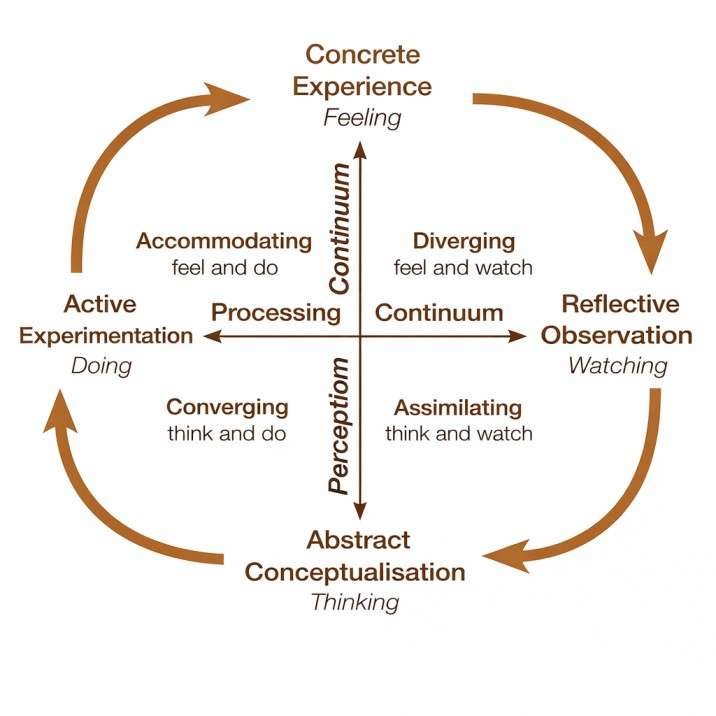
These Four Steps Complete the Outer Part of the following diagram.
| Active Experimentation (Doing) | Reflective Observation (Watching) | |
|---|---|---|
| Concrete Experience (Feeling) | Accommodating (CE/AE) | Diverging (CE/RO) |
| Abstract Conceptualization (Thinking) | Converging (AC/AE) | Assimilating (AC/RO) |
DACA stands for
- Diverging: This is the process of generating new ideas and possibilities.
- Assimilating: This is the process of taking in new information and ideas and understanding them.
- Converging: This is the process of using new informa-tion and ideas to solve problems or create new things.
- Accommodating: This is the process of adapting to new information and ideas, and changing your exist. ing beliefs and ideas as needed.
- Feeling: This is the process of experiencing emotions and sensations.
FWTA stands for
- Watching: This is the process of paying attention to what is happening around you.
- Thinking: This is the process of using your mind to process information and ideas.
- Doing: This is the process of taking action and put-ting your thoughts and ideas into practice.
Benefits of Kolb’s Model: This model is cyclical in nature. The learners have the some flexibility to enter at any stage. Kolb’s Experiential Learning Model offers benefits such as enhanced learning outcomes, customized learning for diverse preferences, and the promotion of critical thinking. Additionally, it encourages adaptability and innovation through experiential learning.
ROLE OF SWAMI VIVEKANANDA
Swami Vivekananda’s speeches at the World’s Parliament of Religions in Chicago in 1893 brought Indian spirituality and philosophy to the global stage. He was a disciple of the Ind the Indian mystic Sri Ramakrishna Paramahamsa. Belur Math was founded by Swami Vivekananda in 1897. His ideas on education
and spirituality received international recognition and influence. He emphasised on holistic and value-based education, the integration of science and spirituality, and the promotion of character development. His ideas continue to shape educational philosophies and institutions in India and around the world.
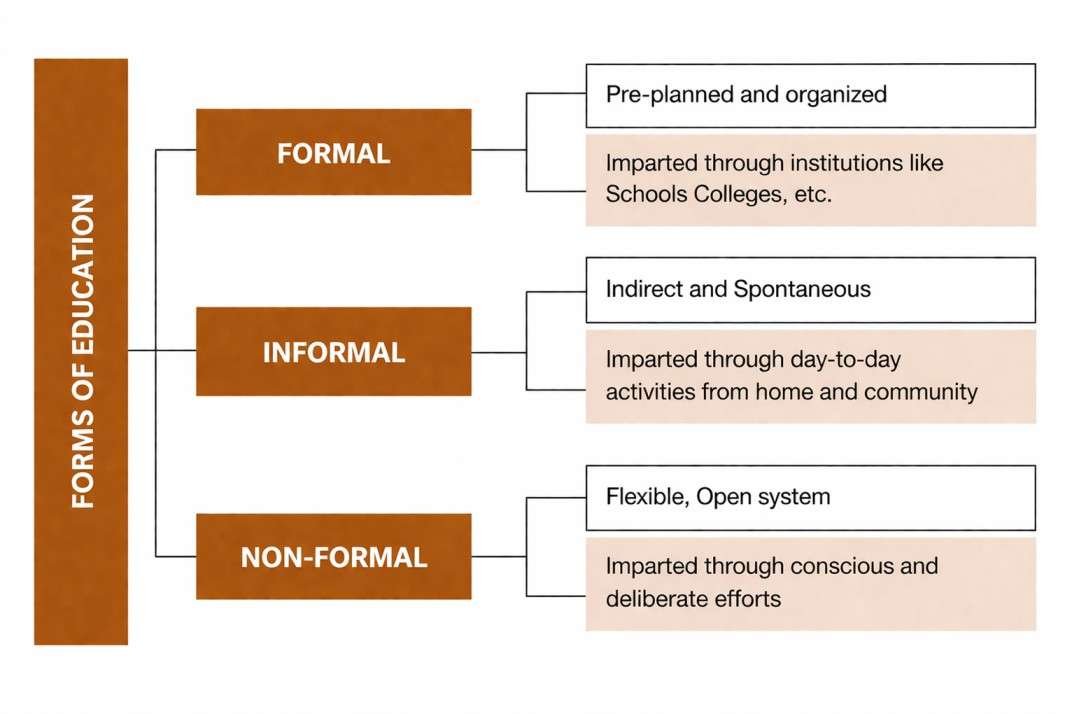
Forms of Education
We can divide the education into three parts.
- Formal
- Informal
- Non-formal
Aims and Objectives of Education
We want that education by which character is formed, strength of mind is increased, the intellect is expanded and by which one stands on one’s own feet.
– Swami Vivekanand
Havighurst and Neugarten have given two important functions of the education system:
A mirror that reflects society as it is or to be the stabi-lizer of the society.
An agent of social change or a force directed towards implementing the ideas of society.
George Payne, a sociologist, has given three main functions of education:
Assimilation of traditions
Development of new social patterns
Creative and constructive role Emile Durkheim worked on structural functionalism that means how does the society function. He focused on the transmission of society’s norms and values as the major function of society. The education was recognized as a training for specialized roles (division of labour) that also includes adopting some occupation for livelihood. Education is required to perform the function of
(a) cultural transmission and enrichment
(b) acceptance and reformulation
(c) change and reconstruction
Two terms can be discussed here.
Enculturation: It is the process why the young generation learns the traditional ways of society. This practice differs from one society to another. Enculturation is formalized through education.
Acculturation: It is the process through which a person or group from one culture comes to adopt the practices and values of another, while still retaining their own dis-tinct culture. This concept has become important in an increasingly globalized society. 6. Exploration of Knowledge: Knowledge is cru-cial for personal growth, social adjustment, and happiness. The pace of knowledge creation has accelerated.
Factors Determining Educational Aims:
Education is mostly a planned and purposeful activity. Educational aims are necessary in giving direction to unique activities so that we become good citizens and society a better place to live and progress.
Philosophy and Education: Both are interconnected. Philosophy determines the aim of education and serves as a means to propagate philosophical ideas.
Human Nature: Different philosophies shape how human nature is perceived. For example, ideal-ists view education as the unfolding of the divine in humans.
Socio-Cultural Preservation: Education plays a role in preserving and transmitting cultural heritage and traditions across generations.
Religious Influence: Religious ideals, like ahimsa and truth, have influenced education systems histori-cally, as seen in Buddhism in ancient India.
Political Ideologies: Various political ideologies, such as authoritarianism, liberalism, and democracy, shape societies and their educational systems. 6. Exploration of Knowledge: Knowledge is cru-cial for personal growth, social adjustment, and happiness. The pace of knowledge creation has accelerated.
Vocational Training: Education prepares individuals for economic self-sufficiency and social efficiency.
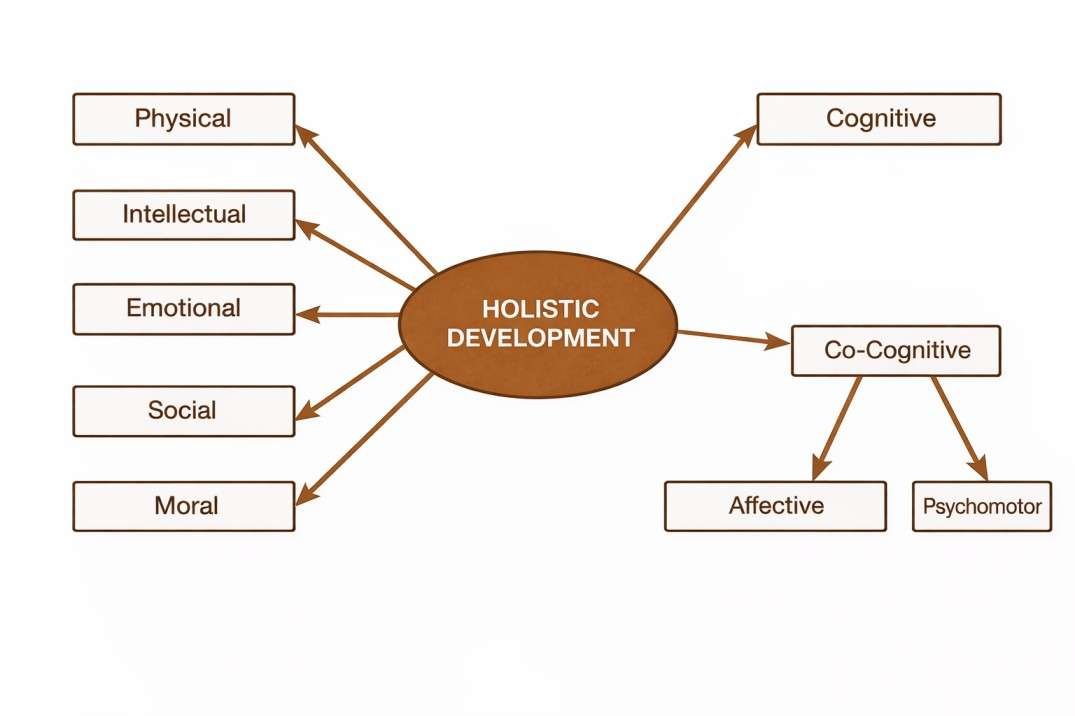
Self-Actualization and Holistic Development: Education aids in self-actualization, realizing one’s potential in physical, mental, emotional, social, and spiritual-moral aspects.
Harmonious Development: Education aims at draw-ing out the best in individuals, encompassing body, mind, and spirit, as per Gandhi’s perspective.
Moral and Character Development: Moral values and virtues, such as truthfulness and honesty are important educational goals. 11. Citizenship: Education instills a sense of responsibil-ity and prepares individuals to be better citizens.
Education for Leisure: Leisure time is for enjoyment, recreation, and maintaining balance. It nurtures artis-tic, moral, and aesthetic aspects of individuals.
Concept of Teaching
The main objective of effective teaching is learning, with teachers as knowledge facilitators. National progress relies on human resource development, requiring compe-tent teachers to guide society. “Teaching aptitude’ assesses candidates’ qualifications, intelligence, attitude, and skills for the teaching profession. Teaching can be defined in the following ways:
Teaching is the purposeful direction and manage-ment of the learning process.
Teaching is a process of providing opportunities for stu-dents to produce relatively permanent change through engagement in experiences provided by the teachers.
Teaching is a skilful application of knowledge, experi-ence and scientific principles with an objective to set up an environment to facilitate learning.
Teaching is a planned activity and effective teaching depends on the following factors:
(a) How clearly the students understand what they are expected to learn.
(b) How accurately their learning can be measured.
Teaching is a process in which the learner, teacher and other variables are organized in a systematic way to attain some predetermined goals.
Teaching is an activity that influences a child to learn and acquire desired knowledge and skills and also their desired ways of living in the society.
Basic Teaching Models
There is no basic model of teaching that fits into all situa-tions. Basically, we have discussed two models-pedagogy and andragogy-that are almost extremes of a teaching continuum. Then there is heutagogy approach.
PEDAGOGY
Pedagogy involves teaching as both an art and a science, with the teacher taking the lead in planning and execut-ing lessons. Friedrich Herbart’s five step approach to ped-agogy includes preparation, presentation, association, generalization, and application of new knowledge.
ANDRAGOGY
Andragogy shifts the responsibility for learning to the students, who interpret and discover knowledge at their own pace. Instructors support this process by facilitating learning opportunities and skill development, often asso-ciated with adult learning.
HEUTAGOGY
Heutagogy focuses on highly autonomous, self-deter-mined learning. It aims to prepare learners for complex workplace challenges and includes ‘Double Loop Learning‘ as a key element.
Major Shifts in Teaching
| From Pedagogy | To Andragogy |
|---|---|
| Teacher-centered, fixed designs | Learner-centered, flexible process |
| Teacher’s direction and decisions | Learner’s autonomy |
| Teacher’s guidance and monitoring of learning | Teacher’s facilitation, support and encouragement for learning |
| Passive reception in learning | Active participation in learning |
| Learning within the four walls of the classrooms | Learning in the wider social context |
| Knowledge as ‘given’ and ‘fixed’ | Knowledge evolves and is created |
| Disciplinary focus | Multidisciplinary, educational focus |
| Linear exposure | Multiple and divergent exposure |
| Assessment is short | Assessment is multifarious, continuous |
NOTE: Please consider the following points.
- Pedagogy is called as engagement
- Andagogy as cultivation and
- Heutagogy as realization
Nature of Teaching
The nature of teaching includes the following:
Teaching works at different levels in life.
Teaching takes place in a dynamic environment.
Teaching is closely related to education, learning, instruction and training.
Teaching is essentially an intellectual activity.
Teaching is an art as well as a science.
Teaching tends towards self-organization.
Teaching is a social service.
Teaching includes lengthy periods of study and training.
Teaching has a high degree of autonomy.
Teaching is a continuous process.
Teaching is a profession.