Concern with Women’s Emancipation
Feminism refers to a social movement that seeks the removal of discrimination against women in terms of rights, opportunities for self-development, and participation in political power.
The philosophy underlying this movement is also called feminism.
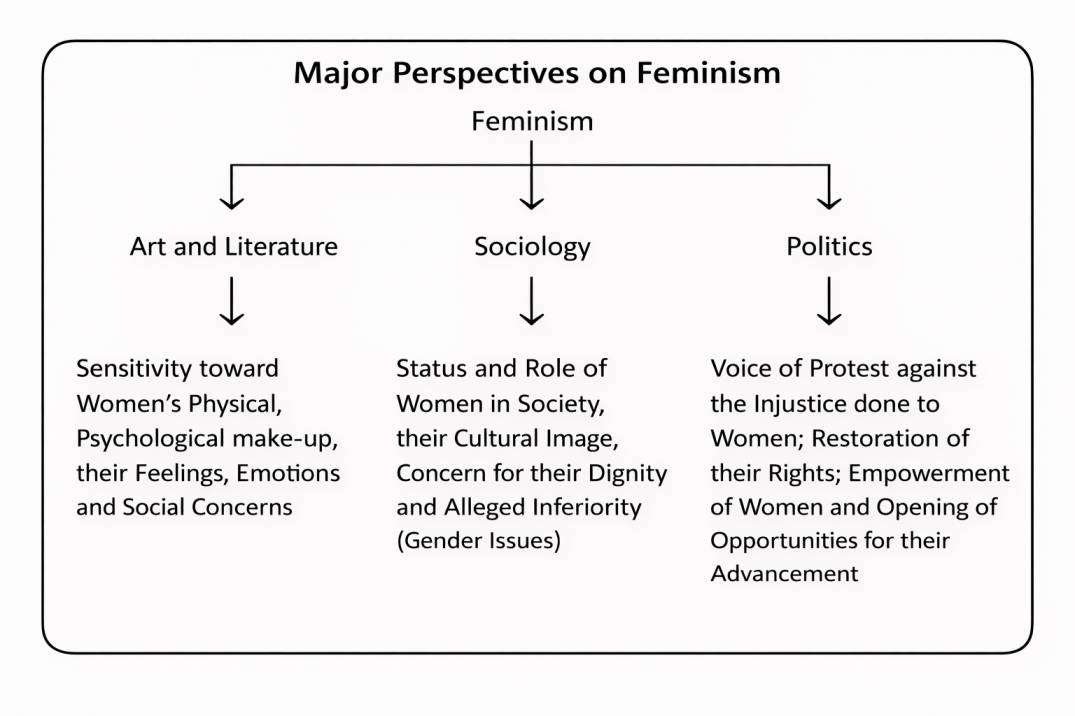
In social and political thought, the study of feminism generally combines perspectives from three major fields:
art and literature,
sociology, and
politics.
In modern Indian political thought, concern for women’s emancipation emerged strongly during the period of the Indian Renaissance.
Raja Ram Mohan Roy played a pioneering role in raising awareness about the plight of women in Indian society.
He strongly opposed the practice of Sati, a cruel custom in which a widow was required to burn herself on her husband’s funeral pyre as a sign of chastity.
Roy successfully campaigned for the legal abolition of Sati in 1829 and also criticized other forms of injustice against women.
Through his efforts, Roy became the first major modern Indian thinker to generate public awareness and reform movements for women’s rights.
Women’s emancipation became a key objective of the Brahmo Samaj, founded by Roy in 1828.
Ishwar Chandra Vidyasagar continued the reform movement initiated by Raja Ram Mohan Roy.
Vidyasagar strongly advocated the upliftment of women and played a crucial role in the enactment of the Hindu Widows’ Remarriage Act (1856).
He also actively campaigned for the acceptance of widow remarriage within mainstream Hindu society.
Swami Dayanand Saraswati strongly supported gender equality and advocated women’s education.
He argued that women should be allowed to study the Vedas, opposing traditional restrictions on women’s learning.
Dayanand cited examples of ancient women scholars such as Gargi, Maitreyi, and Anusuya to demonstrate that women were highly respected for their learning in ancient India.
The Arya Samaj played an important role in promoting women’s education and participation in public life.
Jyotirao Phule worked actively for women’s education, widow remarriage, and the prevention of female infanticide.
Several prominent women reformers and feminists were associated with Phule’s efforts, including:
Savitribai Phule, a pioneer of women’s education in India,
Tarabai Shinde, and
Pandita Ramabai.
Mahadev Govind Ranade also contributed significantly to the women’s reform movement.
He worked for women’s education, opposed child marriage, and criticized the dowry system.
His work was supported by Ramabai Ranade, who became a prominent advocate of women’s rights.
Some leading nationalist leaders and social reformers, such as Bal Gangadhar Tilak and Lala Lajpat Rai, also supported women’s education and social reforms benefiting women.
Swami Vivekananda strongly criticized the degraded status of women in India.
He emphasized the importance of women’s education, arguing that women shape the next generation and determine the future of the nation.
Rabindranath Tagore urged writers and intellectuals to reconstruct the image of women in society and literature.
Many Indian socialist thinkers, including
Acharya Narendra Dev,
Jayaprakash Narayan, and
Ram Manohar Lohia, also actively supported the emancipation of women.
Mahatma Gandhi made women’s regeneration and empowerment a major component of his social philosophy.
He encouraged large-scale participation of women in public life and national movements.
For Gandhi, women’s emancipation served two important purposes:
a humanist purpose, ensuring justice and dignity for the oppressed half of the population, and
a nationalist purpose, channeling the energies of liberated women toward nation-building and service to humanity.
Within the feminist stream of modern Indian political thought, Pandita Ramabai stands out as the only woman who emerged as an independent feminist thinker as well as a women’s rights activist.
Most other women reformers and feminists worked in collaboration with male social reformers who were advocating women’s emancipation and social reform.