Constructing a Model
Economics develops models of social phenomena, where a model is a simplified representation of reality. Its usefulness comes from eliminating irrelevant details, allowing economists to focus only on the essential features needed to understand a particular economic problem, just as a one-to-one scale map would be impractical because it includes unnecessary detail.
A good economic model follows the principle of using the simplest model capable of explaining the economic situation under study. Additional complexities should be introduced gradually, one at a time, so that the model becomes more realistic without losing clarity.
The model discussed examines the apartment market in a medium-sized Midwestern college town where apartments are divided into two categories based solely on location:
Inner-ring apartments are located adjacent to the university, making them more desirable because they provide easier access.
Outer-ring apartments are farther away, requiring students to travel by bus or endure long bicycle rides, so they are generally less preferred unless the closer apartments are unaffordable.
The town is represented as having two large rings around the university:
The inner ring contains the nearby apartments.
The outer ring contains all remaining apartments and serves as the alternative for students unable to obtain an inner-ring apartment.
The analysis focuses only on the inner-ring market, while assuming that the outer-ring apartments are plentiful and available at a fixed price.
The model distinguishes between exogenous and endogenous variables:
The price of outer-ring apartments is an exogenous variable, meaning it is assumed to be determined by factors outside the model and remains fixed.
The price of inner-ring apartments is an endogenous variable, meaning it is determined by the forces explained within the model itself.
To simplify the analysis further, the model assumes that all apartments are identical in every aspect except location, ignoring differences such as the number of bedrooms or other features. This allows discussion of a single price for apartments without considering quality variations.
The simplified model is intended to answer several key economic questions:
What determines the price of the inner-ring apartments.
Which individuals obtain the more desirable inner-ring apartments and which live in the outer ring.
How different economic mechanisms allocate apartments among individuals.
Which concepts or criteria can be used to evaluate the desirability and merit of different apartment allocations.
Optimization and Equilibrium
Explaining human behavior in economics requires a framework for analysis, which is largely based on two fundamental principles:
The optimization principle: People attempt to choose the best pattern of consumption that they can afford.
The equilibrium principle: Prices adjust until the quantity demanded equals the quantity supplied.
The optimization principle is considered almost tautological because, if individuals are free to choose, it is reasonable to assume they select what they prefer rather than what they do not want. Although exceptions exist, they generally fall outside the scope of economic behavior.
The equilibrium principle is less straightforward because it is possible that, at a given moment, demand and supply are not compatible, implying that adjustments must occur. These adjustments may:
Take a long time to reach equilibrium.
Trigger additional changes that could potentially destabilize the entire economic system.
Although such instability is possible, it usually does not occur. In the apartment market, rental prices are generally stable from month to month, so the primary concern is the equilibrium price, rather than the process through which the market reaches equilibrium or the way equilibrium changes over long periods.
The meaning of equilibrium depends on the model being used:
In the simple market model discussed here, equilibrium is achieved when demand equals supply, which is sufficient for the analysis.
In more general economic models, broader definitions of equilibrium are required, where the actions of all economic agents must be mutually consistent.
These two principles—optimization and equilibrium—provide the analytical foundation for answering key economic questions, leading to the introduction of further economic concepts needed for the analysis.
The Demand Curve
Consider all potential renters and identify the maximum amount each is willing to pay for an apartment. Ranking these amounts from highest to lowest provides the basis for analyzing market demand.
Suppose the highest maximum willingness to pay is $500 per month. This willingness may arise from different reasons, such as greater income or a stronger preference for living close to the university, but only the maximum amount willing to be paid matters for the analysis.
If only one person is willing to pay $500, then at a market price of $500, exactly one apartment will be rented. If the price falls slightly to $499, $498, $497, and so on, but remains above $490, the outcome remains unchanged because only the individual willing to pay $500 can afford and is willing to rent at those prices.
If the second-highest maximum willingness to pay is $490, then at a price of $490, two apartments will be rented—one by the person willing to pay $500 and the other by the person willing to pay $490. The same pattern continues as prices reach the reservation prices of successive individuals, with the number of rented apartments increasing each time the price falls to another person’s maximum willingness to pay.
Economists refer to a person’s maximum willingness to pay as the reservation price, which is:
The highest price at which an individual is still willing to purchase the good.
The price at which the individual is just indifferent between purchasing and not purchasing the good.
In the apartment example, if a person’s reservation price is p, that person is exactly indifferent between paying p to live in an inner-ring apartment and living in an outer-ring apartment instead.
At any market price p*, the number of apartments rented equals the number of individuals whose reservation price is greater than or equal to p*:
Individuals with reservation prices at least as high as p* choose inner-ring apartments.
Individuals with reservation prices below p* choose to live in the outer ring.
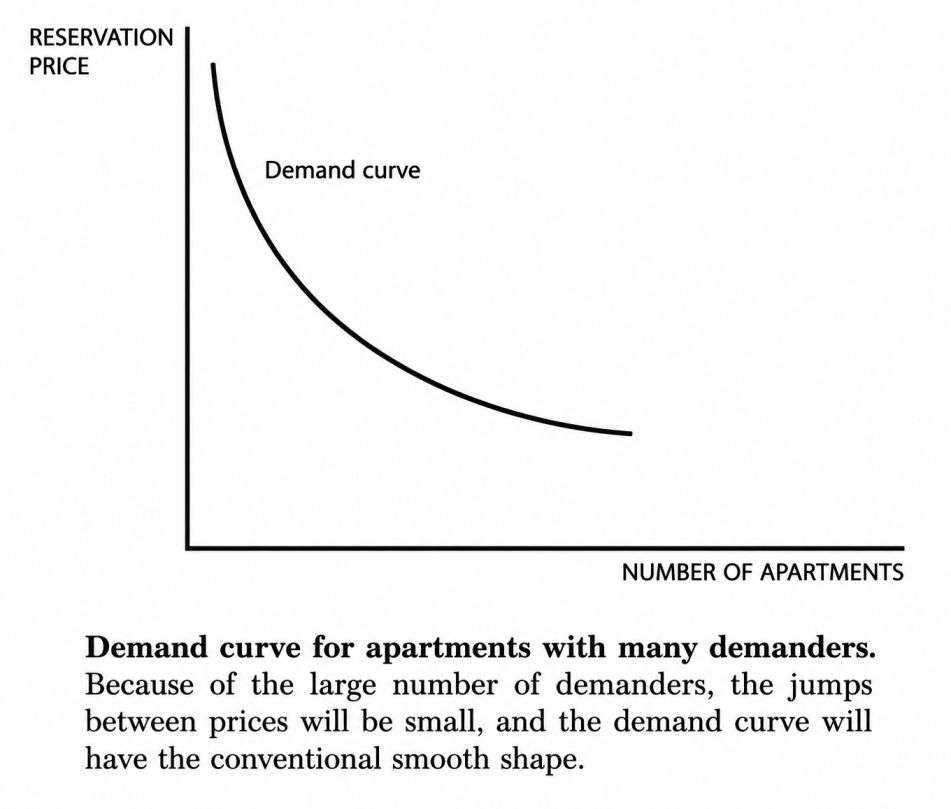
Reservation prices can be represented graphically with price on the vertical axis and the number of people willing to pay that price or more on the horizontal axis, showing the relationship between willingness to pay and the quantity of apartments demanded.
This graphical relationship is the demand curve, which shows the quantity demanded at each possible price:
When the market price is above $500, no apartments are rented.
When the price lies between $500 and $490, one apartment is rented.
When the price lies between $490 and the third-highest reservation price, two apartments are rented.
The same logic continues for lower prices as additional individuals enter the market.
The demand curve slopes downward because a decrease in price makes apartments affordable and worthwhile for more people, increasing the quantity demanded.
In a market with many individuals whose reservation prices differ only slightly, the step-like demand curve becomes smoothly downward sloping because the individual jumps are extremely small relative to the size of the market and can be ignored for practical analysis.
The Supply Curve
After representing demand graphically, the analysis turns to supply, which depends on the nature of the market being studied. The model assumes a competitive market, where there are many independent landlords, each trying to rent out apartments at the highest price the market will accept, while other market arrangements are possible and are examined separately.
In a competitive market, if all landlords seek to maximize their own benefit and renters are fully informed about all rental prices, every inner-ring apartment must have the same equilibrium price. Different prices for identical apartments cannot persist because:
If some landlords charge a higher price (Ph) while others charge a lower price (Pl), renters paying the higher price can approach landlords charging the lower price and offer a rent between Ph and Pl.
Such a transaction benefits both the renter (by paying less than Ph) and the landlord (by receiving more than Pl).
Since all parties act in their own interest and know the available prices, price differences for identical goods are eliminated, resulting in a single equilibrium price.
To determine this equilibrium price, the same method used for deriving the demand curve is applied: choose a particular price and examine how many apartments landlords are willing to supply at that price.
The quantity supplied depends on the time horizon under consideration:
In the long run (over several years), landlords can undertake new construction, so the number of apartments supplied responds to changes in price.
In the short run (within a given year), the number of apartments is essentially fixed, since new construction cannot significantly increase supply during that period.
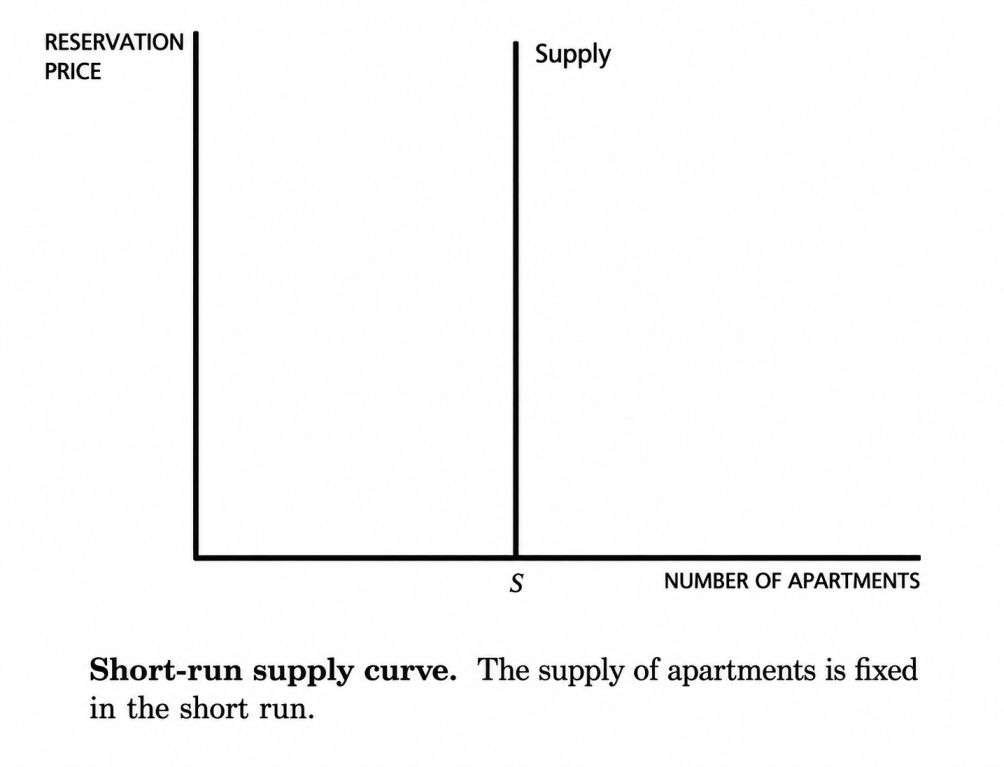
The analysis focuses on the short-run case, where the supply of apartments is fixed at a predetermined quantity regardless of the rental price.
The short-run supply curve is represented by a vertical line, indicating that the same fixed number of apartments is supplied at every possible price, meaning all available apartments are rented irrespective of the rent charged.