Introduction
Intergroup relations — the ways in which members of different social groups perceive, evaluate, and behave toward one another — constitute one of the most consequential and deeply studied domains in social psychology, sociology, political science, and related disciplines. From the psychological roots of prejudice and discrimination to the structural conditions that produce conflict and the mechanisms that foster cooperation and harmony, theories of intergroup relations address some of the most pressing moral and practical challenges facing human societies.
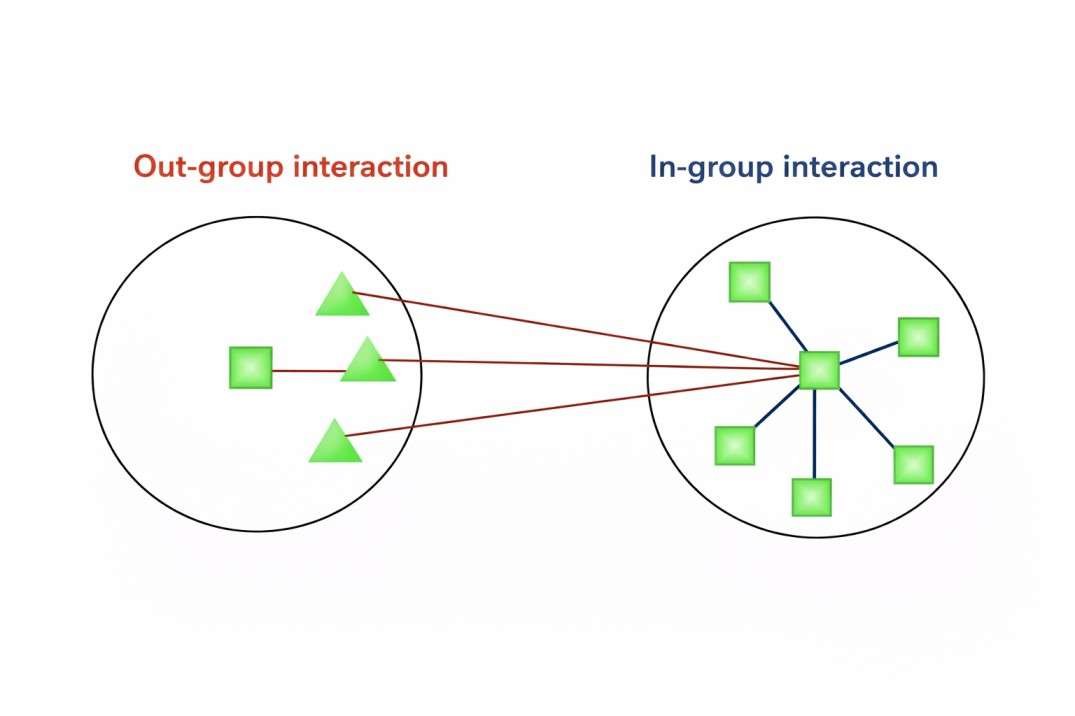
The earliest systematic attempts to explain intergroup hostility drew on biological and evolutionary frameworks. William Graham Sumner, the American sociologist, introduced the concept of ethnocentrism in his 1906 work Folkways, defining it as the tendency to view one’s own group (the in-group) as the center of everything and to evaluate all other groups (the out-group) in relation to it. Sumner proposed that ethnocentrism was a universal feature of human social life — that in-group solidarity and out-group hostility were functionally linked, with cohesion within groups being maintained partly through antagonism toward other groups. This hypothesis, known as the in-group/out-group link hypothesis, has been extensively tested and partially supported by subsequent research, though the relationship between in-group love and out-group hate is now understood to be far more complex and contingent than Sumner suggested.
Instinct theories, drawing on early evolutionary and Freudian frameworks, proposed that intergroup aggression was a natural expression of innate aggressive drives. Sigmund Freud, in Civilization and Its Discontents (1930) and Group Psychology and the Analysis of the Ego (1921), proposed that out-group hostility served a psychological function of displacement — aggressive drives that could not be expressed within the in-group were projected outward onto out-groups, binding the in-group together through shared hatred. This mechanism of scapegoating — attributing the group’s problems to a convenient out-group target — has been empirically studied in contexts ranging from anti-Semitism in Nazi Germany to contemporary political hostility, though modern research grounds these phenomena in cognitive and social processes rather than Freudian hydraulic drive models.
Social Identity Theory
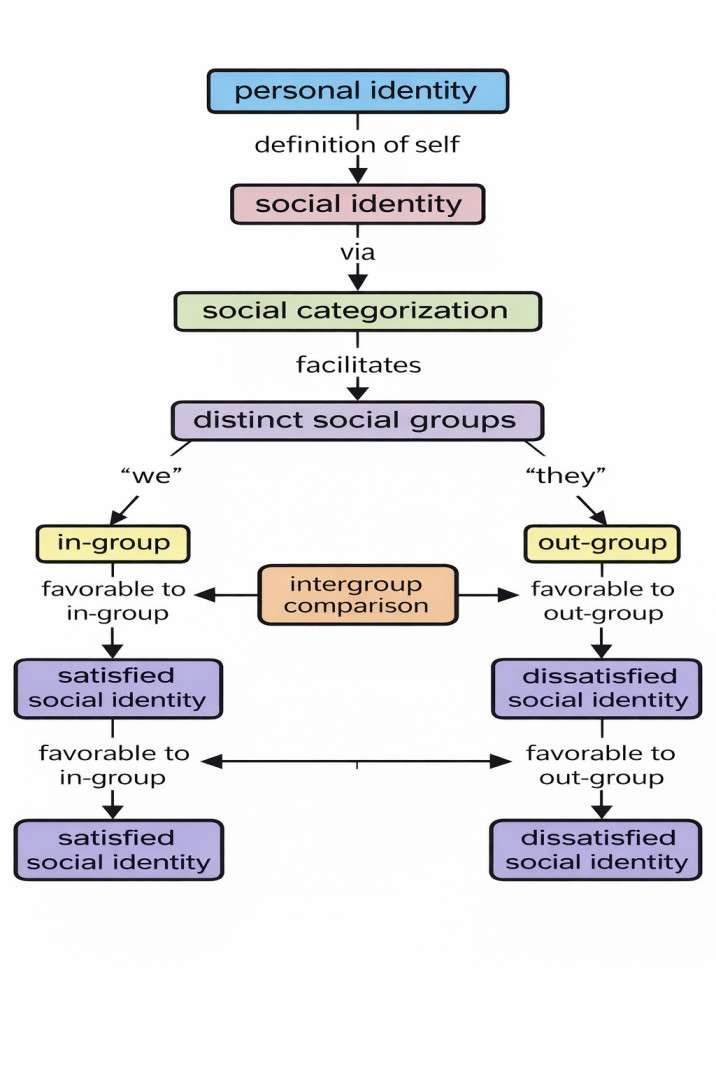
Social Identity Theory (SIT), developed by Henri Tajfel and John Turner in the 1970s and early 1980s, represents perhaps the most influential theoretical framework in the psychology of intergroup relations. Tajfel and Turner were motivated partly by the inadequacies of realistic conflict theory — specifically, its inability to explain the consistent finding that people show in-group favoritism even in the complete absence of realistic conflict.
The Minimal Group Paradigm
The theoretical foundation of SIT rested on Tajfel’s discovery of the minimal group paradigm in the late 1960s and early 1970s. In these experiments, participants were divided into groups on the basis of trivially arbitrary criteria — ostensibly preferring paintings by Klee versus Kandinsky, or the flip of a coin — and then asked to allocate points (representing real money) to anonymous others identified only by group membership. Participants reliably allocated more points to in-group members than out-group members, chose allocation strategies that maximized the relative advantage of the in-group over the out-group even at the cost of absolute in-group gain (maximum differentiation strategy), and exhibited this pattern even when they knew the basis of categorization was arbitrary, when they were anonymous, when they would never meet group members, and when they gained no personal benefit from in-group favoritism.
These findings were deeply surprising because they showed that mere categorization into groups is sufficient to produce discrimination, in the complete absence of competition, personal interest, prior animosity, or meaningful group history. This implied that something fundamental about categorical group membership itself drives intergroup bias.