
Introduction
Economists, sociologists, and demographers have long considered population concerns to be fundamental to understanding human relationships in Theories of Population Growth. Population studies, often known as social demography, investigate the broader causes and effects of population structure and change. Social demographers think that social processes and structures govern demographic processes; similarly to sociologists, they strive to identify the social factors that explain population patterns.
Malthusian Theory of Population Growth
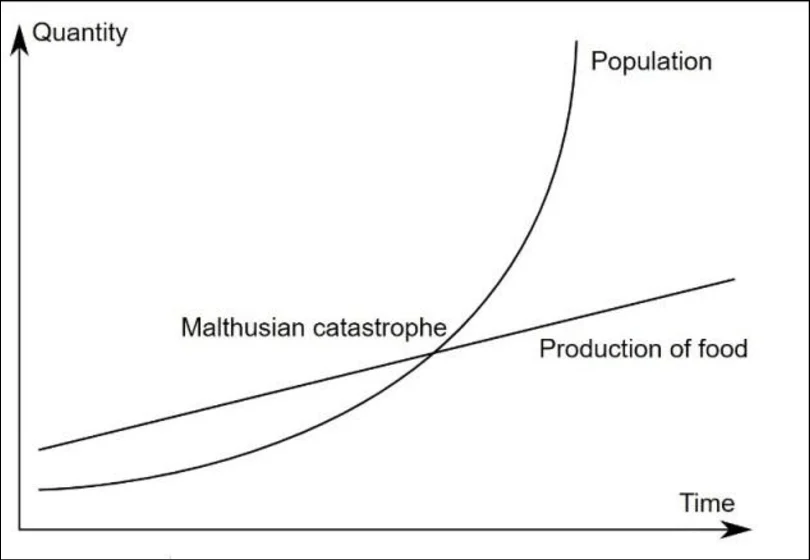
The Malthusian Theory of Population is based on the exponential rise of population and arithmetic food supply. Thomas Robert Malthus proposed the hypothesis. He argued that preventative and positive inspections may be used to achieve a balance between population increase and food availability. According to the theory, the food supply will not be able to keep up with population expansion, leading to sickness, starvation, conflict, and disaster.
- Thomas Robert Malthus (1766-1834) was a pivotal pioneer in the study of population statistics.
- His population formulation was a watershed moment in the history of population ideas. He generalized the link between demographics and social transformation.
- The rate at which human reproduction outpaced the rate at which sustenance from the land could be increased.
- Malthus went on to say that if population growth is unregulated, it will rise in a geometrical ratio. Only in an arithmetic ratio does subsistence rise.’
- In brief, Malthusian theory maintains that the population must be restricted by means of sustenance.
- Unless there are some extremely significant and evident limits, the population will necessarily grow when means of sustenance improve.
- These restraints, as well as the checks that suppress the population’s greater might and maintain its consequences on a par with the means of sustenance, are all resolvable into moral restraint, vice, and suffering.
Major Elements of Malthusian Theory
Population and Food Supply:
- According to the Malthusian idea, population growth occurs in a geometrical pattern.
- At this rate, the population would double in 25 years. The food supply, on the other hand, grows in an arithmetic progression.
- Food supply grows at a slower rate than population growth. That is, in a few years, the food supply will be depleted.
- The scarcity of food suggests that the population is growing.
Checks on Population:
- Disequilibrium develops when the pace of population growth exceeds the rate of food supply.
- As a result, people will not have enough food to survive. People will perish as a result of a shortage of food.
- Adversities like plagues, wars, hunger, famines, and other natural disasters would occur, which Malthus refers to as positive checks. On the contrary, man-made checks known as preventative checks exist.
- The ‘positive’ and ‘preventive’ checks that occur in the human population to prevent excessive growth are related to mortality and fertility practices, respectively.
- Positive and preventive checks, according to Malthus, are inversely related. In other words, while positive checks are very successful, preventative checks are less effective, and vice versa.
- However, in all communities, some of these checks are always in place, albeit in varying degrees of efficacy.
- Malthus argued that, despite these checks, the failure of increased food supply to keep up with population growth always resulted in some kind of overpopulation.
Positive Checks:
- Nature has its own methods of keeping an eye on the growing population. It reduces the population to the amount of available food supply.
- Famines, earthquakes, floods, diseases, wars, and other natural disasters are examples of positive checks.
- When population expansion becomes uncontrollable, nature takes over.
Preventive Checks:
- Preventive measures such as late marriage, self-control, and modest living aid in balancing population growth and food supply.
- These methods not only limit population increase but also have the potential to mitigate the negative consequences of positive controls.
Malthusian Trap:
- The Malthusian Trap is the theory that better levels of food production caused by more improved agricultural practices lead to higher population levels, which ultimately lead to food shortages since the bigger population requires more space to cultivate crops.
- Even though technical improvement would generally lead to increases in per capita wealth, Malthus’s theories that these advantages are not realized since the advancement simultaneously causes population expansion.
- When the population surpasses the capacity of food supply, a Malthusian catastrophe with widespread starvation and illness is said to occur.
- As a result, the population is reduced to prior levels.