

Arthur Lewis, in his model of “Economic Development with Unlimited Supplies of Labour,” argues that economic development occurs through capital accumulation in the modern industrial sector, which progressively draws labour away from the subsistence agricultural sector.
The Lewis model was later modified and extended by Fei and Ranis, but the fundamental essence of both models remains the same.
Both the Lewis and Fei-Ranis models are based on the assumption of surplus labour in the economy, primarily existing as disguised unemployment in agriculture.
The models envisage a dual economic structure consisting of:
A modern sector represented by manufacturing, mining, and plantations.
A traditional/subsistence sector represented by agriculture.
The modern sector is characterised by:
Use of reproducible capital.
Production for the market and profit.
Employment of labour on a wage-payment basis.
Use of modern methods of industrial organisation.
The traditional agricultural sector is characterised by:
Dependence on non-reproducible land.
Predominance of self-employment.
Production mainly for self-consumption.
Use of inferior production techniques.
Presence of surplus labour in the form of disguised unemployment.
Owing to these structural differences, productivity or output per worker is much higher in the modern sector than in the agricultural sector.
The model assumes that over a wide range, the marginal productivity of labour in agriculture is zero because of disguised unemployment, while average productivity remains positive and is equal to the bare subsistence level.
Lewis’ Model of Development with Surplus Labour
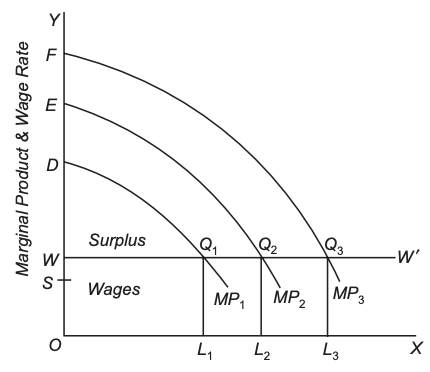
In the Lewis and Fei-Ranis labour-surplus models, the wage rate in the modern industrial sector is determined by the average productivity in the subsistence agricultural sector, plus an additional margin (fixed by Lewis at 30%) to provide an incentive for workers to migrate from rural areas and to compensate for the higher cost of urban living.
Given the existence of surplus labour, the modern sector can obtain any required amount of labour at this fixed wage rate; thus industrial expansion through capital accumulation generates employment opportunities capable of absorbing surplus labour from agriculture and other sectors.
The real wage (OS) represents the average product per worker in the subsistence sector, while the modern-sector wage (OW) is fixed at a level about 30% higher than OS; as long as surplus labour exists, labour supply to the modern sector remains perfectly elastic at wage rate OW.
With an initial stock of industrial capital, labour demand in the modern sector is determined by the marginal productivity of labour curve (MP₁); following the principle of profit maximisation, firms employ labour up to the point where marginal product of labour equals the wage rate (OW), resulting in employment of OL₁ workers.
At this equilibrium:
Workers receive total wages equal to the wage rate multiplied by employment.
The remaining output constitutes the capitalists’ surplus (profits).
Lewis assumes that:
All wages are consumed.
All profits are saved and invested.
When capitalists reinvest profits in establishing new factories or expanding existing ones, the stock of industrial capital increases, which raises labour productivity and shifts the labour demand (marginal productivity) curve outward from MP₁ to MP₂.
With the wage rate remaining constant at OW and labour demand shifting to MP₂:
Employment rises from OL₁ to OL₂.
Capitalists’ profits increase beyond the previous level.
The larger profits generated at the new equilibrium are again reinvested, causing further capital accumulation, which shifts labour demand outward again (e.g., from MP₂ to MP₃) and raises employment further to OL₃.
This cumulative process of profit → investment → capital accumulation → higher labour demand → greater employment continues, enabling the modern sector to absorb increasing amounts of surplus labour from the subsistence sector.
The process continues until all surplus labour is fully absorbed into productive employment, thereby transforming the economy through industrial expansion.
In the Lewis model, the rate of industrial capital accumulation and consequently the rate of surplus labour absorption depend crucially on the distribution of income.
As industrialisation proceeds, the share of profits in the modern sector rises, leading to higher saving and investment rates; the rising profit share serves both:
As an incentive for reinvestment in expanding industrial capacity.
As a source of savings required to finance continued capital accumulation.
Therefore, sustained economic development in the Lewis model is driven by the continuous reinvestment of profits, which expands the modern sector until the economy’s surplus labour is exhausted.