

Introduction
Reciprocal Demand Theory of Terms of Trade is based on a two-country, two-commodity model and assumes: full employment, perfect competition in both product and factor markets, free trade without tariffs or import restrictions, and free domestic mobility of factors within each country.
If these assumptions do not hold in reality, actual terms of trade may differ from those predicted by reciprocal demand; however, like all economic theories, it uses simplifying assumptions, and its validity depends on the soundness of its logic and the correctness of its conclusions regarding the influence of economic forces.
The theory is considered strong because reciprocal demand is undeniably an important determinant of the terms of trade.
F.D. Graham’s criticism:
The theory is applicable mainly to trade in antiques and old masters, which exist in fixed supply and where demand plays the dominant role in determining terms of trade.
For currently produced goods, international values (terms of trade) are determined primarily by comparative production costs (supply conditions).
He argued that the theory overemphasizes reciprocal demand and neglects comparative cost conditions.
Graham’s criticism is regarded as invalid because the concept of reciprocal demand, as represented through the offer curve, incorporates both demand conditions and production-cost (supply) conditions.
In response to Graham, Jacob Viner argued that:
Terms of trade are directly influenced by reciprocal demands and nothing else.
Reciprocal demands themselves are ultimately determined by a combination of cost conditions and the basic utility function.
The theory concludes that terms of trade are determined by reciprocal demands of the trading countries, while reciprocal demands themselves are shaped by both demand factors and supply/cost conditions.
Key determinants of terms of trade include:
The intensity of foreign demand for a country’s exports.
The intensity of that country’s demand for imports from the other country.
The comparative cost conditions of exported and imported goods, which also play an important role in determining the terms of trade.
Trade Barriers: Tariffs, Quotas and Subsidies
Despite the benefits of free trade, countries impose trade barriers, the most important being tariffs and quotas; both can be applied to imports or exports, but are predominantly imposed on imports, while barriers on exports are relatively uncommon.
Tariffs are excise duties imposed on imported goods and are used either to generate government revenue or to protect domestic industries; accordingly, tariffs are classified into revenue tariffs and protective tariffs.
Revenue tariffs are generally imposed on imports of goods that are not produced domestically; their rates are usually low but generate substantial revenue for the government.
Example: In the United States, tariffs on tin, coffee, and bananas—goods not produced domestically—are imposed primarily to raise government revenue.
Protective tariffs are imposed to shield domestic producers from foreign competition; their rates are not set high enough to completely prohibit imports.
By raising the prices of imported goods, tariffs reduce the competitive advantage of foreign producers, thereby protecting domestic industries.
Import quotas are another major instrument used to restrict free trade and refer to the maximum quantity of a good that may be imported during a specified period; they are also known as quantitative restrictions on imports.
Quotas are more effective than tariffs in reducing trade because even high tariffs may still allow substantial imports of a commodity, whereas a low quota completely prevents imports beyond the prescribed limit.
As international negotiations to reduce trade barriers have largely focused on tariffs, many countries have increasingly relied on non-tariff barriers, particularly quotas, to restrict trade.
Effects of a Tariff
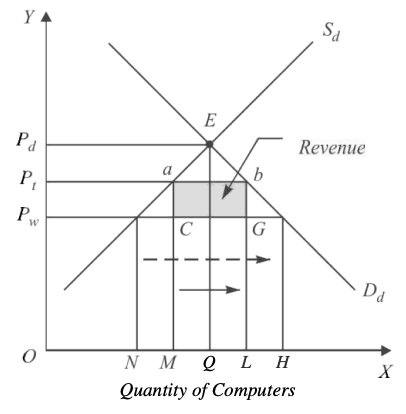
The economic effects of tariffs can be analysed through a partial equilibrium approach using demand and supply analysis; the example considers computers, a product in which India has a comparative disadvantage, while the USA has a comparative advantage.
In the absence of foreign trade, the domestic price is OPd, at which OQ quantity of computers is demanded and supplied domestically; when trade is opened, computers can be imported from the USA at the lower world price OPA (free-trade price).
Under free trade at OPA, domestic consumption rises to OH, domestic producers supply only ON, and the gap NH is met through imports from the USA.
Consumption Effect:
Imposition of a tariff of PP₁ per computer raises the domestic price from OPA to OP₁.
The higher price reduces domestic consumption from OH to OL as consumers move up the demand curve.
Consumers are adversely affected because they pay PP₁ more per computer and purchase fewer computers.
Reduced consumption forces consumers to divert part of their expenditure towards less preferred substitute products.
Production Effect:
Domestic producers benefit from the higher price OP₁ instead of the free-trade price OPA.
Higher prices encourage expansion of domestic production from ON to OM by moving up the domestic supply curve.
The increase in domestic output by NM requires scarce resources to be drawn away from other industries that are presumably more efficient, creating resource reallocation.
Trade Effect:
American producers are harmed because they continue to receive only the world price OPA; the tariff-generated increase in price accrues to the Indian Government, not to foreign producers.
With domestic production increasing from ON to OM and domestic consumption falling from OH to OL, imports decline from NH to ML.
The reduction in imports constitutes the trade effect of the tariff.
Revenue Effect:
The Indian Government gains tariff revenue equal to the tariff per unit multiplied by the reduced volume of imports ML.
Total tariff revenue is represented by the area abGC in the diagram.
This revenue is essentially a transfer of income from consumers to the government and does not represent any net addition to national welfare.
The government gains only a portion of what consumers lose due to higher prices and reduced consumption.
The impact of tariffs extends beyond the domestic market:
Reduced imports by India lower the export earnings of the American computer industry, the industry in which the USA has a comparative advantage.
Lower exports lead to reduced computer production in the USA and shift resources away from the relatively efficient computer industry to relatively inefficient industries where the USA has a comparative disadvantage.
Tariffs therefore cause misallocation of resources internationally.
According to Campbell McConnell and Stanley Brue, specialisation and unrestricted world trade based on comparative advantage promote efficient utilisation of world resources and increase global real output, whereas protective tariffs reduce world trade, diminish the efficient allocation of resources, and ultimately reduce the world’s real output.