Urbanization is a process of socio-economic transformation from traditional rural areas into urban towns. It is a long and continuous process of moving from a spread-out pattern of human settlements to one of concentration in urban centers. India has a long history of urbanization, which dates back to over 5,000 years when the Indus Valley civilization saw the emergence of the world’s first urban settlement. According to the 2011 census, just 31% of India’s population lives in cities. By 2030, another 225 million people will be added to India’s metropolitan regions, i.e. greater than the populations of Japan and Germany combined.
Urbanization
- It is a process of transition from a dispersed pattern of human settlements to a concentrated one in urban areas.
- India has a long history of urbanization, with the Indus Valley Civilisation being regarded as the world’s earliest urban community.
- During ancient times, there were several well-planned and magnificent towns in various parts of the world.
- According to the United Nations, India’s urban population will be around 40% in 2030.
- In comparison to many other emerging countries, India’s urbanization has been rather sluggish during the last century.
Causes of Urbanisation in India
The rise of industries has contributed to the growth of cities, people have begun to migrate to industrial districts in search of work, resulting in urbanization. The following are some of the factors that contributed to the rise of cities:
- As a result of the industrial revolution, more individuals are moving from rural to urban areas in search of better economic opportunities resulting in urbanization.
- Commerce and trade play a significant role in urbanization. Distribution of goods and services and commercial transactions resulted in the development of modern market organizations and exchange systems that have accelerated the construction of towns and cities.
- Employment opportunities: Numerous job opportunities in cities and towns attract individuals from rural areas in search of a better life.
- Living in cities and towns provides various social advantages like better educational facilities, higher living standards, improved sanitation and housing, improved health care, improved recreation facilities, etc.
- Modernization has a big impact on urbanization. People believe they may have a happy life in cities with more technologically advanced, highly sophisticated communication, infrastructure, medical facilities, dressing code, enlightenment, liberalism, etc.
- Changes in their lifestyles such as residential habits, attitudes, clothing, food, and beliefs attract people to move to cities.
Features of Urbanisation
- The size of an urban community is substantially larger than that of a rural community in a country. The size of a community and its urbanity are correlated.
- In urban areas, people are more likely to live in nuclear families, and family disintegration is a common occurrence.
- Urban settlements have a high prevalence of love marriages and inter-caste marriages, divorce cases are also very common.
- Co-existence of slums for the poor and elegant bungalows for the wealthy is a common feature of urban areas.
- Social mobility is a significant aspect of an urban community, an individual’s social rank is defined by his merit, intelligence, and perseverance rather than his birth.
- Urban society is a materialistic society and the value of an individual is determined by what he owns rather than what he is. Status symbols such as financial possessions, income, and high-end household appliances are extremely important.
- Urbanites place a high value on their personal well-being and happiness and have no time to think about societal well-being.
- In the urban community, rationality is emphasized. People are prone to reasoning and debating and their interactions with others are governed by the notion of gain or loss.
- The secular outlook in cities has diluted the rituals, kinship, caste, and religious considerations.
- Some other features of urban settlements are cultural heterogeneity, high population density, modernization, nonagricultural economy, etc.
Status of Urbanisation in the World
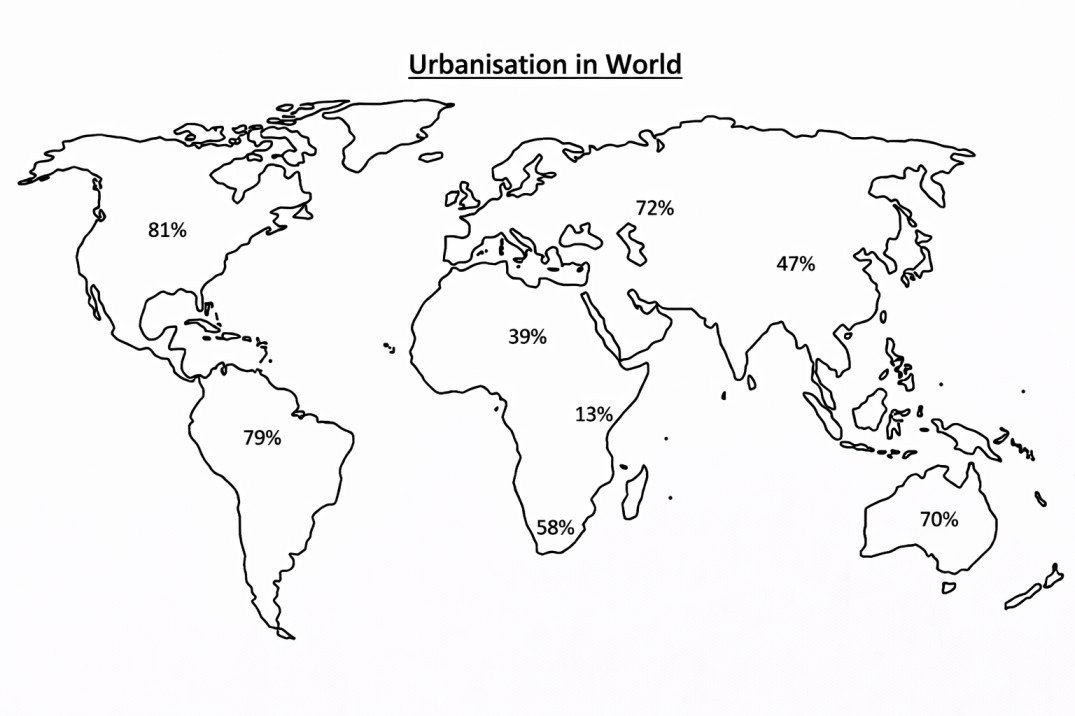
- The developed countries have a high level of urbanization, most of the developed countries have more than 80 percent of urbanization.
- Developing countries are characterized by a low level of urbanization varying between 10 to 40 percent.
- The urban growth rate of emerging countries is relatively high compared to developed countries.
- The global urban population is rapidly increasing, from 17% in 1951 to 20% in 2001, and is anticipated to expand by 68% by 2050.