

In classical (Victorian) economics, utility was viewed as a numerical measure of a person’s happiness or well-being. Consumers were assumed to make choices that maximize utility, meaning they selected the consumption bundle that made them as happy as possible.
This classical interpretation faced major conceptual problems because economists could not explain how utility should be measured. Important unresolved questions included:
How can the amount of utility associated with different choices be quantified?
Can one person’s utility be meaningfully compared with another’s?
What does it mean to say that one good provides twice as much utility as another?
Does utility have any independent meaning apart from being the quantity consumers maximize?
Because of these measurement difficulties, economists abandoned the view of utility as a measure of happiness. Modern consumer theory is instead based on consumer preferences, with utility serving only as a convenient way of representing those preferences.
Economists recognized that, for explaining consumer choice, the ordering of consumption bundles is what matters, not the numerical size of utility differences. Whether one bundle has higher utility than another is important; how much higher the utility is has no effect on choice behavior.
Originally, preferences were defined in terms of utility:
A bundle:
[
(x_1,x_2)
]
was preferred to:
[
(y_1,y_2)
]
if the utility of the first bundle exceeded that of the second.Modern theory reverses this relationship: preferences are the fundamental concept, and utility is simply a numerical representation of those preferences.
A utility function assigns a number to every possible consumption bundle so that more-preferred bundles receive larger numbers than less-preferred bundles. Formally:
[
(x_1,x_2)\succ(y_1,y_2)
\quad\Longleftrightarrow\quad
u(x_1,x_2)>u(y_1,y_2).
]
Thus, a utility function preserves the consumer’s preference ranking of consumption bundles.The only essential property of a utility function is that it correctly orders the consumption bundles according to the consumer’s preferences. The actual numerical values assigned to the bundles have no independent significance.
Since only the ranking (ordering) of bundles matters and not the magnitude of utility differences, this type of utility is called ordinal utility.
Different utility functions can represent the same preferences as long as they preserve the same ordering of consumption bundles. For example, if a consumer prefers:
[
A\succ B\succ C,
]
then any numerical assignment satisfying:
[
u(A)>u(B)>u(C)
]
is a valid utility function, regardless of the specific numbers assigned. All such utility functions represent identical consumer preferences because they produce the same ranking of the bundles.
Different Ways to Assign Utilities
| Bundle | U₁ | U₂ | U₃ |
|---|---|---|---|
| A | 3 | 17 | -1 |
| B | 2 | 10 | -2 |
| C | 1 | 0.002 | -3 |
Since only the ranking of consumption bundles matters in ordinal utility, there is no unique utility function. Once one valid utility assignment is found, infinitely many other utility functions can represent the same preferences.
If a utility function is:
[
u(x_1,x_2),
]
then multiplying it by any positive constant produces another equally valid utility function. For example:
[
2u(x_1,x_2)
]
represents the same consumer preferences because it preserves the ranking of all consumption bundles.Multiplying a utility function by a positive number is an example of a monotonic transformation. A monotonic transformation changes the numerical values of utility while preserving their order, so the consumer’s preference ranking remains unchanged.
A monotonic transformation is generally represented by a function:
[
f(u),
]
which transforms each utility value (u) into a new value (f(u)) such that:
[
u_1>u_2
\quad\Longrightarrow\quad
f(u_1)>f(u_2).
]
Since the ordering is preserved, monotonic transformations and monotonic functions are essentially the same concept in consumer theory.Common examples of monotonic transformations include:
Multiplying by a positive constant:
[
f(u)=3u.
]Adding a constant:
[
f(u)=u+17.
]Raising utility to an odd power:
[
f(u)=u^3.
]Any other transformation that preserves the original ordering of utility values.
The rate of change of a transformation function is measured by:
[
\frac{\Delta f}{\Delta u}\frac{f(u_2)-f(u_1)}{u_2-u_1}.
]For a monotonic transformation, the numerator:
[
f(u_2)-f(u_1)
]
always has the same sign as the denominator:
[
u_2-u_1.
]
Consequently:
[
\frac{\Delta f}{\Delta u}>0,
]
meaning a monotonic function always has a positive rate of change.Since the rate of change is always positive, the graph of a monotonic function is upward sloping (positive slope). As the original utility increases, the transformed utility also increases, ensuring that the preference ordering of consumption bundles remains unchanged.
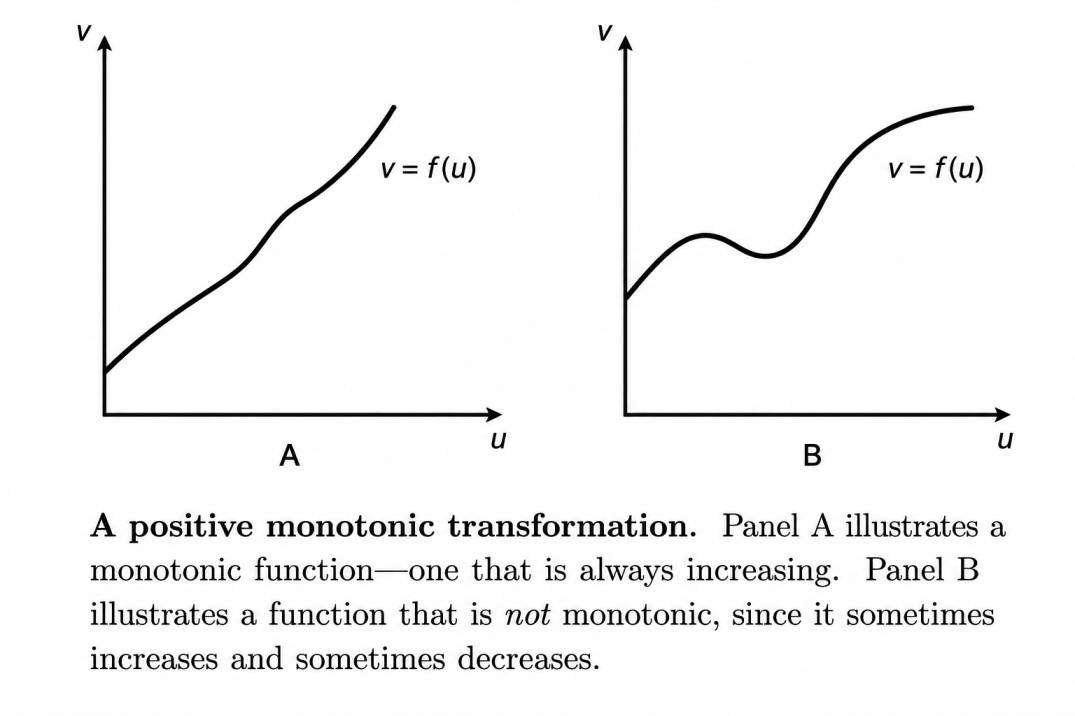
If:
[
u(x_1,x_2)
]
is a utility function representing a consumer’s preferences, then any monotonic transformation of that utility function,
[
f!\left(u(x_1,x_2)\right),
]
is also a valid utility function representing exactly the same preferences.This result follows from three logical steps:
A utility function represents preferences if:
[
u(x_1,x_2)>u(y_1,y_2)
\quad\Longleftrightarrow\quad
(x_1,x_2)\succ(y_1,y_2).
]
Thus, a bundle is preferred if and only if it is assigned a higher utility.If:
[
f(u)
]
is a monotonic transformation, then it preserves the ordering of utility values:
[
u(x_1,x_2)>u(y_1,y_2)
\quad\Longleftrightarrow\quad
f!\left(u(x_1,x_2)\right)>
f!\left(u(y_1,y_2)\right).
]Combining these two results gives:
[
f!\left(u(x_1,x_2)\right)>
f!\left(u(y_1,y_2)\right)
\quad\Longleftrightarrow\quad
(x_1,x_2)\succ(y_1,y_2).
]
Therefore,
[
f!\left(u(x_1,x_2)\right)
]
represents the same consumer preferences as the original utility function.
The fundamental principle is that a monotonic transformation of a utility function is itself a valid utility function representing exactly the same preferences because it preserves the ranking of all consumption bundles.
Geometrically, a utility function can be viewed as a method of labeling indifference curves:
Every bundle lying on the same indifference curve receives the same utility value because the consumer is indifferent among those bundles.
Higher indifference curves, representing more preferred bundles, receive larger utility numbers than lower indifference curves.
From this geometric perspective, a monotonic transformation simply relabels the indifference curves without changing their order. Although the numerical labels assigned to the curves change, the underlying preference ranking remains identical.
As long as more-preferred indifference curves continue to receive higher utility values than less-preferred indifference curves, the transformed utility function represents exactly the same consumer preferences as the original utility function.