
Population Growth
- The size of a population for any species is not a static parameter. It keeps changing in time, depending on various factors including food availability, predation pressure and reduced weather. In fact, it is these changes in population density that give us some idea of what is happening to the population, whether it is flourishing or declining.
- Whatever might be the ultimate reasons, the density of a population in a given habitat during a given period, fluctuates due to changes in four basic processes, two of which (natality and immigration) contribute an increase in population density and two (mortality and emigration) to a decrease.
- Natality refers to the number of births during a given period in the population that are added to the initial density.
- Mortality is the number of deaths in the population during a given period.
- Immigration is the number of individuals of the same species that have come into the habitat from elsewhere during the time period under consideration.
- Emigration is the number of individuals of the population who left the habitat and gone elsewhere during the time period under consideration.
- Under normal conditions, births and deaths are the most important factors influencing population density, the other two factors assuming importance only under special conditions. For instance, if a new habitat is just being colonised, immigration may contribute more significantly to population growth than birth rates.
- The rapid growth of population is one of the greatest obstacles in the progress of developing countries. If the population grows fast, poverty cannot be eradicated. Progress made in the fields of agriculture, industry and technology fails to cope with the needs of a rapidly growing population. Thus, overpopulation leads to poverty and unemployment.
- A high rate of birth and a decline in death rates have resulted in population explosions, especially in underdeveloped countries. The Census Report of 2001 states that while in Europe, the population growth rate is 0.3 per cent, in India it is about 2.1 per cent. Countries like Scandinavia and Russia have a negative growth of population which also leads to problems like shortage of manpower.
- If the world population can be evenly distributed and a free flow of people throughout the world ensured, the problem of population explosion may be solved. Besides, to counter excessive population, the government should take up family planning schemes and spread awareness and literacy. The Indian government has taken up several family planning projects.
Characteristics of Population Growth
- Exponential Growth
- Doubling Time
- Infant Mortality Rate
- Total Fertility Rate
- Replacement Level
- Male/Female Ratio
- Demographic Transition
Growth Models
We have been concerned about unbridled human population growth and problems created by it in our country and it is therefore natural for us to be curious if different animal populations in nature behave the same way or show some restraints on growth. Perhaps we can learn a lesson or two from nature on how to control population growth.
There are two types of growth curves:
- S-shaped growth curve
- J-shaped growth curve
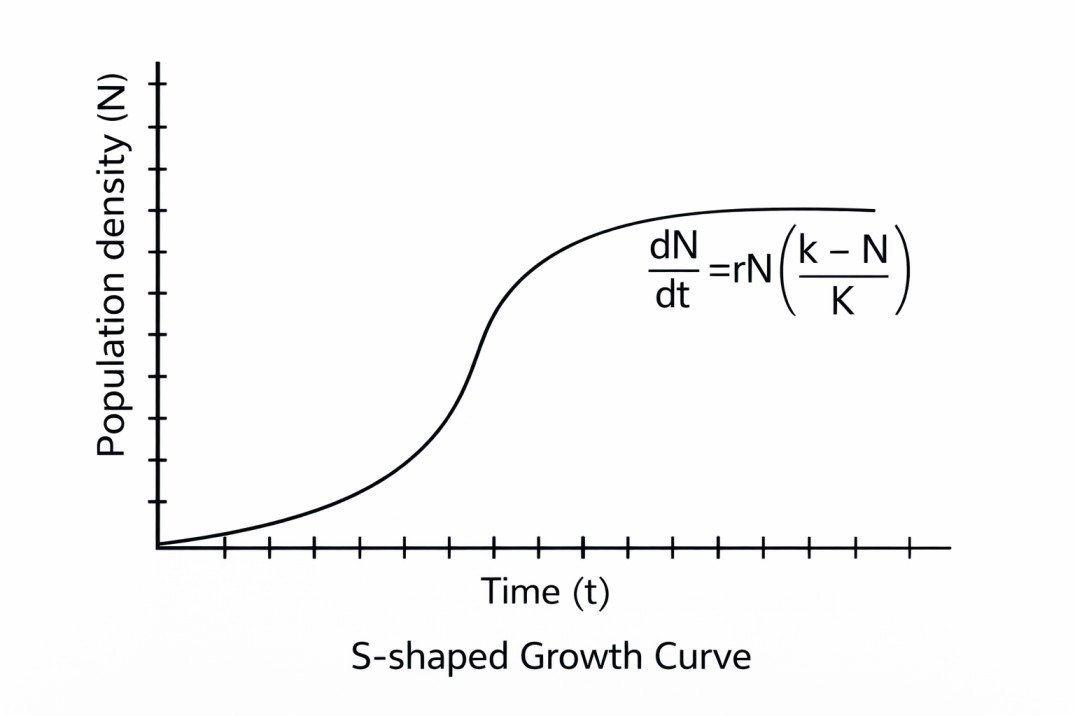
Difference between S-shaped Growth curve and J-shaped Growth Curve:
| S-shaped growth curve | J-shaped growth curve |
|---|---|
| 1. It has three phases, i.e., early phase of no growth, middle phase of rapid growth and stationary phase of zero growth. | 1. It has three phases, i.e., early phase of no growth, middle phase of rapid growth, last phase stops abruptly due to mass starvation and mortality. |
| 2. In the last phase, the number of new cells produced is almost the same as the number of dying cells. | 2. In the last phase, growth stops due to the stoppage of food supply. |
| 3. It is applicable to many microorganisms, plants and animals. | 3. It is not applicable to many microorganisms and animals. |