
Europe in 1914
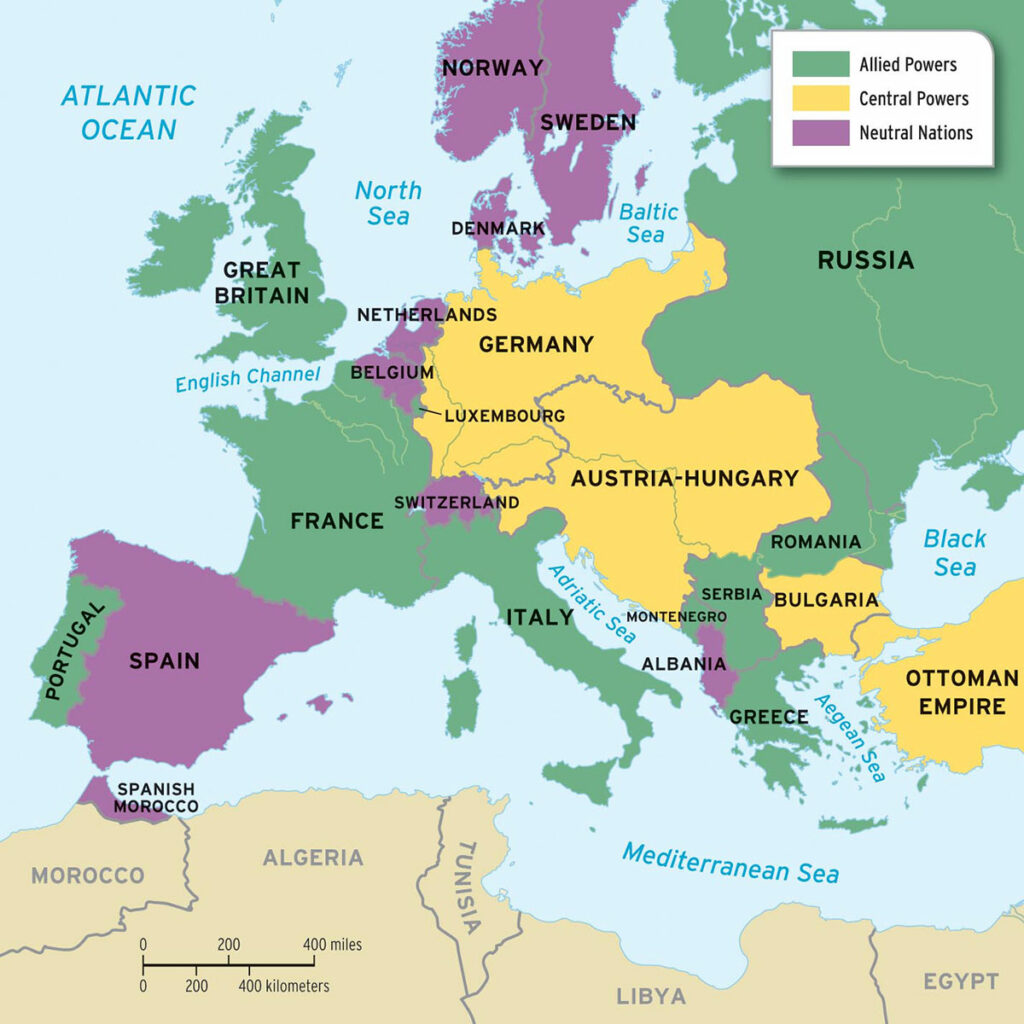
- In 1914, Europe was the force to reckon with. European countries were having vast colonies in different parts of the world and thus decisions of the European powers used to decide the fortunes of the millions of people around the globe. European countries were strong both economically and militarily. Major European powers of the time were Britain, Germany, France, Austria-Hungary, Italy and Russia. Britain and Germany were leading the rest in this pack. Political systems of these powers were also varied widely.
- Britain and France were democracies. Germany had an elected lower house of the parliament, but real powers were exercised by the Chancellor and the Kaiser (King). Austria-Hungary and Russia were autocracies. Italy was a monarchy with an elected parliament (but right to vote was based on property qualification).
Causes of World War I
- World War I was the first of its kind war. Before it, the world had never seen war of such proportion and scale. Destruction caused by this war was far greater than any preceding conflict. It was a war fought by many countries in different continents and it continued for four years. It resulted in large scale deaths and changed the fortunes of many countries.
- That’s why it raised the question, ‘What caused the war of these proportions?’ Below are listed some of the reasons which have been suggested for the escalation of the war.
Alliance System
- Otto Von Bismarck was the Chancellor of unified Germany from 1871-90. After the unification in 1871, Germany had emerged as the most powerful nation in continental Europe. Bismarck wanted to maintain the status quo and prevented formation of any anti-German alliance so that Germany remains supreme in the continental Europe. To achieve these objectives Bismarck adopted a system of peacetime military alliances. Dual alliance was signed in 1879 with Austria-Hungary and in 1882 Italy joined this system making it Triple alliance. With the Russia, Reinsurance treaty was signed in 1887.
- These alliances achieved the immediate foreign policy objectives of Bismarck. However, in the long term these alliance systems proved extremely harmful for the peace of Europe. These treaties were never published in totality and there was always secrecy about their nature and content. After the exit of Bismarck from the office of the Chancellor, the counter alliances were also formed which split the Europe into two hostile armed camps.
- In 1894, Franco-Russian alliance was formed. In 1904, Britain and France signed ‘Entente Cordiale’ and in 1907 Britain and Russia came together and signed an alliance. Suspicions kept mounting between these opposing camps and, according to many, these alliances were the main reason for spread of war and turning war into a total war.
Colonial Rivalry
- European countries had a vast colonial empire, they were used as monopolized markets and source of raw materials for the colonial masters. By 1900 the British Empire extended over five continents and France had control of large areas of Africa. With the rise of industrialized countries needed new markets. The amount of lands ‘owned’ by Britain and France increased the rivalry with Germany who had entered the scramble to acquire colonies late and only had small areas of Africa.
- After the German unification of 1871, Germany had emerged as the most powerful country, economically and militarily, in continental Europe. However, the colonial empire of Germany was neither extensive nor economically very rewarding in comparison with many of the European countries.
- Till the time Bismarck was the German Chancellor, Bismarck did not allow German ambition to vitiate European peace in this matter. After his ouster from the office of the chancellor German ambitions were not kept in check by their leaders.
- The aggressive policies of Kaiser Wilhelm II (1888 – 1918) to acquire colonies in Africa created bad blood between some countries and their populations, which led many to believe that it created a hostile environment which contributed towards the outbreak of World War I.
Naval Race
- Britain was the world’s greatest sea power during those days. With an ambition to have a vast colonial empire, Germany started building a vast and powerful navy. At first this German naval expansion did not bother Britain because they had an enormous lead. However, the introduction of ‘Dreadnought’ type of battleship in 1906 changed the whole scenario. It made all other battleships obsolete. It intensified the naval rivalry since both countries had to start on equal terms. For many of the British, this naval expansion of Germany was the sign that Germany intended to make war against Britain.
Economic Rivalry
- It has been argued by many that economic rivalry was the main reason that Germany went to war with Britain. Colonial rivalry was considered as a by product of this economy rivalry by proponents of this theory. As per them to achieve the economy mastery of the world, it was necessary to destroy the British economic supremacy by war. This was the reason the German businessmen and the capitalists also supported war with Britain.
Situation in Balkan
- Weakening of Ottoman Empire had made the situation in Balkan problematic. It had given rise to the aspirations and ambitions of different empires and nationalities (Habsburg Empire, Russian Empire, Serbs, Croats, Slavs etc.). Serbian nationalism was presenting the most serious challenge in keeping the Balkan peninsula peaceful. Serbian nationalists had resented the 1878 Treaty of Berlin. Annexation of Bosnia, an area desired by Serbia, by Austria in 1908 made the situation more volatile and complicated .
- The Serbian ambition of creating a large South Slav Kingdom was posing existential threat to the Habsburg Empire, which was an amalgamation of many different nationalities. If the Serbs and Croats were allowed to leave the fold, it was expected that many other nationalities within the Habsburg Empire would demand their independence as well. Russian support for Serbia had made Serbia more aggressive.
- Balkan wars of 1912 and 1913 had made Serbia stronger and more determined to challenge Austrian occupation of Bosnia. It had made Austrians equally determined to end Serbian ambitions through military means. Assassination of Austrian Archduke in 1914 did provide an opportunity to end Serbian aspirations and Austria was determined to use it for its benefit .