
Elements of Weather and Climate
Weather refers to short term changes in atmospheric conditions whereas climate refers to long-term weather observation. Weather is nothing more than the various elements that make it up, as well as how they interact with one another to produce various atmospheric conditions and weather events.
| Weather | Climate |
|---|---|
| Weather denotes hour by hour and day-by-day conditions of the atmosphere. | The average state of weather over a lengthy period of time is referred to as climate. |
| The weather fluctuates frequently. | Climate does not fluctuate frequently. |
| This phenomenon is limited to smaller areas, such as a district or a state. | Climate is dependent on larger areas such as the state or national territory. |
| Collective meteorological data is used to forecast weather. | Weather records collected over a long period of time is used to forecast climate. |
- Weather is nothing more than the various elements that make it up, as well as how they interact with one another to produce various atmospheric conditions and weather events.
- All-weather is driven by eight basic elements/factors.
The primary elements include:
- Temperature
- Atmospheric Pressure
- Wind
- Precipitation
- Humidity
- Visibility
- Clouds
- Duration of Sunshine
Let us have a look in detail at these elements:
Temperature
- Temperature is a measure of the amount of kinetic energy in the air that manifests physically as heat or cold.
- The Celsius, Fahrenheit, and Kelvin scales are commonly used to measure temperature.
- A thermometer is a device that is used to measure temperature.
- In more practical terms, kinetic energy is created when particles in the air move or vibrate at a given speed.
- The temperature rises as the particles begin to move/rotate faster.
- The temperature begins to drop as the particles begin to slow down.
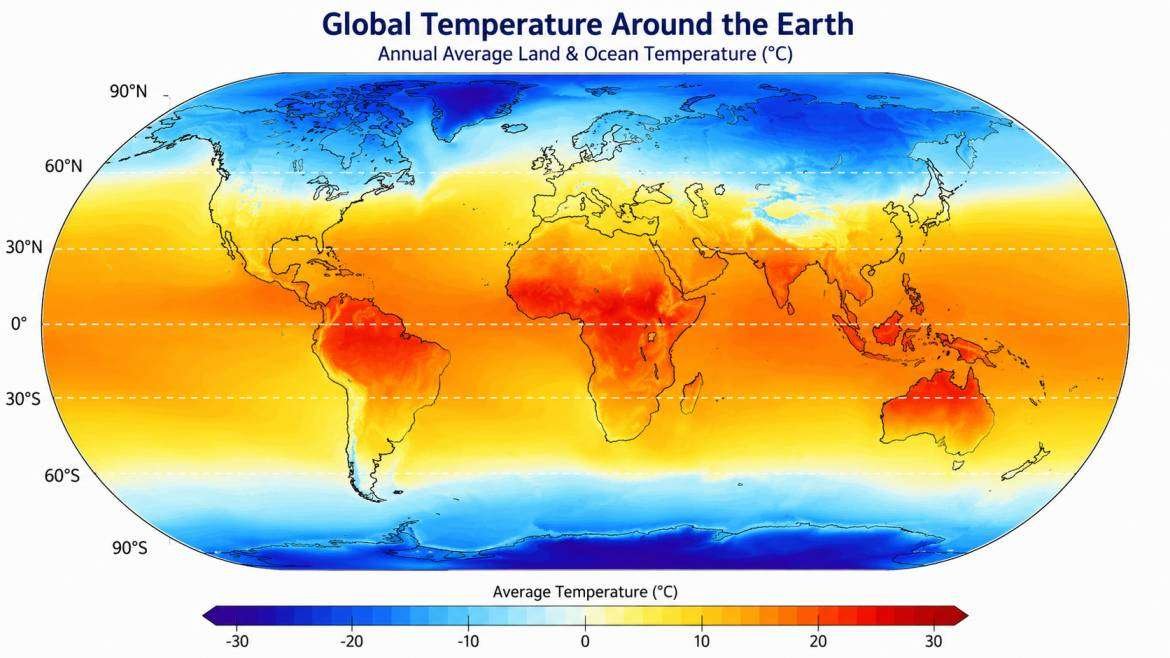
Temperature around the Earth
Atmospheric Pressure
- Another important aspect of weather is air pressure, which is especially important when it comes to establishing or changing atmospheric conditions.
- It’s also one of the most important factors in precise weather forecasting.
- The pressure formed by the weight of air in the Earth’s atmosphere is known as air pressure.
- It’s also known as barometric pressure, named after the device that measures air pressure.
- Air has weight, even if it isn’t apparent, because it isn’t empty.
- It’s filled with nitrogen, oxygen, argon, carbon dioxide, and a few more gases in microscopic particles.
- Due to the gravitational force of the Earth, the weight of the particles in the air causes pressure.
- Because there is more air above the air near the ground, air pressure is higher.
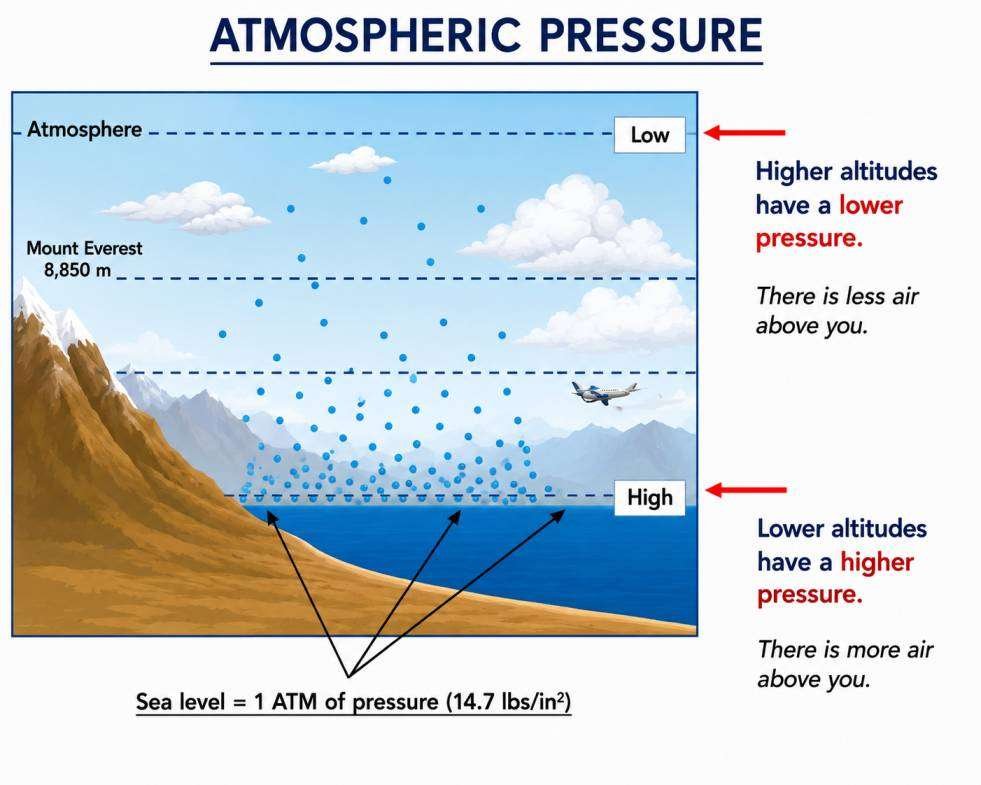
Atmospheric Pressure