
Introduction
The natural movement of air or other gases relative to a planet’s surface is referred to as wind. Changes in air pressure, which are mostly caused by temperature differences, create wind. When there is a difference in atmospheric pressure, air travels from the higher to the lower pressure area, resulting in varying speeds of wind.
- The wind is the movement of air caused by differences in air pressure in our atmosphere.
- High-pressure air flows toward low-pressure areas.
- The greater the pressure difference, the faster the air flows.
- Winds also cause heat exchange between the various columns of air across the latitudes.
- Winds help to balance the world’s unequal pressure distribution.
Winds are generally divided into four categories:
- Planetary winds
- Periodic winds
- Variable winds
- Local winds
Planetary Winds
The primary winds are the winds that always blow in the same direction all year. They are also known as planetary winds, prevailing winds, or persistent winds. Trade winds, westerlies, and polar winds are examples of these winds.
- On average, the location of high and low-pressure belts on the globe is thought to be stationary (though they are seldom stationary).
- Winds blow from high-pressure belts to low-pressure belts as a result.
- The direction of such winds remains relatively constant throughout the year, though their extent varies seasonally.
- As a result, such winds are referred to as permanent winds.
- Because these winds are distributed all over the world and are related to thermally and dynamically induced pressure belts and the rotation of the earth, they are referred to as planetary winds.
- Trade winds, westerlies, and polar winds are examples of these winds.
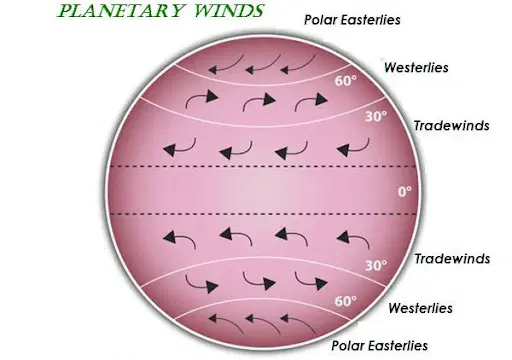
Planetary Winds
Trade Winds
- The trade winds are the winds that blow from subtropical high-pressure areas to the equatorial low-pressure belt.
- As a result, they are restricted to a portion of the earth’s surface between 30°N and 30°S.
- In the northern hemisphere, they flow as the north-eastern trades, while in the southern hemisphere, they flow as the south-eastern trades.
- The Coriolis force and Farrel’s law are used to explain the deflection in their predicted north-south orientation.
- In their origin areas (subtropical high-pressure band), trade winds are descending and stable, but as they approach the equator, they grow humid and warmer after collecting up moisture along the route.
- At the equator, trade winds from two hemispheres meet, and due to convergence, they ascend, causing heavy rainfall.
- Eastern trade winds, which are connected with cool ocean currents, are drier and more stable than western trade winds.
- Winds blowing from subtropical high-pressure areas to the equatorial low-pressure belt are known as trade winds.
- As a result, they are only found between 30°N and 30°S on the earth’s surface.
- They flow as the north-eastern trades in the northern hemisphere and as the south-eastern trades in the southern hemisphere.
- The distortion in their projected north-south direction is explained using the Coriolis force and Farrel’s law.
- Trade winds are descending and steady in their origin areas (subtropical high-pressure system), but as they approach the equator, they become humid and warmer after accumulating moisture along the way.
- Trade winds from both hemispheres meet at the equator, and due to convergence, they ascend, causing heavy rainfall.
- Eastern trade winds are drier and more steady than western trade winds because they are linked to cool ocean currents.