
Subject resourcesQuick Links
Unit I. Geomorphology↗Unit II. Climatology↗Unit III. Oceanography↗Unit IV. Geography of Environment↗Unit V. Population and Settled Geography↗Unit VI. Geography of Economic Activities and Regional Development↗Unit VII. Cultural, Social and Political Geography↗Unit VIII. Geographic Thought↗Unit IX. Geographical Techniques↗Unit X. Geography of India↗
Unit I. Geomorphology↗Unit II. Climatology↗Unit III. Oceanography↗Unit IV. Geography of Environment↗Unit V. Population and Settled Geography↗Unit VI. Geography of Economic Activities and Regional Development↗Unit VII. Cultural, Social and Political Geography↗Unit VIII. Geographic Thought↗Unit IX. Geographical Techniques↗Unit X. Geography of India↗
1. Geomorphology↗2. Climatology↗3. Oceanography↗4. Geography of Environment↗5. Population & Settlement Geography↗6. Geography of Economic Activities & Regional Development↗7. Cultural, Social & Political Geography↗8. Geographic Thought↗9. Geographical Techniques↗10. Geography of India↗11. Models & Theory↗
Circulation: Warm and Cold Currents
(Detailed Notes)
Unit 3
UGC NET GEOGRAPHY
Language
Choose your preferred language
Circulation: Warm and Cold Currents
🎨 Reading Colors
Background
Text Color
Table of Contents
- Introduction
- Types of Ocean Currents
- Based on Depth
- Based on Temperature
- Forces Responsible For Ocean Currents
- Primary Forces
- Secondary Forces
- Important Ocean Currents
- Causes of Ocean Currents
- Planetary Winds
- Variation in Seawater Temperatures
- Variation in Water Salinity
- Rotation of Earth
- Configuration of the Coastline
- Desert Formation and Ocean Currents
- Atlantification
Introduction
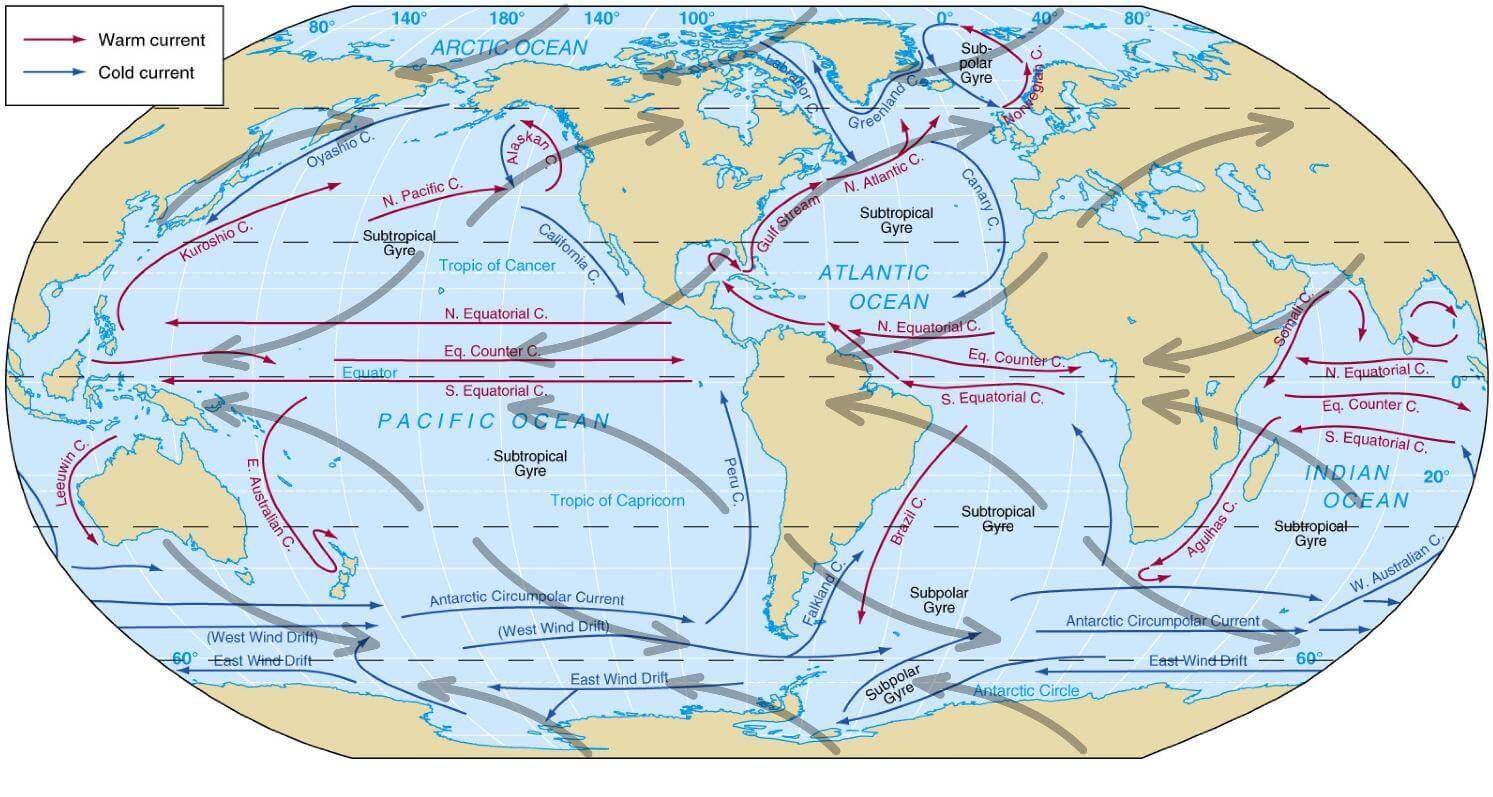
- Ocean currents are the continuous, predictable, directional movement of seawater. It is a massive movement of ocean water that is caused and influenced by various forces. They are like river flows in oceans.
- Ocean water moves in two directions: horizontally and vertically.
- Horizontal movements are referred to as currents, while vertical changes are called upwellings or downwellings.
- Ocean currents impact humankind and the biosphere due to their influence on climate.

Types of Ocean Currents
Based on Depth
- The ocean currents may be classified based on their depth as surface currents and deep water currents:
- surface currents constitute about 10 percent of all the water in the ocean, these waters are the upper 400 m of the ocean;
- deep water currents make up the other 90 percent of the ocean water. These waters move around the ocean basins due to variations in density and gravity.
- The density difference is a function of different temperatures and salinity
- These deep waters sink into the deep ocean basins at high latitudes where the temperatures are cold enough to cause the density to increase.