
Subject resourcesQuick Links
Unit I. Geomorphology↗Unit II. Climatology↗Unit III. Oceanography↗Unit IV. Geography of Environment↗Unit V. Population and Settled Geography↗Unit VI. Geography of Economic Activities and Regional Development↗Unit VII. Cultural, Social and Political Geography↗Unit VIII. Geographic Thought↗Unit IX. Geographical Techniques↗Unit X. Geography of India↗
Unit I. Geomorphology↗Unit II. Climatology↗Unit III. Oceanography↗Unit IV. Geography of Environment↗Unit V. Population and Settled Geography↗Unit VI. Geography of Economic Activities and Regional Development↗Unit VII. Cultural, Social and Political Geography↗Unit VIII. Geographic Thought↗Unit IX. Geographical Techniques↗Unit X. Geography of India↗
1. Geomorphology↗2. Climatology↗3. Oceanography↗4. Geography of Environment↗5. Population & Settlement Geography↗6. Geography of Economic Activities & Regional Development↗7. Cultural, Social & Political Geography↗8. Geographic Thought↗9. Geographical Techniques↗10. Geography of India↗11. Models & Theory↗
Demographic Transition
(Detailed Notes)
Unit 5
UGC NET GEOGRAPHY
Language
Choose your preferred language
Demographic Transition
🎨 Reading Colors
Background
Text Color
Table of Contents
- Demographic Transition
- Demographic Transition Theory
- Stages of Demographic Transition Theory
- First Stage
- Second Stage
- Third Stage
- Fourth Stage
- Criticisms
- Demographic Transition in India
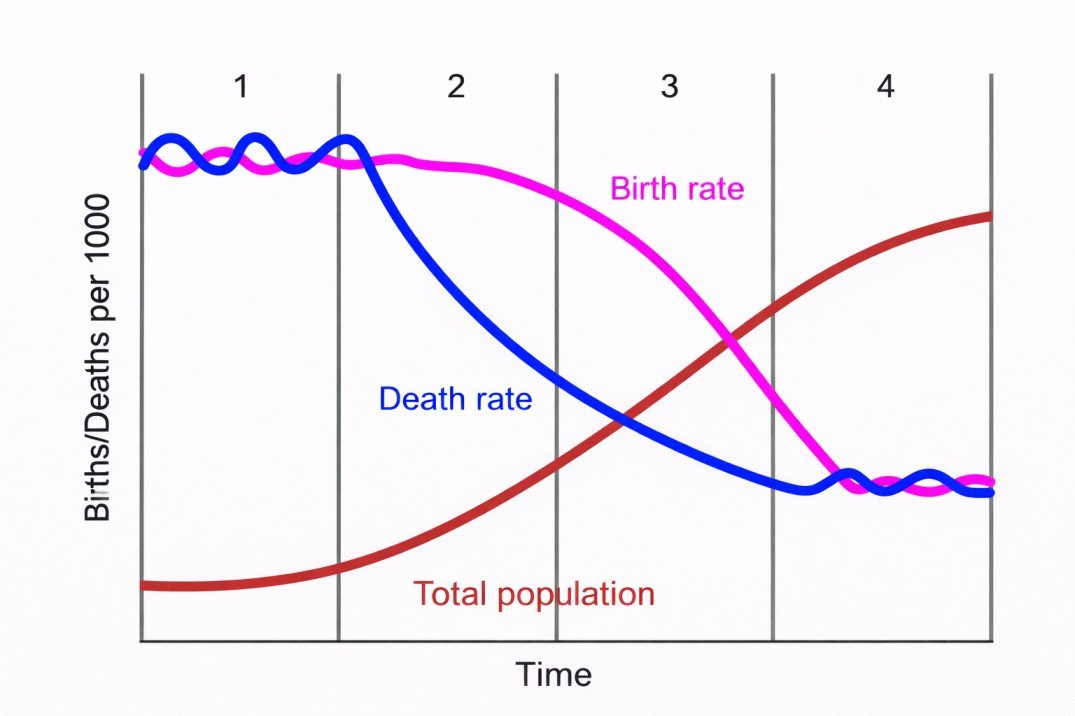
Demographic transition is a long-term trend in birth and death rates that results in a significant shift in a population's age distribution. Demographic transition theory can be used to describe and forecast any area's future population. These demographic data are critical for the development and implementation of state policies, particularly those aimed at economic development and general public welfare.
Demographic Transition
- "Demographic transition" refers to a population cycle that begins with a decrease in the death rate, continues with a period of rapid population growth, and ends with a decrease in the birth rate, according to E.G. Dolan.
- The term demographic transition was coined by Warren S. Thompson (1929) and later popularized by Frank W. Notestein (1945) to describe a historical process of change that explains trends in births, deaths, and population growth in today's industrialized societies, particularly European societies.
- The demographic transition should be viewed as a generalized description of the evolutionary process rather than a 'law of population growth.'
- In a nutshell, it is a theory that attempts to specify general laws that govern how human populations change in size and structure as a result of industrialization.
- It is widely accepted as a useful tool for describing a country's demographic history.
 Demographic Transition