
Subject resourcesQuick Links
Unit I. Geomorphology↗Unit II. Climatology↗Unit III. Oceanography↗Unit IV. Geography of Environment↗Unit V. Population and Settled Geography↗Unit VI. Geography of Economic Activities and Regional Development↗Unit VII. Cultural, Social and Political Geography↗Unit VIII. Geographic Thought↗Unit IX. Geographical Techniques↗Unit X. Geography of India↗
Unit I. Geomorphology↗Unit II. Climatology↗Unit III. Oceanography↗Unit IV. Geography of Environment↗Unit V. Population and Settled Geography↗Unit VI. Geography of Economic Activities and Regional Development↗Unit VII. Cultural, Social and Political Geography↗Unit VIII. Geographic Thought↗Unit IX. Geographical Techniques↗Unit X. Geography of India↗
1. Geomorphology↗2. Climatology↗3. Oceanography↗4. Geography of Environment↗5. Population & Settlement Geography↗6. Geography of Economic Activities & Regional Development↗7. Cultural, Social & Political Geography↗8. Geographic Thought↗9. Geographical Techniques↗10. Geography of India↗11. Models & Theory↗
Electoral Reforms in India
(Detailed Notes)
Unit 7
UGC NET GEOGRAPHY
Language
Choose your preferred language
Electoral Reforms in India
🎨 Reading Colors
Background
Text Color
Table of Contents
- Major Challenges In The Indian Electoral System
- Criminalization Of Politics
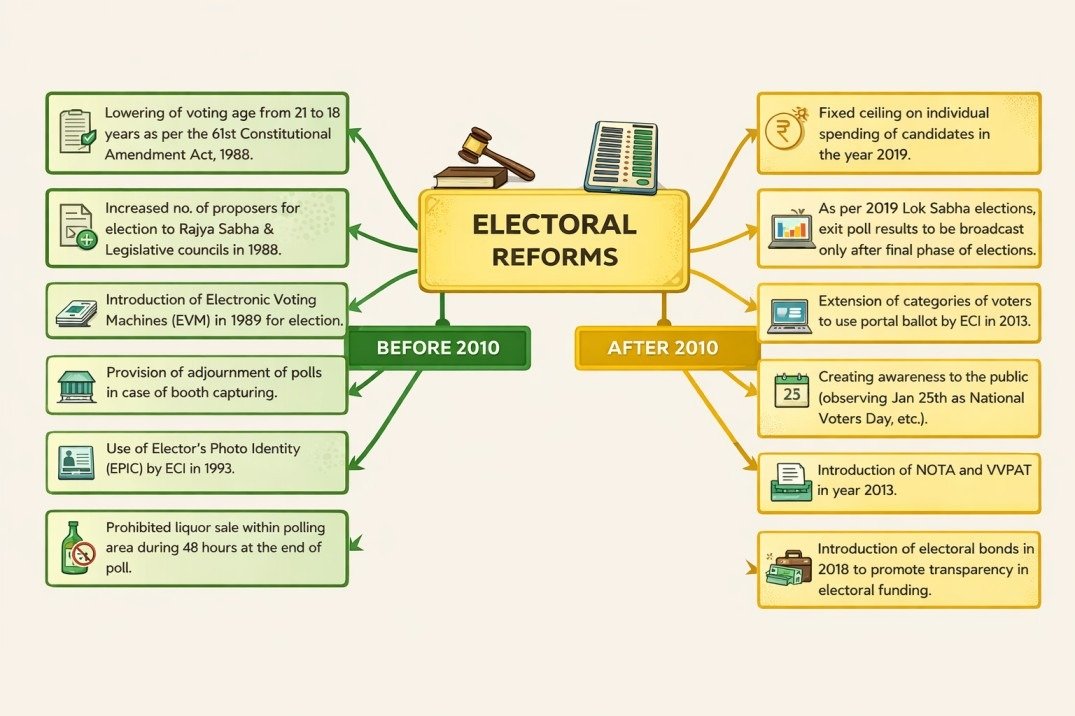
- Electoral Reforms Before 2010
- Electoral Reforms After 2010
- Measures Taken By ECI For Electoral Reforms
- Various Committees On Electoral Reforms
- Dinesh Goswami Committee
- Jeevan Reddy Committee
- Tarkunde Committee
- Conclusion
Electoral reforms in India refer to the evolution and positive change in election processes in order to promote greater democracy, clean politics, ideal members of legislative chambers, and equal representation, among other things. Elections and electoral reforms are covered in Articles 324-329. Electoral reforms are essential to fulfill our forefathers' dream, to realize our constitution's goals, and to have a true democracy in text and spirit by conducting fair elections.
Major Challenges In The Indian Electoral System
- Money Power: Electioneering is a costly process in any democratic government, but it is especially so in India.
- Money power has a negative impact on our electoral system, substantially undermining the functioning of periodic elections. It leads to widespread corruption and is a major contributor to the black money economy.
- Muscle Power: Pre-election intimidation, post-election victimization, most riggings of any kind, and silent and brutal booth capturing are all fruits of physical power.
- Criminalization of politics and criminalization of criminals, both of which are now freely practiced, are two sides of the same coin and are primarily responsible for the display of brute power at elections. Criminals are able to win elections for their benefactors through the use of violence.
- Misuse of Government Machinery: It is commonly said that the government in power at the time of an election abuses official machinery to help its party's candidates win elections.
- Misuse of official machinery takes many forms, including the publication of advertising at the expense of the government and the public exchequer publiciing their accomplishments, disbursements from ministerial discretionary funds, and the use of government cars for canvassing.