
- Introduction
- Physiography of Oceans
- Physiographic Subdivision of Ocean
- Subdivision of Ocean
- Oceanic Margin
- Origin and Evolution of Ocean Basins
- Shelf and Deep Sea Sedimentation
- Physical, Chemical and Biological Aspects of Sea Water
- Physical Aspects
- Chemical Composition
- Biological Characteristics of Ocean
Introduction
The Earth is divided into several plates, and each plate consists of continental and oceanic parts.
The continental section forms the landmass and is subdivided into continental shelf, slope, and rise.
The continental shelf contains remnant landforms that were submerged due to sea-level rise.
The deep ocean regions constitute the oceanic plate, which is formed by the generation of new oceanic crust at convergent and divergent boundaries.
During earlier cold climatic phases, large quantities of water were locked in ice sheets and glaciers, leading to a reduction in sea level and ocean extent.
Plate tectonics controls the distribution of continents and oceans and plays a crucial role in the expansion and destruction of ocean basins.
The oceanic crust is youngest at the mid-oceanic ridge and becomes progressively older as it moves away due to plate movement.
Oceanic sedimentation is regulated by the supply of detritus from rivers, winds, and biological productivity.
Slumping is an important process supplying sediments to the continental rise.
The oceanic plate receives a negligible amount of sediment from land sources.
Chemical and physical processes regulate the biogeochemical cycles of the ocean.
The ocean exhibits a layered structure, with density increasing with depth.
Salinity decreases in the halohaline layer, while temperature decreases in the thermocline.
The physical, chemical, and biological properties of the ocean significantly influence Earth processes and help regulate the global climate.
Physiography of Oceans
The Earth formed as a molten mass of gases billions of years ago.
As the Earth cooled, released gases and water vapour led to the formation of the atmosphere and water on the globe.
During the formation of the core, mantle, and crust, water migrated from the deeper interior of the Earth to the crust.
Nearly 96% of Earth’s water is stored in the oceans.
The oceans have a vast horizontal extent stretching over several hundred kilometres.
The ocean covers about 71% of the Earth’s surface area.
The vertical extent of the ocean is variable, with an average depth of about 3.7 km.
The physiography of the ocean is crucial as it determines the amount of water stored in the oceans.
The exchange of water between the ocean and other water reservoirs controls the degree of submergence of the continental margins under the ocean.
Physiographic Subdivision of Ocean
The physiography of the ocean is controlled by ongoing geologic processes of the Earth.
Most of the oceans are relatively young compared to the age of the Earth.
This is because oceanic crust is continuously created at divergent boundaries and destroyed at convergent boundaries.
The persistent destruction of oceans and reorganization of continents have repeatedly reshaped the ocean basins.
The current phase of continental reorganization began with the breakup of Pangaea, the supercontinent.
As a result, the oceanic crust does not exceed an age of about 200 million years.
Consequently, the physiographic features of the ocean change and evolve through time.
Subdivision of Ocean
The submerged parts of continents are termed the continental margin, while crust formed at divergent boundaries through tectonic activity is called the oceanic region.
The physiographic features of the ocean floor are shaped by tectonic and hydrological processes, which regulate the volume of ocean water.
Based on their origin and degree of submergence, ocean margins are classified into continental margins and oceanic margins.
The continental margin represents the portion of the continent that is presently submerged beneath the sea.
The continental crust is characterized by a relatively low density of about 2.7 g/cm³.
The oceanic crust, formed through volcanogenic processes, has a higher density of about 2.9 g/cm³.
The continental crust has a thickness of several kilometres, whereas the oceanic plate is comparatively thin.
The Continental Margin of the Ocean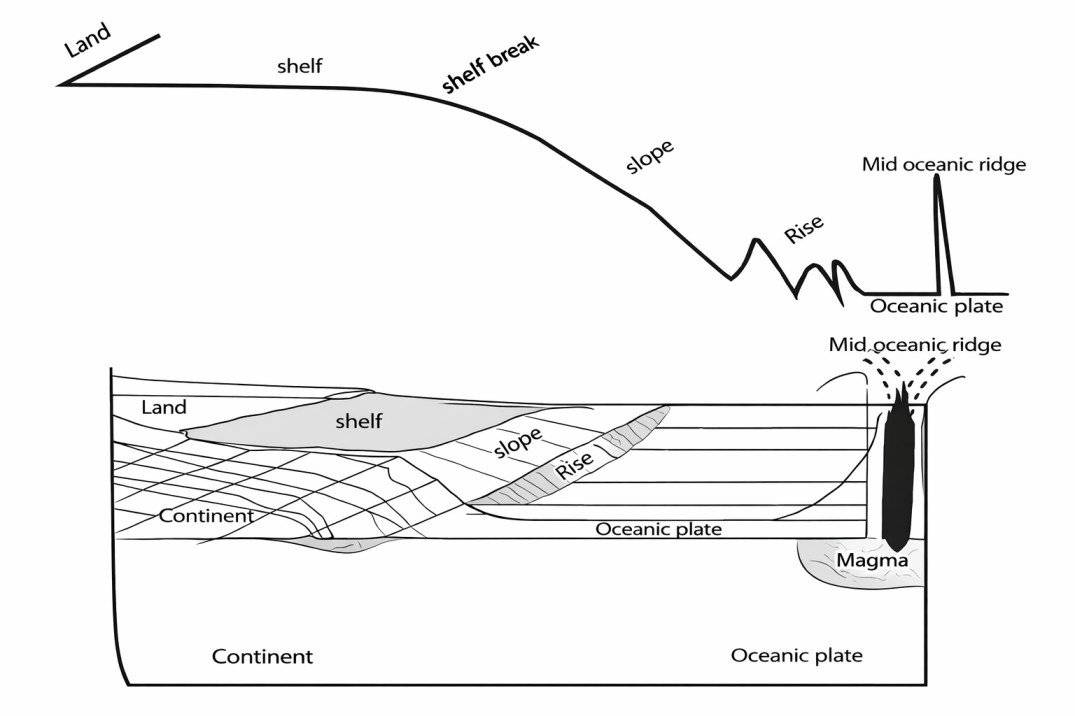 The Subdivision of the Ocean