
Subject resourcesQuick Links
Unit I. Geomorphology↗Unit II. Climatology↗Unit III. Oceanography↗Unit IV. Geography of Environment↗Unit V. Population and Settled Geography↗Unit VI. Geography of Economic Activities and Regional Development↗Unit VII. Cultural, Social and Political Geography↗Unit VIII. Geographic Thought↗Unit IX. Geographical Techniques↗Unit X. Geography of India↗
Unit I. Geomorphology↗Unit II. Climatology↗Unit III. Oceanography↗Unit IV. Geography of Environment↗Unit V. Population and Settled Geography↗Unit VI. Geography of Economic Activities and Regional Development↗Unit VII. Cultural, Social and Political Geography↗Unit VIII. Geographic Thought↗Unit IX. Geographical Techniques↗Unit X. Geography of India↗
1. Geomorphology↗2. Climatology↗3. Oceanography↗4. Geography of Environment↗5. Population & Settlement Geography↗6. Geography of Economic Activities & Regional Development↗7. Cultural, Social & Political Geography↗8. Geographic Thought↗9. Geographical Techniques↗10. Geography of India↗11. Models & Theory↗
Relief of Oceans
(Detailed Notes)
Unit 3
UGC NET GEOGRAPHY
Language
Choose your preferred language
Relief of Oceans
🎨 Reading Colors
Background
Text Color
Table of Contents
- Introduction
- Ocean Relief Features
- Major Ocean Relief Features
- Continental Shelf
- Continental Slope
- Continental Rise
- Deep Sea Plain or Abyssal Plain
- Oceanic Deeps or Trenches
- Minor Ocean Relief Features
- Mid-Oceanic Ridges
- Seamount
- Submarine Canyons
- Guyots
- Atoll
- Bank
- Shoal
- Reef
- Significance of Study of Oceanic Relief
- Estuary vs Delta
- Lagoon and Estuary
Introduction
- The Ocean Relief Features are quite different from the continental features because the Oceanic crust is less than 60-70- million years old whereas continental features are of Proterozoic age (Over 1 Billion years old).
- While there is only one global ocean, the vast body of water that covers 71 percent of the Earth is geographically divided into distinct named regions. The boundaries between these regions have evolved over time for a variety of historical, cultural, geographical, and scientific reasons.
- Historically, there are four named oceans: the Atlantic, Pacific, Indian, and Arctic. However, a new ocean has now been recognized as the Southern (Antarctic) ocean as the fifth ocean. The Pacific, Atlantic, and Indian are known as the three major oceans.
- They are the source of food– fish, mammals, reptiles, salt, and other marine foodstuffs.
- The tides can be harnessed to provide power.
- Oceanography is the branch of science that deals with the physical and biological properties and phenomena of the sea.
- Earlier echo-sounding techniques were used, now radar soundings and electrical Echo devices are used to find the precise depths of ocean floors and map the relief of oceans.
Ocean Relief Features
- The oceans, unlike the continents, merge so naturally into one another that it is hard to demarcate them.
- The geographers have divided the oceanic part of the earth into five oceans, namely the Pacific, the Atlantic, the Indian, Southern, and the Arctic.
- The various seas, bays, gulfs, and other inlets are parts of these four large oceans.
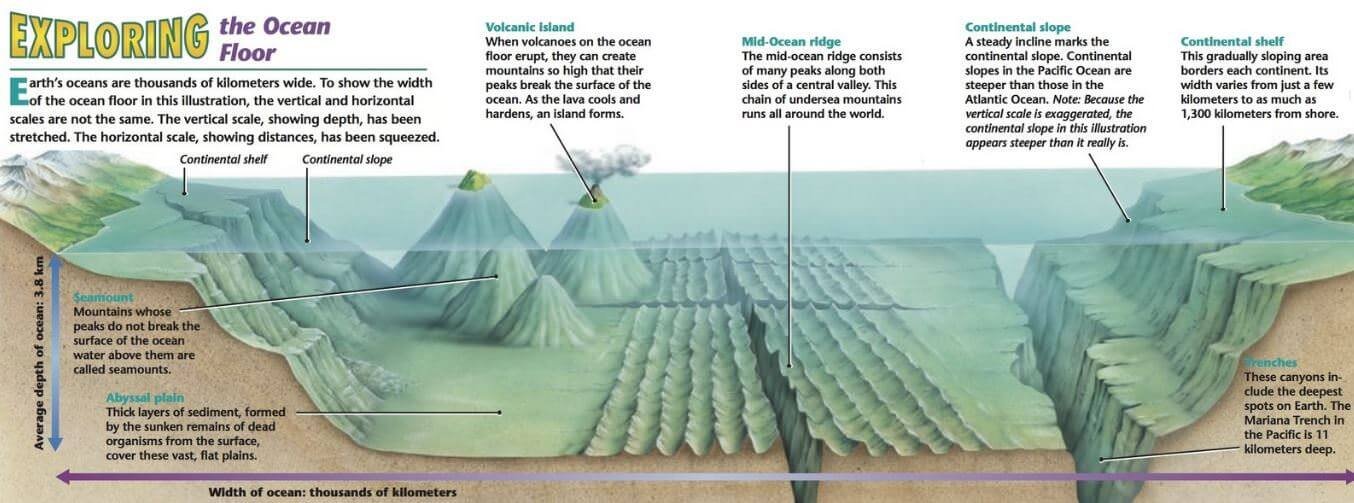
- A major portion of the ocean floor is found between 3-6 km below the sea level.
- The floors of the oceans are rugged with the world’s largest mountain ranges, deepest trenches, and the largest plains. These features are formed, like those of the continents, by the factors of tectonic, volcanic, and depositional processes.
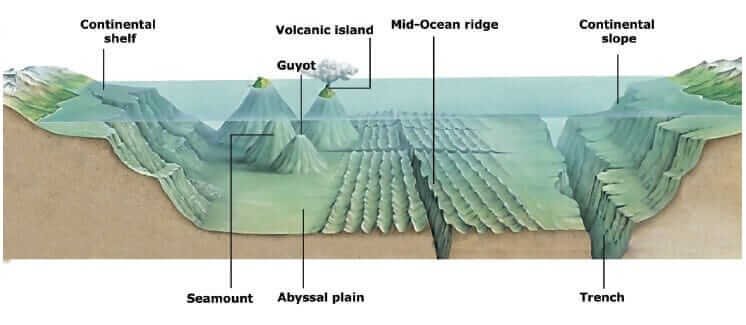
Major Ocean Relief Features
The ocean floors can be divided into four major divisions:
- the Continental Shelf
- the Continental Slope
- the Deep Sea Plain
- the Oceanic Deeps
Continental Shelf
- Continental Shelf is the gently sloping seaward extension of continental plate.
- These extended margins of each continent are occupied by relatively shallow seas and gulfs.
- Continental Shelf of all oceans together cover 7.5% of the total area of the oceans.
- Gradient of continental is of 1° or even less.
- The shelf typically ends at a very steep slope, called the shelf break.
- The continental shelves are covered with variable thicknesses of sediments brought down by rivers, glaciers etc..
- Massive sedimentary deposits received over a long time by the continental shelves, become the source of fossil fuels [Petroleum].
- Examples: Continental Shelf of South-East Asia, Great Banks around Newfoundland, Submerged region between Australia and New Guinea.
- The shelf is formed mainly due to
- submergence of a part of a continent
- relative rise in sea level
- Sedimentary deposits brought down by rivers
- There are various types of shelves based on different sediments of terrestrial origin —
- glaciated shelf (Surrounding Greenland),
- coral reef shelf (Queensland, Australia),
- shelf of a large river (Around Nile Delta),
- shelf with dendritic valleys (At the Mouth of Hudson River)
- shelf along young mountain ranges (Shelves between Hawaiian Islands).