
- Definition: Urban System
- Why is it Called a 'System'?
- Key Components of Urban System
- Key Characteristics
- Challenges and Opportunities in Urban Systems
- Importance of Studying Urban Systems
- Conclusion
Definition: Urban System
An urban system is the network of cities and towns within a country or region that are connected with each other through different kinds of relationships (economic, social, cultural, administrative, etc.). It studies how settlements interact and function together, instead of looking at a single city in isolation.
Urban systems refer to the complex networks of infrastructure, services, and institutions that support the functioning of cities. These systems encompass a wide range of components, including transportation networks, public services, housing, and urban development. Urban systems are characterized by their interconnectedness, with each component influencing the others in complex ways.
The study of urban systems in geography examines the relationships between towns and cities on a social and economic level and how these relationships affect the development and operation of cities.
Why is it Called a 'System'?
Because, like parts of a machine, each city or town plays a role in the larger setup.
Example: A metropolitan city may act as a financial hub, while a smaller nearby town may supply raw materials or labor. Together they form a system.
An urban system is not one city but a connected chain of settlements working together.
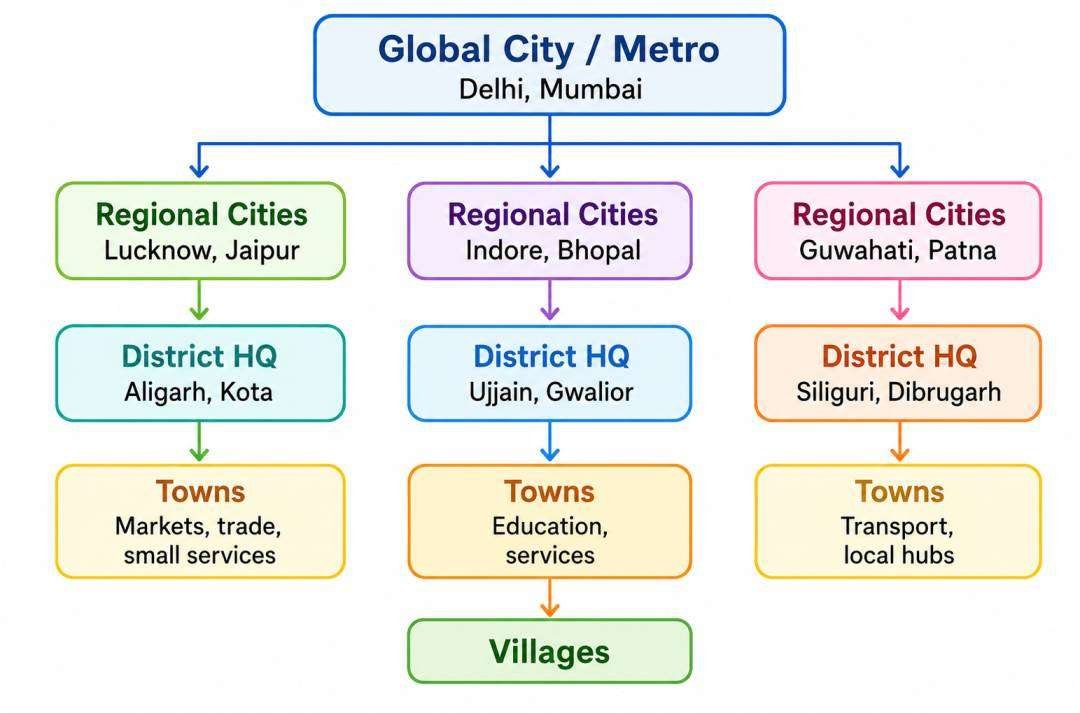
An urban system is an entire group of cities that are connected through trade, information distribution and exchange, and the movement of people, capital, and goods (Pred, 1977). Cities, which are the elements of urban systems, do not expand, stagnate, or decay independently of one another. Instead, they experience change in response to growth or decline in other cities.
By considering cities as points in a network, the study of urban systems highlights interurban relationships rather than focusing on the internal structure or spatial expansion of the cities. Interurban interdependence is caused by the spread of economic activity over a large area and the development of transportation and information networks. Since cities are becoming more and more exposed to the outside world, it is not possible to understand how these systems function and expand without considering social and economic variables as well.
Systems analysis is a popular explanation in urban studies. Systems analysis was introduced by the Chicago School, which coined the term 'cities as organisms'. According to this school, cities exist and operate as systems. However, cities also operate within additional systems such as social systems, economic systems, cultural systems, and political systems. This means that no individual city can operate in isolation from other cities.
Jim Simmons (1981) explains that 'an urban system' is typically characterized by 'a predetermined threshold population (or functional composition)'. According to him, urban systems are organized around 'nodes' that are principally service hubs that serve the concerned population.
In simple terms, a country is divided into 'functional regions' or 'regional economies'.
These regions are ranked on the basis of population densities, service densities, and types and magnitudes of stocks and flows, along with their interactive relationships.
With respect to the Canadian Urban System, Simmons (1981) stated that 'the urban region' is connected to two types of economy.
(i) 'to the national economy by means of consumer demand and fiscal policies'
(ii) 'to the international economy by means of commodity prices'