- Cyclones are a type of low-pressure environment with rapid inward air circulation. In the Northern Hemisphere, air flows counterclockwise, while in the Southern Hemisphere, it circulates clockwise.
- Storms and poor weather are frequently associated with cyclones.
- The word Cyclone comes from the Greek word Cyclos, which means snake coils.
- Henry Paddington invented the term because tropical storms in the Bay of Bengal and the Arabian Sea resemble coiled sea serpents.
Cyclones are of two types:
- Tropical cyclones
- Temperate cyclones(also called Extratropical cyclones or middle-latitude cyclones or Frontal cyclones or Wave Cyclones).
Tropical Cyclones
Low-pressure systems that originate over warm tropical waters are known as tropical cyclones. When the sea surface temperature is over 26.5°C, tropical cyclones form. Tropical cyclones can last for days, even weeks, and their courses can be highly irregular. When a cyclone passes over land or over cooler oceans, it dissipates.
- Cyclones are a type of low-pressure environment with rapid inward air circulation.
- In the Northern Hemisphere, air flows counterclockwise, while in the Southern Hemisphere, it circulates clockwise.
- Storms and poor weather are frequently associated with cyclones.
- The word Cyclone comes from the Greek word Cyclos, which means snake coils.
- Henry Paddington invented the term because tropical storms in the Bay of Bengal and the Arabian Sea resemble coiled sea serpents.
Concept
- The term ‘Tropical Cyclone‘ is used by the World Meteorological Organization to describe weather systems with winds greater than ‘Gale Force’ (minimum of 63 km per hour).
- In the region between the Tropics of Capricorn and Cancer, tropical cyclones form. They’re large-scale weather systems that form over tropical or subtropical oceans and coalesce into surface wind circulation.
- Tropical cyclones are strong storms that form over tropical oceans and then travel inland, wreaking havoc with violent winds, heavy rainfall, and storm surges.
- Tropical cyclones are one of the world’s most destructive natural disasters.
- Tropical cyclones form over warm tropical oceans and intensify.
Favorable Conditions for the Formation of Tropical Cyclone
- A large area of water surface with a temperature above 27° C.
- The Coriolis force is strong enough to form a cyclonic vortex.
- Variations in the vertical wind speed are minor.
- A weak low-pressure area or low-level cyclonic circulation already exists.
- Above the sea level system, there should be a higher divergence.
Origin of Tropical Cyclones
- Tropical cyclones arise over tropical oceans in late summers and have a thermal origin (August to mid-November).
- Because of the Coriolis effect, the powerful local convectional currents take on a whirling motion at these regions.
- These cyclones form and move until they reach a weak place in the trade wind belt.
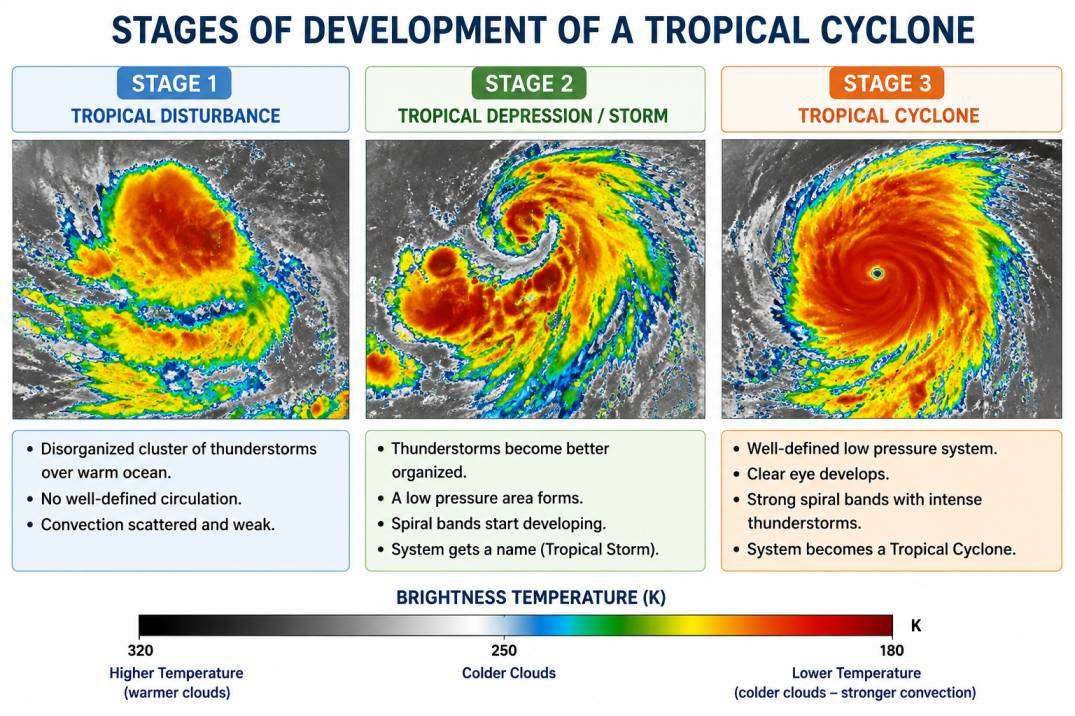
Developmental Stages of Tropical Cyclone
Tropical cyclones can be classified into three stages throughout their development:
Formation and Initial Development Stage:
- The transport of water vapor and heat from the warm ocean to the overlying air, largely through evaporation from the sea surface, is crucial to the creation and early development of a cyclonic storm.
- Convection with condensation of rising air above the ocean surface stimulates the creation of huge vertical cumulus clouds.
Mature Stage:
- The air rises in powerful thunderstorms as a tropical storm intensifies, and it tends to spread out horizontally at the tropopause level. When air spreads out, a positive pressure is created at high elevations, speeding up the downward migration of air due to convection.
- When subsidence is induced, the air warms up due to compression, resulting in a warm ‘Eye‘ (low-pressure center).
- A mature tropical cyclone in the Indian Ocean has a concentric pattern of highly turbulent large cumulus thundercloud bands as its principal physical feature.
Modification and Decay:
- As soon as its source of warm moist air begins to ebb or is abruptly cut off, a tropical cyclone begins to weaken in terms of core low pressure, internal warmth, and extremely fast speeds.
- This occurs after it reaches land or passes across chilly water.