
Humidity
Humidity is basically the amount of water vapour in the air. The amount of water vapour that the air can hold is determined by its temperature. Humidity is of three types namely absolute, relative, and specific humidity.
- Humidity is a measurement of the amount of water vapour present in the air, regardless of temperature.
- It’s measured in gallons of water per cubic metre of air (g/m3).
- At different times of the day, it varies drastically from place to place.
- Humidity Capacity refers to the greatest quantity of moisture that the air can contain at a given temperature.
Types of Humidity
Humidity is classified into three types namely:
- Absolute Humidity
- Relative Humidity
- Specific Humidity
Absolute Humidity:
- Absolute humidity represents the weight of the actual amount of water vapour contained in a unit volume of air.
- It is measured in grams per cubic metre.
- Absolute humidity varies from location to place on the earth’s surface.
- As volume changes as an air mass ascends or descends, the absolute humidity varies with contraction or expansion of air, it is less commonly utilized by meteorologists.
- The numerators and denominators of a unit of measurement differ significantly, making it unsuitable for mathematical manipulation.
Relative Humidity:
- The ratio between the entire capacity of the air to contain moisture at a particular temperature and the actual amount of moisture carried by it is known as relative humidity.
- It’s measured in percentages.
- The relative humidity drops as the temperature rises.
- Over the oceans, relative humidity is higher, whereas, over the continental, it is lower.
- Dew point temperature is the temperature at which relative humidity reaches 100% and the air is said to be saturated.
- In other terms, the dew point temperature is the temperature at which moisture condensation begins when air is cooled. The saturation temperature of water vapour at its partial pressure is the same as this temperature.
Specific Humidity:
- Specific humidity is measured by the weight of water vapour per unit weight of air.
- The specific humidity is unaffected by changes in pressure or temperature because it is measured in weight units (typically grammes per kilogramme).
- Specific Humidity is a constant, whereas Absolute and Relative Humidity are variable.
Dew Point
- At a certain temperature, the air is considered to be at a dew point when it contains moisture to its full capacity, i.e. when the air is saturated to 100 percent, or when the relative humidity is 100 %.
- It means that at that point, the air at that temperature is incapable of holding any extra moisture.
- Dew point is the temperature at which a given sample of air becomes saturated.
- Vapour condenses when the air temperature falls below the dew point temperature.
- When the dew point exceeds 0 degrees, the vapour condenses into a liquid droplet.
- When the dew point falls below zero degrees, the vapour condenses into ice crystals.
- Condensation occurs in free air when microscopic particles known as hygroscopic condensation nuclei cool.
- Due to their ability to absorb water, dust, smoke, and sea salt are particularly suitable nuclei.
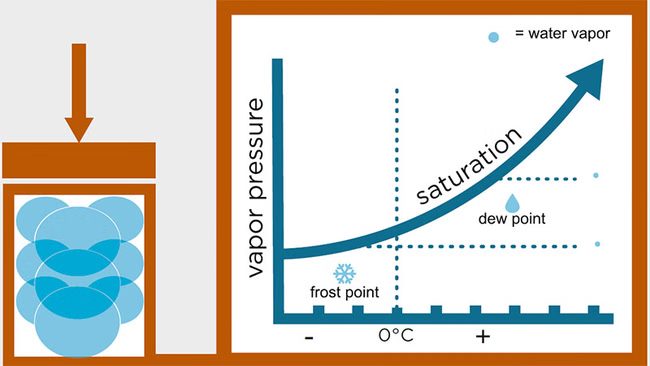
Dew Point
Dew Point Temperature
- The dew point temperature is the temperature at which humid air or gas must be cooled at constant pressure to the point where condensation begins to form.
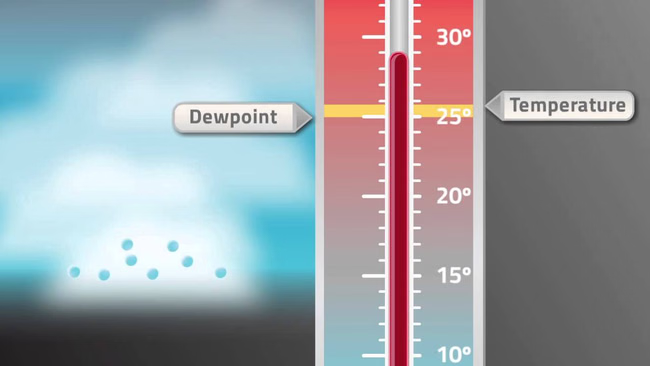
Dew Point Temperature
Significance of Humidity
- Humidity has a huge impact on human health because it affects our thermal comfort.
- Humidity can store a lot of energy and then release it when it converts to a liquid state, like rain.
- Humidity in the air stabilises our climate and avoids severe temperature swings due to its qualities.