Introduction
Soil is the uppermost weathered layer of the Earth’s crust, formed over thousands of years by the continuous, interacting action of climate, organisms, relief, parent rock and time upon exposed rock material. It is composed of four essential constituents — mineral matter, organic matter, water, and air — whose relative proportions and arrangement determine everything from fertility to load-bearing capacity. Mineral texture is further divided by particle size into sand, silt and clay, while the organic fraction, chiefly humus, plays an outsized role in fertility despite being present only in small quantities.
Pedogenesis (soil genesis) is the scientific process by which soil originates from parent rock material under the combined action of climate and vegetation, evolving distinguishable layers or horizons that together constitute a soil profile. The dedicated scientific study of soils — their formation, classification, and distribution — is called pedology. Soil formation is a truly global biospheric process: it links climate and vegetation through their mutual, reciprocal influence on man’s activities, and as its manifestation, soil develops features absent in the parent rock from which it originated, distinguishing it fundamentally from its source material.
Definition — Soil Genesis / Pedogenesis
Three defining characteristics of soil deserve emphasis at the outset, since they frequently anchor introductory paragraphs in 20-mark answers:
- Soil is a relatively thin surface layer of mineral matter that normally contains a considerable amount of organic material and is capable of supporting living plants.
- It occupies that part of the “outer skin” of the Earth extending from the surface down to the maximum depth to which living organisms penetrate — essentially the depth occupied by plant roots — and is characterised by its ability to produce and store plant nutrients through the interaction of water, air, sunlight, rock, plants and animals.
- Although thinly distributed over the land surface, soil functions as the fundamental interface where the atmosphere, lithosphere, hydrosphere and biosphere meet. Since the bulk of soil is inorganic material, it is conventionally classified as part of the lithosphere, but it is intimately related to — and shaped by — the other three Earth spheres as well.
From Rock to Soil: Weathering, Regolith and the Developing Profile
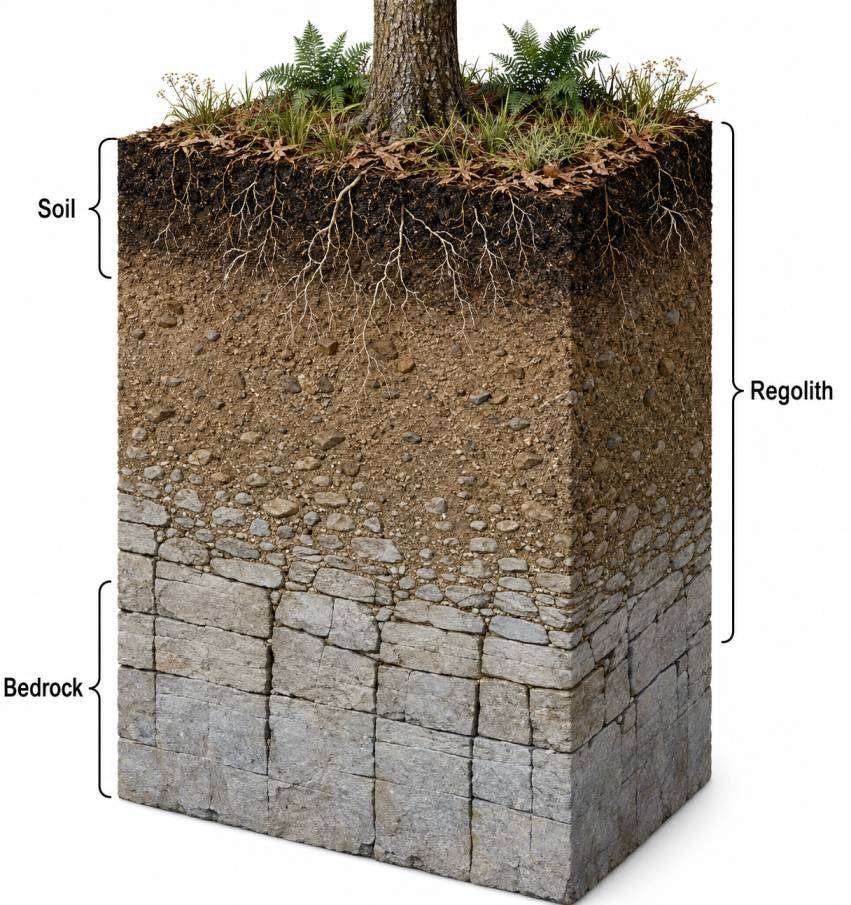
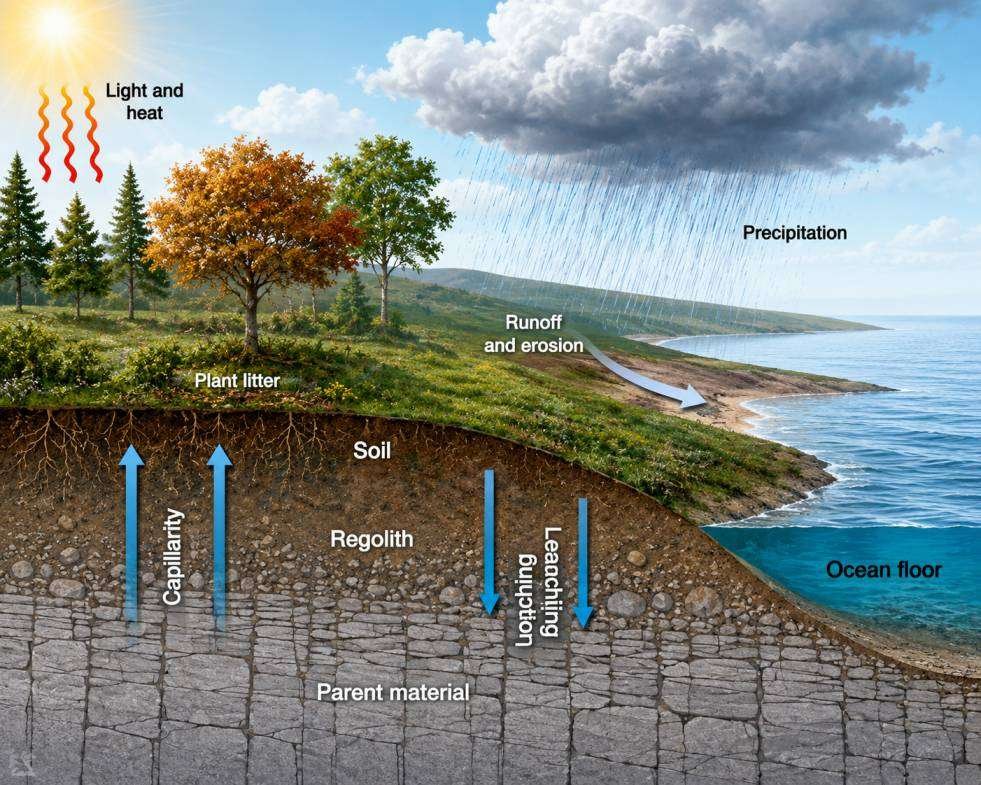
Soil development begins with the physical and chemical disintegration of rock exposed to the atmosphere and to water percolating down from the surface — a process termed weathering. The basic result of weathering is the weakening and breakdown of solid rock: the fragmentation of coherent rock masses into progressively smaller fragments.
The principal product of this weathering is a layer of loose, inorganic material called regolith (sometimes informally described as a “blanket rock”), because it lies like a blanket over the unfragmented rock below. Typically, the regolith consists of material that has weathered from the underlying rock and displays a crude gradation of particle sizes — with the largest and least-fragmented pieces at the bottom, immediately adjacent to bedrock. Sometimes, however, the regolith consists of material transported from elsewhere by the action of wind, water, or ice; such transported regolith may vary significantly in composition from place to place, independent of the underlying bedrock.
The upper half-metre or so of the regolith normally differs from the material below it in several important ways, most notably in the intensity of biological and chemical processes taking place. This upper portion is soil — composed largely of finely fragmented mineral particles and representing the ultimate product of weathering. It normally also contains an abundance of living and dead plant parts, microscopic plants and animals, and a variable amount of air and water. Crucially, soil is not the end-product of a process, but merely a stage in a never-ending continuum of physical–chemical–biological processes — a point worth stating explicitly, since examiners reward candidates who grasp soil as dynamic rather than static.
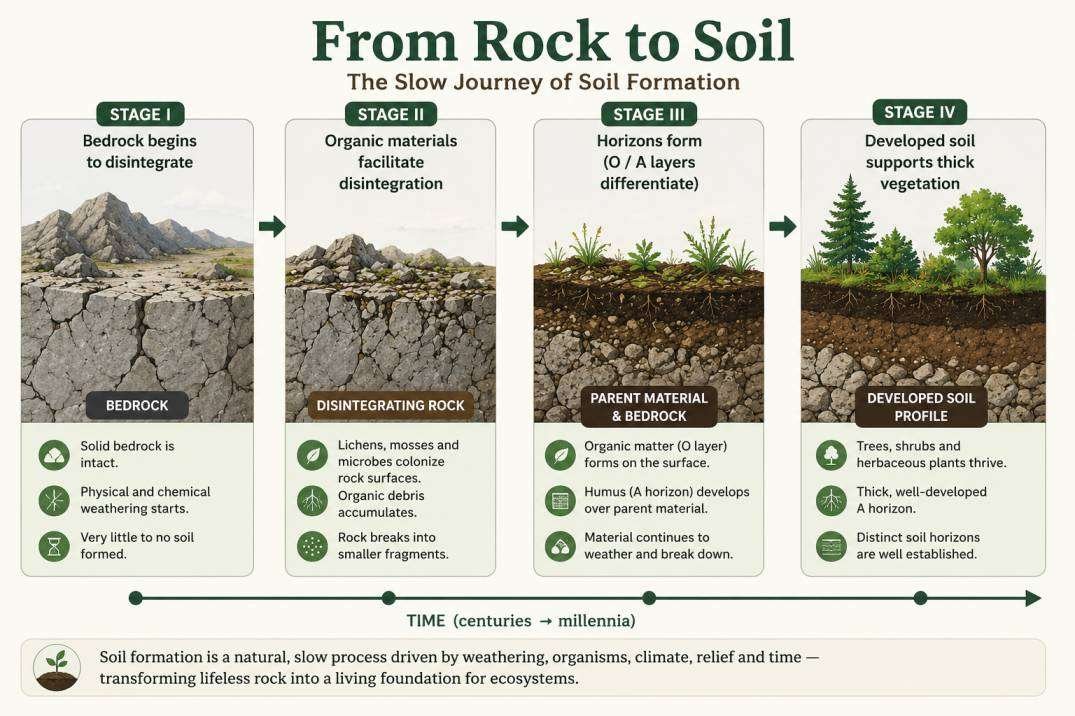
| Stage | Key Characteristics | Illustrative Marker | UPSC Relevance |
|---|---|---|---|
| Stage I — Bedrock begins to disintegrate | Physical/chemical weathering opens fractures in exposed bedrock; no true soil yet | Fresh rock exposure (e.g., newly exposed lava flow, glacial retreat surface) | Establishes weathering as the trigger mechanism of pedogenesis |
| Stage II — Organic materials facilitate disintegration | Pioneer organisms (lichens, mosses, bacteria) colonise regolith; organic acids accelerate chemical breakdown | Lichen crusts on bare rock | Introduces the biotic factor early in genesis, linking to “Organisms” as a CLORPT factor |
| Stage III — Horizons form | Differentiated layers (mineral fragments + organic matter, humus) begin to appear; translocation processes commence | Emergence of a rudimentary A horizon over regolith | Bridges to the Soil Profile sub-topic (O-A-E-B-C-R horizons) |
| Stage IV — Developed soil supports thick vegetation | Mature, layered profile with distinct horizons capable of sustaining dense plant cover | Climax vegetation over a well-developed soil | Demonstrates the reciprocal soil–vegetation relationship central to Biogeography |