
Introduction
The scientific study of weather and climate depends fundamentally on the systematic, standardized observation, measurement, and recording of meteorological elements — temperature, pressure, humidity, wind, precipitation, sunshine, and cloud cover — at a network of observatories across the globe. This raw data is then processed, plotted, and represented graphically and cartographically through techniques such as climographs, hythergraphs, isopleths (isotherms, isobars, isohyets), and weather maps, which allow meteorologists and geographers to visualize spatial and temporal patterns of weather and climate, and to forecast future conditions.
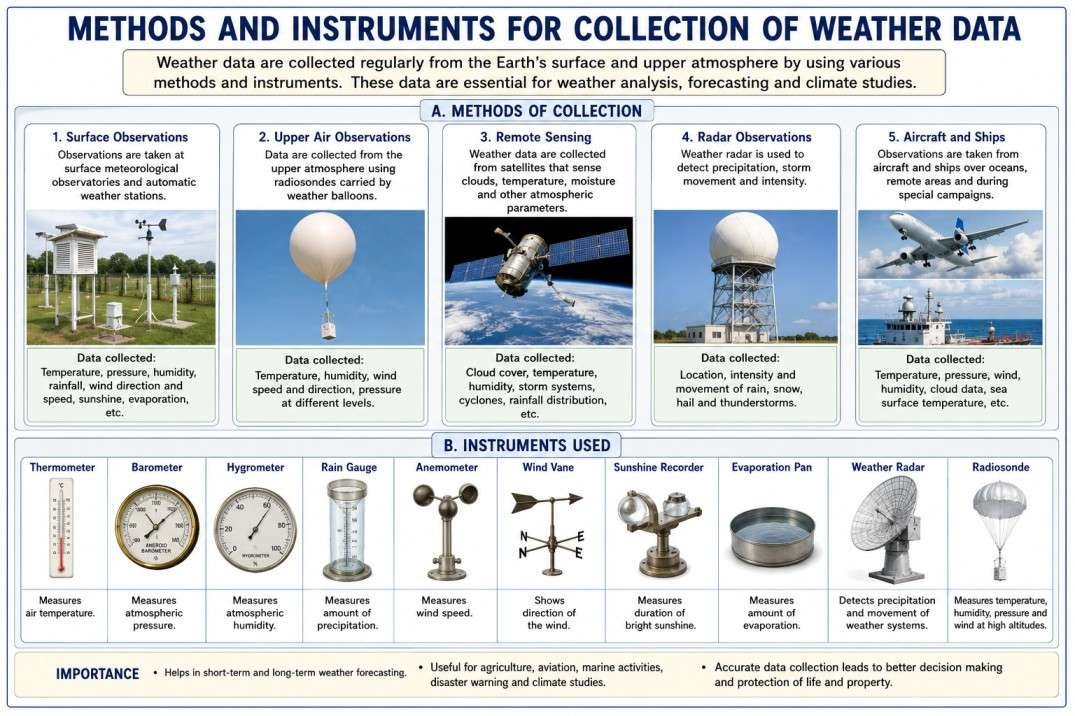
Methods and Instruments for Collection of Weather Data
Meteorological data is collected at surface observatories, upper-air stations, and increasingly through remote sensing (radar and satellites), using a standardized set of instruments housed in a Stevenson Screen (a louvred, white-painted wooden box that shields instruments from direct sunlight and precipitation while allowing free air circulation, ensuring accurate temperature/humidity readings).
Temperature
- Ordinary (mercury/alcohol) thermometer: Measures instantaneous air temperature.
- Maximum thermometer: A mercury thermometer with a constriction in the bore, designed to record the highest temperature reached in a 24-hour period (mercury pushed past the constriction stays in place even as temperature falls).
- Minimum thermometer: An alcohol thermometer containing a small dumb-bell shaped index that records the lowest temperature reached.
- Thermograph: A self-recording instrument using a bimetallic strip or Bourdon tube connected to a pen that traces a continuous temperature record on a rotating clockwork drum (chart).
- Six’s thermometer: A combined maximum-minimum thermometer.
Atmospheric Pressure
- Mercury barometer (Fortin’s barometer): The standard, highly accurate instrument measuring atmospheric pressure through the height of a mercury column balanced against atmospheric pressure, expressed in millibars (mb)/hectopascals (hPa) or mm/inches of mercury.
- Aneroid barometer: A portable instrument using a partially evacuated metal (corrugated) capsule that expands/contracts with pressure changes, mechanically linked to a dial pointer — less precise than mercury barometers but far more portable.
- Barograph: A self-recording aneroid barometer, tracing a continuous pressure record on a rotating drum chart.
- Altimeter: A specialized aneroid barometer calibrated to show altitude (used in aircraft).