
Introduction
The natural vegetation is the endowments of nature. They grow naturally by following the climatic variables. The types of natural vegetation differ according to precipitation, soil, climate, and topography.
India is bestowed with a wide range of flora and fauna. Due to a diverse geographical and climatic condition, an extensive range of natural vegetation grows in India.
- Climate, soil, and topography are the major factors that influence the Natural Vegetation of a place.
- The main climatic factors are rainfall and temperature. The amount of annual rainfall has a great bearing on the type of vegetation.
- Temperature is the major factor in the Himalayas and other hilly regions with an elevation of more than 900 meters.
- As the temperature falls with altitude in the Himalayan region the vegetal cover changes with altitude from tropical to sub-tropical, temperate, and finally alpine.
- Soil is an equally determining factor in few regions. Mangrove forests, swamp forests are some of the examples where the soil is the major factor.
- The topography is responsible for certain minor types e.g. alpine flora, tidal forests, etc.
| Annual Rainfall | Type of Vegetation |
| 200 cm or more | Evergreen Rain Forests |
| 100 to 200 cm | Monsoon Deciduous Forests |
| 50 to 100 cm | Drier Deciduous or Tropical Savanna |
| 25 to 50 cm | Dry Thorny Scrub (Semi-arid) |
| Below 25 cm | Desert (Arid) |
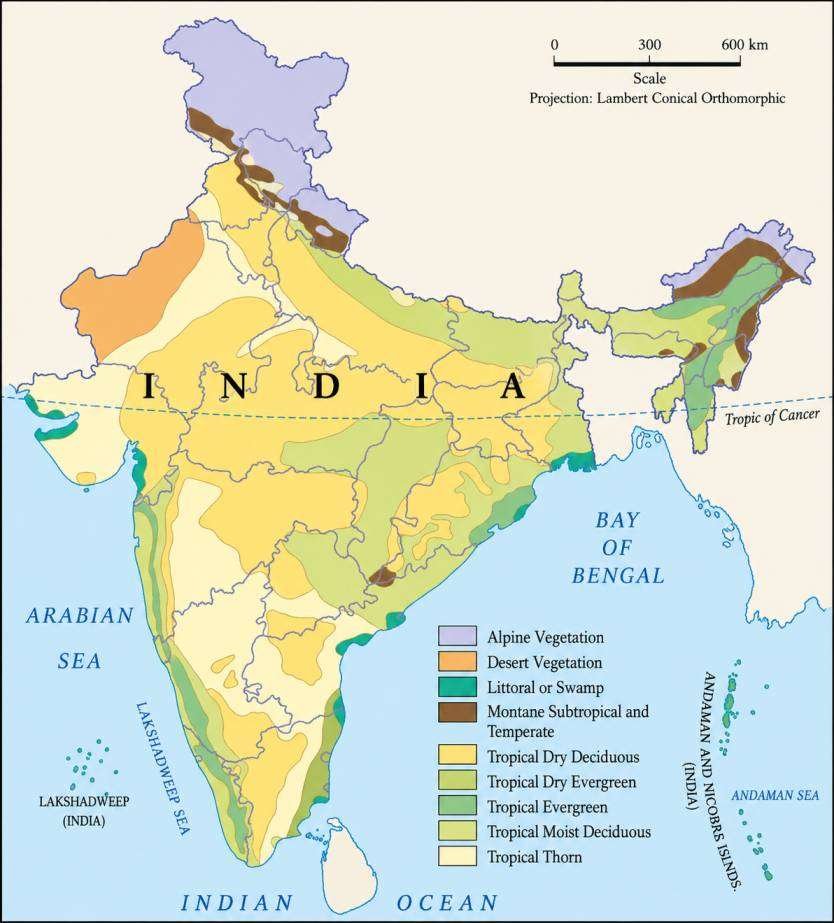
Classification of Natural Vegetation of India
- Classification of Natural Vegetation of India is primarily based on spatial and annual variations in rainfall. Temperature, soil and topography are also considered.
- India’s vegetation can be divided into 5 main types and 16 sub-types as given below.
A. Moist Tropical Forests
- Tropical Wet Evergreen
- Tropical Semi-Evergreen
- Tropical Moist Deciduous
- Littoral and Swamp
B. Dry Tropical Forests
- Tropical Dry Evergreen
- Tropical Dry Deciduous
- Tropical Thorn
C. Montane Sub-tropical Forests
- Sub-tropical broad leaved hill
- Sub-tropical moist hill (pine)
- Sub-tropical dry evergreen
D. Montane Temperate Forests
- Montane Wet Temperate
- Himalayan Moist Temperate
- Himalayan Dry Temperate
E. Alpine Forests
- Sub-Alpine
- Moist Alpine scrub
- Dry Alpine scrub
| Forest Type in India | % of Total Area |
| Tropical Moist Deciduous | 37 |
| Tropical Dry Deciduous | 28 |
| Tropical Wet Evergreen | 8 |
| Sub-Tropical Moist Hill | 6 |
| Tropical Semi-Evergreen | 4 |
| Rest below 4 % |