
Classification of Urban Settlements
- An urban settlement has a large population size and a high population density where secondary activities like manufacturing and tertiary activities such as trade are dominant.
- Urban settlements may be classified on various bases:
- On the basis of Population
- On the basis of Location
- On the basis of Pattern
- On the basis of Function
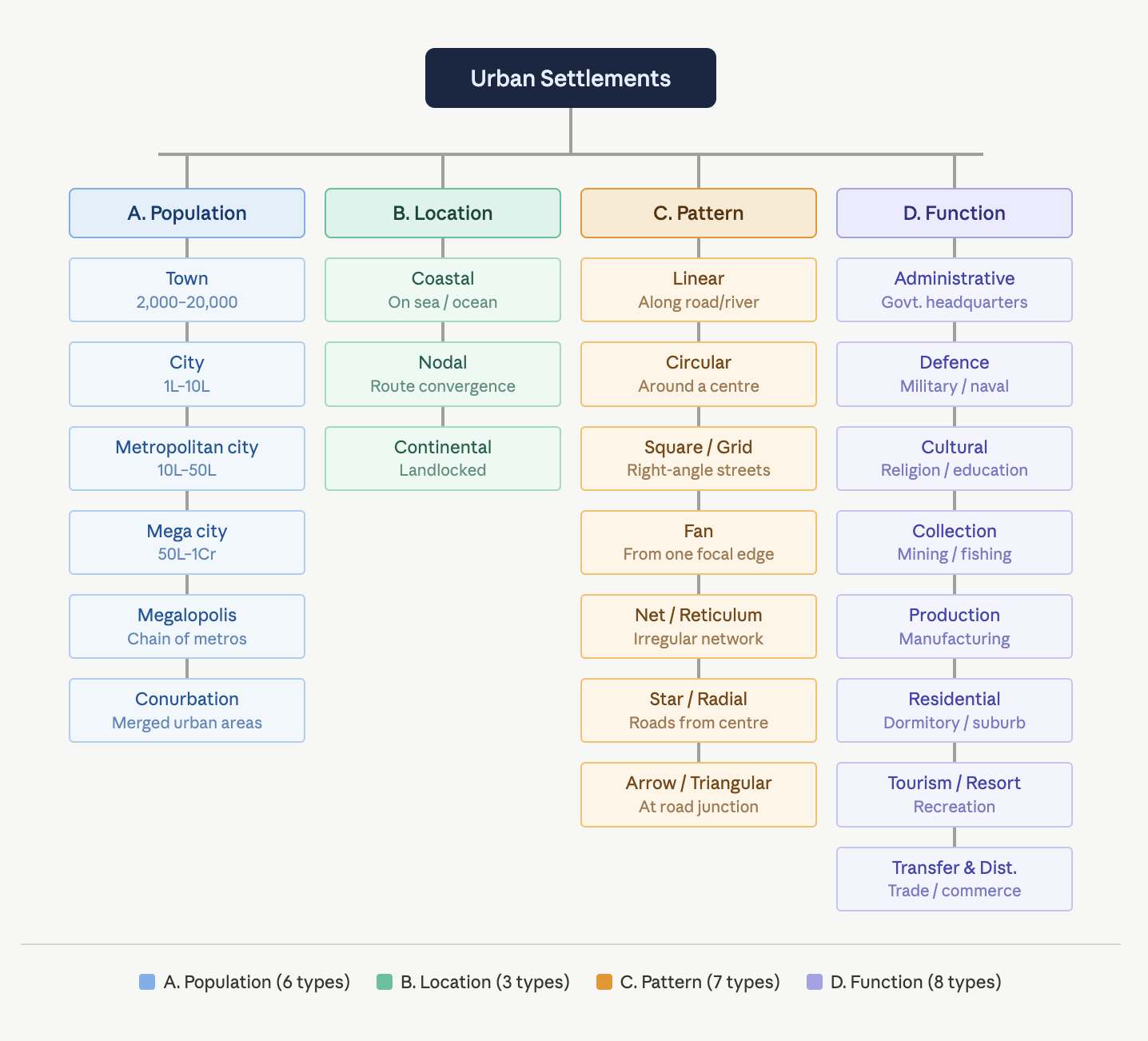
Types of Urban Settlement on the Basis of Population
- Six main categories: Town, City, Metropolitan City, Mega City, Megalopolis, Conurbation
Town
- A human settlement that is larger than a village but smaller than a city.
- Has a municipality, notified area committee (NAC), or town area committee (TAC) for local administration.
- Population ranges between 2,000 to 20,000 persons (though this varies by country).
- Population size is not the only criterion — specific functions also matter.
- Key functions present in towns:
- Manufacturing and small-scale industry
- Retail and wholesale trade
- Professional services (doctors, lawyers, accountants)
- Indian examples: Titabar (Assam), Etah (UP), Solan (HP).
- As per the Census of India, a settlement is classified as a town if:
- (a) it has a minimum population of 5,000;
- (b) at least 75% of the male working population is engaged in non-agricultural pursuits; and
- (c) a population density of at least 400 persons per km².
- These multi-factor criteria prevent over-counting of “urban” population.
City
- A large and permanent human settlement — regarded as a “leading town.”
- Lewis Mumford defined it as: “the physical form of the highest and most complex type of associative life.”
- Population: one lakh (1,00,000) to one million (10,00,000).
- Much larger than towns with a greater number of economic functions.
- Key features of a city:
- Major transport terminals (railway stations, bus depots, airports)
- Regional and national financial institutions (banks, stock exchanges)
- Regional administrative offices and courts
- Specialized educational and healthcare facilities
- Indian examples: Jhansi, Mysuru, Coimbatore, Nagpur, Amritsar.
- Cities globally are defined very differently. Japan requires 50,000 inhabitants; China sets the bar at 100,000. The UN’s Degree of Urbanisation (2020) classifies a city as any contiguous high-density cluster of ≥1,500 persons/km² with a total population of at least 50,000 — to allow cross-country statistical comparisons.
Metropolitan City
- Cities with population between one million (10 lakh) to five million (50 lakh).
- Serve as regional economic engines, drawing people and businesses from large surrounding areas.
- Have extensive suburban spread, satellite towns, and complex commuter zones.
- Key characteristics:
- Multi-sector economy (industry, services, IT, trade)
- Major regional airports and inter-city rail connections
- Universities, research institutions, and teaching hospitals
- Significant in-migration from rural and smaller urban areas
- Indian examples: Lucknow, Pune, Ahmedabad, Surat, Kochi.
Mega City
- Cities having more than 5 million population.
- Characterized by intense economic activity, severe infrastructure pressure, and complex governance.
- Generate a disproportionately large share of national GDP.
- Challenges associated with mega cities:
- Housing shortages and growth of informal settlements/slums
- Traffic congestion and air pollution
- Pressure on water supply, sanitation, and waste management
- Rising inequality between rich and poor neighborhoods
- Indian examples: Hyderabad, Chennai, Bengaluru.
- The UN now defines megacities as urban areas with 10 million+ inhabitants. As of 2025, there are 33 megacities worldwide — up from just 8 in 1975. Jakarta (Indonesia) has overtaken Tokyo as the world’s largest city with nearly 42 million residents, followed by Dhaka (~40 million) and Tokyo (~33 million). Nineteen of the 33 megacities are in Asia.
Global Fact — Megacities 2025 (UN World Urbanization Prospects)
- The number of megacities has quadrupled from 8 in 1975 to 33 in 2025. By 2050, the count is expected to rise to 37, with new entrants from Africa including Addis Ababa (Ethiopia) and Dar es Salaam (Tanzania). Despite their prominence, small and medium-sized cities house more people than megacities and are growing faster, particularly in Africa and Asia.
Megalopolis
- A very large, heavily populated city or urban complex with more than 5–10 million population.
- Formed from the coalescence of a chain of metropolitan areas into one continuous urban corridor.
- Each metropolitan area within it has grown around a substantial urban nucleus.
- The term was coined by geographer Jean Gottmann (1961) to describe the northeastern US corridor.
- Characteristics of a megalopolis:
- Continuous built-up area stretching hundreds of kilometres
- Multiple city centres with distinct identities but shared infrastructure
- Complex inter-city commuting patterns
- Extremely high land values and property costs
- Key global examples:
- BosWash (USA) — Boston–New York–Philadelphia–Washington D.C. corridor, ~700 km long, ~55 million people
- Taiheiyō Belt (Japan) — Tokyo–Nagoya–Osaka–Kobe corridor, world’s most productive megalopolis
- Pearl River Delta (China) — Guangzhou–Shenzhen–Hong Kong region, the world’s largest urban agglomeration by area
- India’s emerging Delhi–Meerut–Agra corridor and the Mumbai–Pune industrial belt are developing megalopolitan characteristics, driven by expressway connectivity, economic zones, and rapid population growth along these corridors.
Conurbation
- An extended urban area comprising a number of cities, large towns, and other urban areas that have merged to form one continuous urban and industrially developed area.
- Formed through population growth and physical expansion — neighbouring cities grow until their boundaries touch and eventually merge.
- Unlike a megalopolis, a conurbation is typically more compact and regionally limited.
- The term was coined by Patrick Geddes (1915) in his book Cities in Evolution.
- Key global examples:
- West Midlands, England — Birmingham, Wolverhampton, Coventry
- Rhine-Ruhr, Germany — Cologne, Dortmund, Essen, Düsseldorf
- Randstad, Netherlands — Amsterdam, Rotterdam, The Hague, Utrecht
- Greater London — London with surrounding boroughs and commuter towns
- Indian context: The National Capital Region (NCR) — Delhi, Gurgaon, Noida, Faridabad, Ghaziabad — is India’s most prominent conurbation.