
Soil is the topmost layer of the continental crust having weathered particles of rocks. The soils of India are the product of physical factors as well as human factors.
Soil can be simply defined as a mixture of small rock particles/debris and organic materials/ humus which develop on the earth’s surface and support the growth of plants.
Factors that influence soil formation–
- Parent Material
- Relief/Topography
- Climate
- Natural Vegetation & Biological factors
- Time
Soil Types in India (Types of Soil)
The first scientific classification of soil was done by Vasily Dokuchaev. In India, the Indian Council of Agricultural Research (ICAR) has classified soils into 8 categories.
- Alluvial Soil
- Black Cotton Soil
- Red Soil
- Laterite Soil
- Mountainous or Forest Soils
- Arid or Desert Soil
- Saline and Alkaline Soil
- Peaty, and Marshy Soil/Bog Soil
This classification scheme is based on constitutional characteristics – colour and the resource significance of the soils.
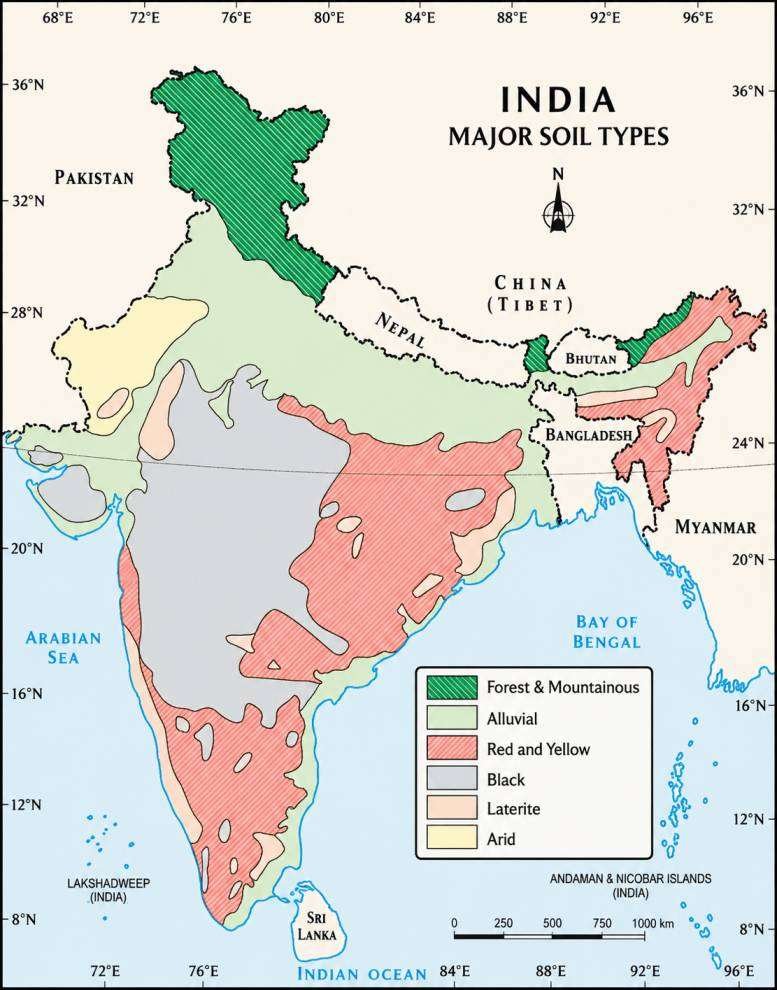
The ICAR has also classified the Indian soils on the basis of their nature and character as per the United States Department of Agriculture (USDA) Soil Taxonomy.
- Inceptisols (39.74%)
- Entisols
- Alfisols
- Vertisols
- Aridisols
- Ultisols
- Mollisols
- Others