
Origin of Earth
The Origin and Evolution of Earth explains how a hot, barren planet transformed into a life supporting world over billions of years. Earth formed about 4.6 billion years ago from cosmic material within the solar system. Scientific theories and geological evidence describe its gradual development through stages of planetary formation, atmospheric changes and biological evolution.
The Origin and Evolution of Earth begins with cosmic events that led to the formation of The Universe, solar system and finally the Earth through gradual accumulation processes.
- Big Bang Event: Around 13.7 billion years ago, the universe began as a tiny, dense, hot point. Rapid expansion created matter and energy and within three minutes, the first atomic particles formed.
- Formation of Atoms: About 300,000 years after the Big Bang, temperature dropped to around 4,500 Kelvin, allowing atoms to form and the universe became transparent, enabling radiation to travel freely.
- Galaxy Formation: Uneven distribution of matter created gravitational differences, leading to clustering of matter and formation of galaxies containing billions of stars spread across thousands of light years.
- Star Formation: Around 5-6 billion years ago, dense hydrogen gas clouds collapsed under gravity forming nebulae. These condensed into protostars where nuclear fusion began at approximately 15 million degrees Celsius.
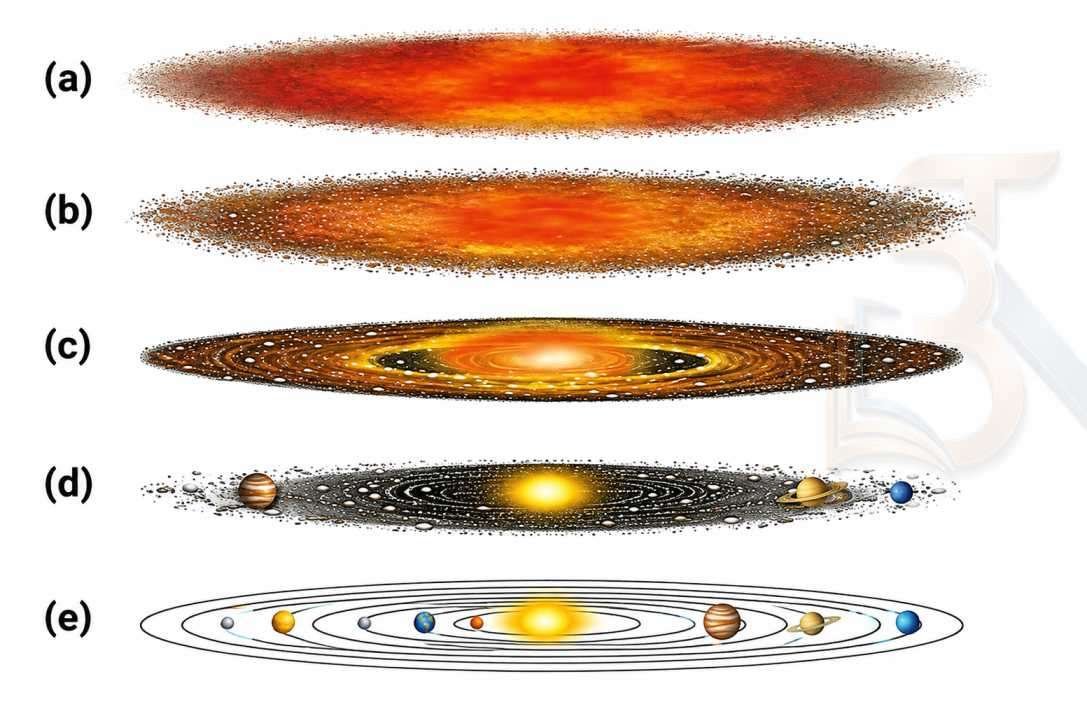
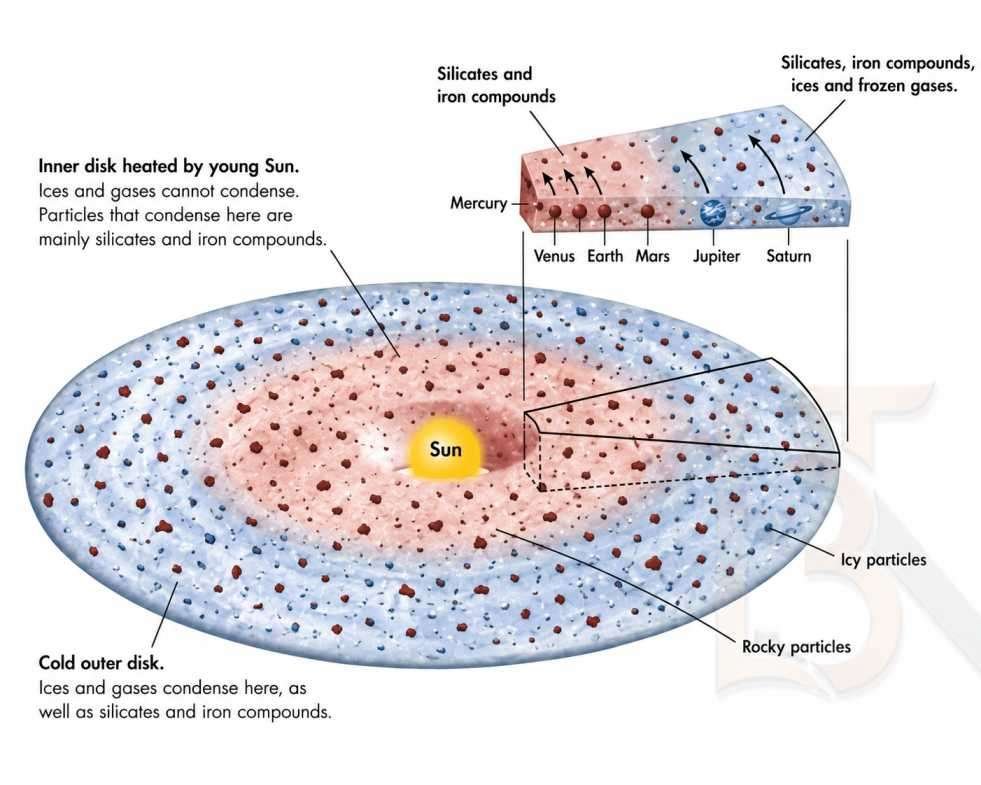
- Solar System Formation: A rotating nebula formed the Sun at the center, surrounded by a disk of gas and dust. This disk provided the material for planetary formation.
- Formation of Planetesimals: Dust particles collided and stuck together forming small rounded bodies called planetesimals through cohesion and gravitational attraction.
- Accretion into Planets: Planetesimals combined into larger bodies through continuous collisions, eventually forming planets including Earth through a process known as accretion.
- Formation of Earth: About 4.6 billion years ago, Earth formed as a hot, molten mass composed mainly of hydrogen, helium and heavier elements gathered from the solar nebula.
Evolution of Earth
The Origin and Evolution of Earth continued through cooling, differentiation, atmospheric changes and biological development that transformed Earth into a habitable planet.
- Early Earth Condition: Initially, Earth was extremely hot, rocky and barren with a thin atmosphere composed mainly of hydrogen and helium, making it unsuitable for life.
- Loss of Primordial Atmosphere: Solar winds stripped away the early hydrogen-helium atmosphere, similar to other terrestrial planets, leading to the need for a secondary atmosphere.
- Planetary Differentiation: As Earth cooled, heavier elements like iron sank to the core, while lighter materials rose to the surface, forming distinct layers through a process called differentiation.
- Formation of Lithosphere: Cooling of the outer surface led to solidification, forming the crust. The Earth developed layered structure including crust, mantle, outer core and inner core with increasing density inward.
- Giant Impact and Heating: The formation of the Moon due to a massive collision further heated Earth, accelerating internal differentiation and structural development.
- Degassing Process: Volcanic activity released gases like water vapour, carbon dioxide, nitrogen, methane and ammonia from Earth’s interior, contributing to the formation of a secondary atmosphere.
- Evolution of Early Atmosphere: The early atmosphere contained very little free oxygen and was dominated by Water Vapour, carbon dioxide and nitrogen.
- Formation of Hydrosphere: As Earth cooled, water vapour condensed into rain. Continuous rainfall filled surface depressions, forming oceans within 500 million years of Earth’s formation.
- Age of Oceans: Oceans are estimated to be about 4 billion years old, indicating early establishment of water bodies crucial for life development.
- Carbon Dioxide Reduction: Carbon dioxide dissolved in rainwater, reducing atmospheric CO₂ levels and contributing to further cooling of the planet.
- Beginning of Life: Around 3.8 billion years ago, simple life forms began to evolve in oceans through chemical reactions that produced complex organic molecules.
- Fossil Evidence: Geological records contain fossils of microscopic organisms, including blue-green algae like structures dating back over 3 billion years, confirming early life existence.
- Photosynthesis Evolution: Between 2.5 to 3 billion years ago, Photosynthesis began, allowing organisms to convert sunlight into energy and release oxygen.
- Oxygenation of Oceans: Oxygen produced by photosynthetic organisms first accumulated in oceans, gradually saturating them over time.
- Oxygen in the Atmosphere: Around 2 billion years ago, oxygen began to accumulate in the atmosphere, transforming it into an oxygen rich environment suitable for complex life.
- Development of Water Cycle: Interaction between land and water, including freshwater systems, may have started as early as 4 billion years ago, supporting early life conditions.
- Formation of Landmasses: Cooling and solidification led to the emergence of continental crust and dry land, providing diverse environments for life evolution.
- Biological Evolution: Life gradually evolved from simple unicellular organisms to more complex forms, aided by oxygen availability and stable environmental conditions.
- Atmospheric Stabilization: Nitrogen and oxygen became dominant gases, forming the present atmospheric composition essential for sustaining life.
- Modern Earth System: Continuous geological and biological processes shaped Earth into a dynamic system with lithosphere, hydrosphere, atmosphere and biosphere interacting in balance.
Theories of Origin of Earth
Gaseous Hypothesis of Kant
- Immanuel Kant, the German philosopher, presented his treatise entitled ‘The General Natural History and Theory of the Heaven or the Essay on the Working and Mechanical Origin of the Entire Universe on the Basis of Newtonian Laws’ in 1755.
- Kant claimed that his ‘gaseous hypothesis’ of the origin of the earth was based on the sound principles of Newton’s laws of gravitation and rotatory motion.
- In the beginning his hypothesis acclaimed world-wide appreciation but later on it was disproved as it was based on erroneous concepts and wrong application of Newtonian laws of gravitation.
- Inspite of severe criticism the hypothesis was considered a great step forward in the field of cosmogony and ‘he almost reverberated the mid-18th century with his words…Give me matter and I will build a world out of it.’
- Kant postulated his gaseous hypothesis of the origin of the earth on the basis of a few assumptions. He assumed that supernaturally created primordial hard matter was scattered in the universe.
- In fact, according to Kant there was a primeval, slowly rotating cloud of gas (now called a nebula) and matter comprised of very cold, solid and motionless particles.
- Nebula – It is a primordial (primitive) amorphous (without shape) mass of cloud of gas and dust.
- In terms of modern scientific language it can be said (but not described by Kant) that the temperature of primordial matter was near about -273 °C or absolute zero or 0 K. This was the reason that cold matter was initially motionless (according to the molecular theory of matter).
- He further assumed that the particles began to collide against each other under their mutual gravitational attractions. This mutual attraction and collision between the particles generated random motion in the primordial matter. Collision of the particles also generated friction which generated heat, with the result the temperature of the primordial matter started rising.
- He further argued that the random motion of the particles also generated rotatory motion in the primordial matter. Thus, the original cold and motionless cloud of matter became in due course a vast hot nebula and started spinning (rotating) around its axis.
- According to Kant with the increase in temperature, the random motion as well as the rate of collision among the particles also increased. This gave extra impetus of the rate of rotatory motion (spinning) of the primordial matter. The rise in temperature also changed the state of primordial matter from solid to gaseous particles. Thus, the initial primordial matter gradually changed in hot rotating nebula. With continuous rise in temperature and rate of rotatory motion the nebula started expanding in size.
- According to Immanuel Kant as the heat increased, the size of nebula increased and as the size of nebula increased, the angular velocity or rotatory speed further increased. Due to continuous increase in the size of nebula the rotatory speed became so fast that the centrifugal force (away from the centre) exceeded the attractional or centripetal force (directed towards the centre).
- The nebula started spinning so rapidly that an irregular ring was separated from the middle part of the nebula and was ultimately thrown off due to centrifugal force. By the repetition of the same process a system of concentric rings (nine) were separated from the nebula. The residual central mass of the nebula remained as the sun.
- The irregularity of the rings caused the development of the cores (knots) for the formation of the corresponding planets. In other words, all the matters of each ring were aggregated at a point to form a core or a knot which ultimately grew as a planet in due course of time. Thus, it is apparent that according to Kant the earth was formed due to aggregation of all the matter of the ring which was separated from the nebula due to centrifugal force.
- By the repetition of same process rings were separated from the newly formed planets and the materials of each ring were condensed to form satellites of the concerned planets. Thus, the whole solar system comprised of the sun (residual part of the rotating nebula), nine planets and their satellites were formed.
Evaluation:
Though Immanuel Kant based his gaseous hypothesis on scientific principles (Newton’s law of gravitation) to solve the problem of the origin of the solar system and the earth but his hypothesis has been rendered baseless because it is based on several erroneous facts of science. In fact, Kant’s hypothesis was declared dynamically unsound:
- It was one of the basic assumptions of Kant’s hypothesis that there was primordial matter in the universe but he never explained the source of the origin of the primordial matter.
- Kant did not explain the source of energy to cause random motion of the particles of the primordial matter which were cold and motionless in the initial stage.
- According to Newton’s first law of motion ‘a body remains at rest, or if in motion it remains in uniform motion with constant speed, unless or until an external force is applied on it.’ The particles of the primordial matter, as assumed by Kant, were at rest and no external force was applied on them, then what was the cause for the random motion among the particles of primordial matter?
- The collision among the particles of the primordial matter can never generate rotatory motion in it. It is an erroneous statement of mechanism.
- It means that if anybody is rotating, the total amount of its angular momentum will always remain constant unless an external force is applied on the rotating body.
- This statement is erroneous as it is against the law of conservation of angular momentum.
Thus, the very foundation, on which Kant’s hypothesis was based, is proved unsound and wrong. However, the importance of Kant’s hypothesis lies in the fact that it was first scientific attempt for the explanation of the origin of the earth. In fact, Kant’s hypothesis paved the way for the postulation of nebular hypothesis by Laplace.
Nebular Hypothesis of Laplace
- Laplace, a French scholar, proposed the “Nebular Hypothesis of Laplace,” which is one of the earliest theories on the origin of the earth. Laplace attempted to revise Kant’s Gaseous Hypothesis.
- In terms of the assumption of primordial matter, Laplace’s nebular hypothesis differs from Kant’s. Kant considered that primordial substance was composed of a cloud or nebula of cold static matter. Nebulae, according to Laplace, are made out of hot primordial matter. Pierre Simon de Laplace suggested the Nebular Hypothesis in 1796.
Assumptions:
- He assumed that there was a huge and hot gaseous nebula in the space.
- From the very beginning huge and hot nebula was rotating on its axis.
- The nebula was continuously cooling due to loss of heat from its outer surface through the process of radiation and thus it was continuously reduced in size due to contraction on cooling.
According to Laplace:
- Based on the above mentioned assumptions Laplace believed that the nebula was formed of gases rather than solids, and that everything, including the sun, stars, plants, and asteroids, was formed from the nebula cloud.
- Initially, there was a nebula cloud composed of Helium, Hydrogen, and dust particles, with a size similar to that of the present-day solar system.
- Since, Nebula was continuously reduced in size due to gradual loss of heat from the outer surface of the nebula through radiation.
- Thus, Reduction in the size and volume of the nebula increased the circular velocity (rotatory motion) of the nebula.
- Due to the increase in velocity, nebula started spinning at very fast speed and consequently the centrifugal force becomes so great that it exceeded the centripetal force.
- Consequently, the Outer surface was condensed due to excessive cooling and so it could not rotate with the still cooling and contracting the central nucleus of the nebula.
- And, Thus the outer ring was separated from the remaining part of the nebula.
- And this separated ring started moving around the nebula.
- Laplace further maintained that the original ring was divided into nine rings and each ring moved away from the outer ring.
- Thus, nine planets were formed from the nine rings and the remaining central nucleus of the nebula become the Sun.
Evaluations:
- He did not describe the source of the origin of the nebula.
- He did not explain that, why did only 9 rings come out from irregular ring detached from the nebula?
- If the sun is the remaining nucleus of the nebula as claimed Laplace, it should have a small bulge around its middle part which would point out the probable separation of the irregular ring from the sun but there is no such bulge in the middle part of the sun.
- According to the nebular hypothesis all satellites should revolve in the direction of father planets but few satellites of Saturn and Jupiter revolve in the opposite direction of their father planets.
- The nebular hypothesis is unable to explain the peculiar distribution of present-day angular momentum in our solar system.
Outcome: The merit of the theory lies in the fact that it is the most acceptable explanation in explaining the layered structure of the earth’s interior.