
The continental shelf, the continental slope, the deep sea plain, and the oceanic deeps are the four primary divisions of the ocean floor. Apart from these divisions, the ocean floors contain significant and minor relief features such as ridges, hills, seamounts, guyots, trenches, and canyons. The oceans comprise 69% of the earth’s surface whereas continents comprise 29% of the earth’s surface.
General Characteristics of Ocean Floor
- The ocean floor has the same general characteristics as the world’s land areas.
- Mountains, basins, plateaus, ridges, canyons, and trenches can all be found beneath the ocean’s surface.
- Submarine relief refers to the relief features present on the ocean floor.
- Before the invention of SONAR, many people believed that the ocean floor had a completely flat surface.
- It became easier to investigate the structure, features, and topography of the ocean floors as technology advanced.
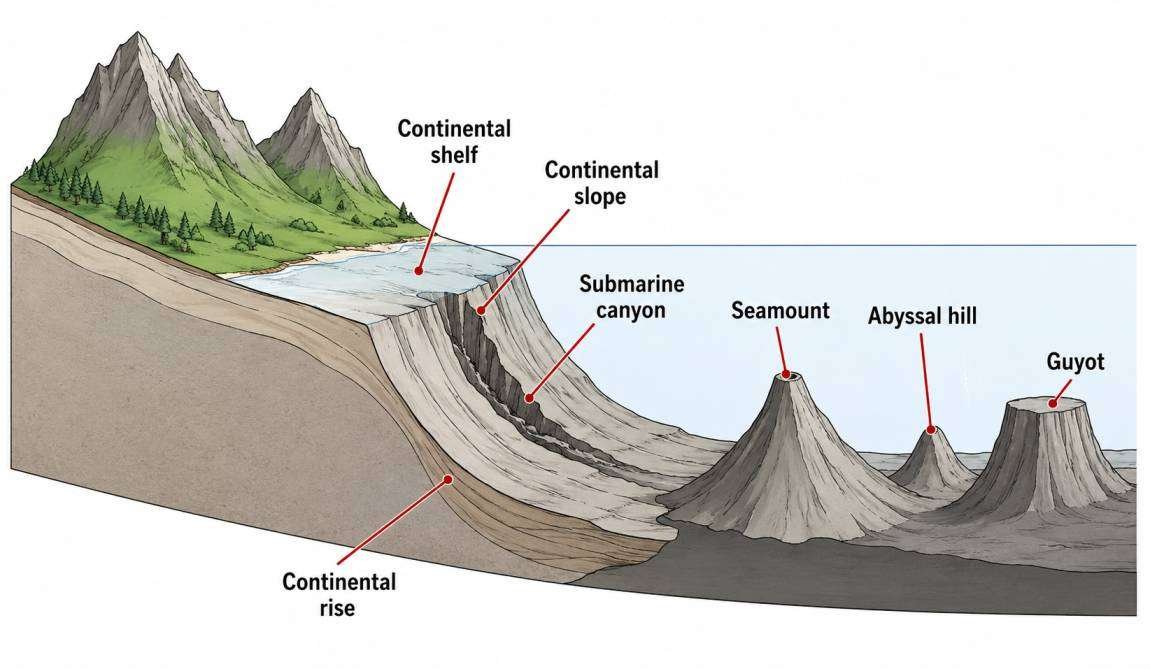
Configuration of Ocean Floor
Configuration of Ocean Floor
Based on depth and relief patterns, the ocean floor can be divided into four major divisions which are as follows:
- Continental Shelf
- Continental Slope
- Abyssal Plains
- Ocean Deeps or Submarine Trenches
Continental Shelf
- Oceans and continents are not separated by a clear or well-defined line. In reality, continents do not abruptly cease at the ocean’s edge.
- They slant seaward from the coast to a point where the incline is extremely severe.
- The Continental Shelf is the shallow submerged extension of the continent.
- From the surface, the depth normally ranges from 120 to 370 metres.
- Their width varies as well, from a few kilometres to over 100 kilometres.
- Even in the context of the Indian peninsula, this variety can be seen. The western coast of India has a much larger continental shelf than the eastern coast.
- Man is more concerned with continental shelves because they provide fish, minerals like sand and gravel, and other resources.
- The shelves provide a significant amount of the world’s petroleum and natural gas.
- On continental shelves, coral reefs are also frequent.
- The presence of undersea canyons that continue to the continental slope is one of the most noticeable aspects of the continental shelf.
- These canyons are ‘steep-sided valleys’ carved out of the ocean floor.